
You are using an out of date browser. It may not display this or other websites correctly.
You should upgrade or use an alternative browser.
You should upgrade or use an alternative browser.
USA: News from Solve ME
- Thread starter Andy
- Start date


ahimsa
Senior Member (Voting Rights)
New video from Solve ME: "What's New in ME/CFS? Interview with Dr. Per Sjögren & Dr. Bo Bertilson"
The Solve ME website has a short description of the video:
“What’s New in ME/CFS?” Why Heterogeneity is the Key to Breakthroughs
The Solve ME website has a short description of the video:
“What’s New in ME/CFS?” Why Heterogeneity is the Key to Breakthroughs

New Catalyst Award Funding From Solve M.E. Advances Innovative ME/CFS and Long Covid Studies Toward Treatments
"May 12, 2026
In recognition of World ME Day, Solve M.E. announced today new funding for two award-winning research studies aimed at accelerating progress toward diagnostics and treatments for ME/CFS and Long Covid."
“A Safe, Accessible Treatment for ME/CFS? The Mitochondrial Stabilizer IVO-21 Study” with Dr. Jay H. Chung
Tuesday, September 8, 2026
3:00-4:00 pm PT / 6:00-7:00 pm ET
Register here.
“Sequence ME & Long Covid: The Search for ME/CFS and Long Covid Biomarkers and Subtypes” with the Decode ME Management Team
Wednesday, June 10, 2026
11:00 am-12:00 pm PT / 2:00 pm-3:00 pm ET
Register here.
---
Edit: Post on the SequenceME thread for discussion specific to that study: https://www.s4me.info/threads/seque...edinburgh-and-action-for-me.41663/post-692572
"May 12, 2026
In recognition of World ME Day, Solve M.E. announced today new funding for two award-winning research studies aimed at accelerating progress toward diagnostics and treatments for ME/CFS and Long Covid."
“A Safe, Accessible Treatment for ME/CFS? The Mitochondrial Stabilizer IVO-21 Study” with Dr. Jay H. Chung
Tuesday, September 8, 2026
3:00-4:00 pm PT / 6:00-7:00 pm ET
Register here.
“Sequence ME & Long Covid: The Search for ME/CFS and Long Covid Biomarkers and Subtypes” with the Decode ME Management Team
Wednesday, June 10, 2026
11:00 am-12:00 pm PT / 2:00 pm-3:00 pm ET
Register here.
---
Edit: Post on the SequenceME thread for discussion specific to that study: https://www.s4me.info/threads/seque...edinburgh-and-action-for-me.41663/post-692572
Last edited:
ahimsa
Senior Member (Voting Rights)
Found out about this LA Weekly article from a Bluesky post by Solve ME
"How Emily Taylor Shaped Solve M.E.’s Catalyst Awards to Accelerate Breakthrough Research in ME/CFS and Long COVID"
Solve M.E. said:Check out the LA Weekly feature on Solve CEO Emily Taylor. The piece highlights how caregiving for her mother informs Emily's commitment to accelerating research breakthroughs and the creation of our ME/CFS Catalyst Awards Program.
"How Emily Taylor Shaped Solve M.E.’s Catalyst Awards to Accelerate Breakthrough Research in ME/CFS and Long COVID"
ahimsa
Senior Member (Voting Rights)
Solve ME has two reports on Advocacy Week. I've included some quotes below but there's a lot more detail in the reports so please read the articles on their website for the full picture.
You Reached Out and Your Senators Showed Up for ME/CFS
Advocacy Week 2026: What We Did, What Comes Next, and How We Win
You Reached Out and Your Senators Showed Up for ME/CFS
Earlier this appropriations season, we put out a call to action asking you to contact your Senators in support of ME/CFS research funding, and so many of you responded.
We’ve had 918 community members reach out to their members of Congress, with 2,516 individual outreaches to Senators and Representatives. I know that it can feel like a small thing sometimes: Send an email, make a call, fill out a form. But it’s how we make sure that our community gets heard in the Hall of Congress.
When we have champions like Sen. Markey fighting for us inside Congress, when we line things up through the official processes those offices use, and when we ask you to contact your Senators about something that is genuinely easy for them to say yes to? That combination is powerful. Your calls and emails are the signal that tells other Senators this issue matters to their constituents. And it works. We get results.
Advocacy Week 2026: What We Did, What Comes Next, and How We Win
In coordination with #MEAction, with input from the Open Medicine Foundation and Bateman Horne, we ran three tracks simultaneously this year: outreach to patient safety & regulatory agencies; state medical board and chief medical officer outreach; and federal appropriations budget advocacy.
Here’s what we accomplished across all three:
- 497 people signed up to participate in Advocacy Week
- 118 letters were sent to Patient Safety and Regulatory Agencies across 30 states and reported back to us, formally documenting the links between a lack of medical education about ME/CFS and patient safety and healthcare quality issues.
- 561 people signed onto our community letters to both individual State Medical Boards and the national Federations of State Medical Boards. The forms are now closed, and we emailed the letters and sent physical copies in the mail.
- 42 medical professionals signed onto our Chief Medical Officer outreach letters
- 918 community members took federal action, with 2,516 individuals reaching out to Senators and Representatives during a critical federal funding window.
Our asks this year were:
- To keep ME/CFS as an eligible topic area in the Congressionally Directed Medical Research Project (CDMRP)
- To provide at least $50 million in funding for the implementation of the NIH ME/CFS Research Roadmap
- To increase funding for the CDC’s ME/CFS program to $15.4 million.

Chandelier
Senior Member (Voting Rights)
A recording of this webinar has been posted on the Solve ME YouTube channel:
Edit: Solve ME has just posted a short article about this webinar.

Webinar Replay: The Discovery of Target Antigens for Dysfunctional T Cells in ME/CFS and Long COVID - Solve ME/CFS Initiative
In our webinar hosted by Solve M.E. VP of Scientific Programs Dr. Jessica Maya, the panelists discuss the study and how this work could also produce new disease biomarkers and suggest new treatments for patient subgroups, as well as how the libraries of human leukocyte antigen–displayed...solvecfs.org

Hitting the Target? ME/CFS and long COVID T-Cell Researchers on Uncovering the Precise Drivers of the Illnesses - Health Rising
Dr. Selin and company believe they can solve one of the key mysteries of ME/CFS and long COVID: exactly why the T-cells are getting pummeled.
www.healthrising.org
Hitting the Target? ME/CFS and long COVID T-Cell Researchers on Uncovering the Precise Drivers of the Illnesses
The recent Solve M.E. webinar, “The Discovery of Target Antigens for Dysfunctional T Cells in ME/CFS and Long COVID”, highlights one of the more exciting themes to emerge recently in the ME/CFS and long-COVID fields – a new confidence that researchers will be able to pluck out biologically defined subsets that can be targeted with the drugs.
ahimsa
Senior Member (Voting Rights)
Solve ME webinar - this is from an email announcement, I could not find this webinar on their website, not listed on the events page.
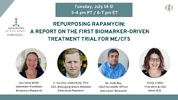
"Repurposing Rapamycin: A Report On the First Biomarker-Driven Treatment Trial for ME/CFS"
Tuesday, July 14, 3 - 4 pm PT / 6-7 pm ET
Registration link
(Registration shows time in your time zone)
"Repurposing Rapamycin: A Report On the First Biomarker-Driven Treatment Trial for ME/CFS"
Tuesday, July 14, 3 - 4 pm PT / 6-7 pm ET
Registration link
(Registration shows time in your time zone)
Solve ME said:Register for Our July 14 Webinar "Repurposing Rapamycin: A Report On the First Biomarker-Driven Treatment Trial for ME/CFS"
In 2025, Simmaron Research was the second recipient of Solve’s ME/CFS Catalyst Award in support of its study, “Low Dose Rapamycin in ME/CFS, Long Covid, and Other Infection-Associated Chronic Conditions.” The study hypothesizes that mTOR inhibition through rapamycin may address observed findings of autophagy impairment and symptoms in a subset of patients with ME/CFS and other infection-associated chronic conditions and illnesses (IACCIs).
The study advances an already FDA-approved drug for reducing key symptoms of ME/CFS and Long Covid, repurposing rapamycin to reduce fatigue, orthostatic intolerance, post-exertional malaise, and sleep issues for a subset of people with ME/CFS.
In this webinar hosted by Solve M.E. President Emily Taylor, panelists Courtney Miller (Board President at Simmaron), Dr. C. Gunnar Gottschalk (Chief Executive Officer at Simmaron), and Dr. Avik Roy (Chief Scientific Officer at Simmaron) will discuss the latest learnings from the study, and their plan to conduct an NIH exploratory treatment trial based on the data.

Utsikt
Senior Member (Voting Rights)
Have they done more than the pilot with no control group?Solve ME webinar - this is from an email announcement, I could not find this webinar on their website, not listed on the events page.
"Repurposing Rapamycin: A Report On the First Biomarker-Driven Treatment Trial for ME/CFS"
Tuesday, July 14, 3 - 4 pm PT / 6-7 pm ET
Registration link
(Registration shows time in your time zone)

ChronicallyOverIt
Senior Member (Voting Rights)
If I was a betting man it’s probably that they fulfilled recruitment for:
 clinicaltrials.gov
The trial is listed as 1 year ending July 2027. That lines up awfully close to exactly a year from now.
ClinicalTrials.gov
clinicaltrials.gov
The trial is listed as 1 year ending July 2027. That lines up awfully close to exactly a year from now.
Utsikt
Senior Member (Voting Rights)
Yet another trial with no control group?!If I was a betting man it’s probably that they fulfilled recruitment for:
ClinicalTrials.gov
The trial is listed as 1 year ending July 2027. That lines up awfully close to exactly a year from now.
ChronicallyOverIt
Senior Member (Voting Rights)
Probably lol it’s all getting bank rolled I think by AgelessRX so who knows how real the trial will be to begin with, they have financial incentive to have this work. I guess the good thing is maybe it’s not costing solveME much?Yet another trial with no control group?!
Utsikt
Senior Member (Voting Rights)
They also have a financial incentive to still be able to say it might work if they don’t think it’s actually going to work. They do that by conducting bad trials. It’s textbook BPS.Probably lol it’s all getting bank rolled I think by AgelessRX so who knows how real the trial will be to begin with, they have financial incentive to have this work. I guess the good thing is maybe it’s not costing solveME much?