Temporal dynamics of the plasma proteomic landscape reveals maladaptation in ME/CFS following exertion, 2025, Germain et al.

"Exercise is Not Producing Muscle Damage in ME/CFS: PEM May be All About Muscle Repair"

Delayed PEM affects all muscles whether I'm using them or not during exercise. If I go over my energy boundary and experience delayed PEM from walking, my whole body feels a loss of power/ weak, including my arms.
 
1763172116903.png
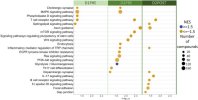
I see a pathway called "SNARE interactions in vesicular transport" in the figure, but not anywhere in Supplemental Table 3.

Some of the log10q values seem different, for example the spreadsheet says "T cell receptor signaling pathway" at D1PRE [edit: D2PRE] has padj=0.00446, which comes out to -log10q=2.35, but in the figure it looks to be closer to 1.85.

I contacted the authors who confirmed the figure was not correct, and I see that they've updated the figure:

gr4.jpg
 
Did we know this?
“Glass, who had ME/CFS and is now in remission, noted of the condition”
It's the following sentence that I find disturbing. Quote follows:
Glass, who had ME/CFS and is now in remission, noted of the condition, “It’s so incredibly difficult because when you rest too much, you get worse, and then when you do too much, even a tiny bit too much, you get worse, and then you can no longer maintain the same baseline….I think post-exertional malaise really is the biggest challenge that both researchers and clinicians need to address for the patient.”

Doing too little does not make us worse. Having a progressive and untreated illness makes us worse. She's describing the downward spiral of an untreated patient and STILL thinks it's about exercise, despite her data.
 
Doing too little does not make us worse.
Depending on how you define «too much rest», it can worsen your overall health. An extreme example would be someone who can leave their house twice a week without PEM suddenly deciding that strict bedrest would be good for them. We’ve seen this kind of extreme rest promoted in some ME/CFS circles.

You need to try to rest enough to avoid PEM if that’s possible in your circumstances, but doing much less than that isn’t good either unless you’re anticipating having to go way over your limit so you try to build a buffer for some time to limit the consequences.
 
Depending on how you define «too much rest», it can worsen your overall health. An extreme example would be someone who can leave their house twice a week without PEM suddenly deciding that strict bedrest would be good for them. We’ve seen this kind of extreme rest promoted in some ME/CFS circles.

You need to try to rest enough to avoid PEM if that’s possible in your circumstances, but doing much less than that isn’t good either unless you’re anticipating having to go way over your limit so you try to build a buffer for some time to limit the consequences.
People actually do this?! I would go stir crazy.

I think the phrasing of "too much rest" is unfortunate, given our history of GET and the challenges we still face getting this message out.

Now, I'm just extrapolating from my own experience, but I am constantly struggle to rest enough. It's just too boring and when I feel better i so desperately want to do something, anything, that I end up in the push crash cycle more often than not. Trying to force myself to stay in bed right now to stop the current cycle. I have to think that if anyone with ME/CFS is staying in bed, there is a good reason for it-building your buffer as you mention- and not a mistake. Bedrest is just so basically awful, that if someone can do, I'm sure there's a reason.
 
People actually do this?!
At least according to their own reports online.
I think the phrasing of "too much rest" is unfortunate, given our history of GET and the challenges we still face getting this message out.
I agree that it could at least be clarified a bit. The latest factsheet also warns about excessive rest, but is very clear that you have to rest as much as you need, and doing more won’t make you better and might harm you.
 
People actually do this?! I would go stir crazy.

I think the phrasing of "too much rest" is unfortunate, given our history of GET and the challenges we still face getting this message out.

Now, I'm just extrapolating from my own experience, but I am constantly struggle to rest enough. It's just too boring and when I feel better i so desperately want to do something, anything, that I end up in the push crash cycle more often than not. Trying to force myself to stay in bed right now to stop the current cycle. I have to think that if anyone with ME/CFS is staying in bed, there is a good reason for it-building your buffer as you mention- and not a mistake. Bedrest is just so basically awful, that if someone can do, I'm sure there's a reason.
This is exactly what I did, several times, and each time, after a month or so of resting far more than I thought I needed, I emerged with a significantly reduced baseline. I obviously don't know if the decline would have happened anyway, but it certainly felt like doing less made me worse. I was simply terrified that by moving my arms or getting out of bed at all I was ensuring permanent deterioration, even though I could not identify obvious PEM from any of my activities (something with which I still struggle). The absolute terror was enough to keep me in bed.
 
The absolute terror was enough to keep me in bed.
It's never been enough for me, even when I was so sick I could barely make it to the toilet. I keep thinking to myself that if I rested more, I wouldn't be severe now.

I'm partly struggling to make sense of my own experience here. My illness has been progressive for 9 years, no matter what I did or didn't do. I can choose to interpret that as I made myself sicker by overdoing, or choose to believe that I would have gotten sicker no matter what I did. I decided the latter for my own peace of mind.

Someday we will have this data about what's going on inside us, but for now I see a commonality in out stories: we both got worse with time, despite our best efforts, you with resting, and me with staying as active as I could. That speaks to me of a disease process beyond our control with either exercise or rest.

What if neither one of us made ourselves worse with what we did? What if the disease is just churning on inside us, while we try to cope by pacing? All the what ifs we put ourselves through- what did I do to cause PEM? I didn't do anything and I still have PEM? I can't figure out what caused the PEM this time? maybe all that is because it's not really us. Maybe it's the disease.

I'm trying to make peace with it all, but that means giving up a certain amount of control. I'll try not to PEM myself, but it's really not avoidable if I am going to maintain skin integrity.
 
Back
Top Bottom