Temporal dynamics of the plasma proteomic landscape reveals maladaptation in ME/CFS following exertion, 2025, Germain et al.

"Exercise is Not Producing Muscle Damage in ME/CFS: PEM May be All About Muscle Repair"

Delayed PEM affects all muscles whether I'm using them or not during exercise. If I go over my energy boundary and experience delayed PEM from walking, my whole body feels a loss of power/ weak, including my arms.
 
1763172116903.png
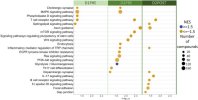
I see a pathway called "SNARE interactions in vesicular transport" in the figure, but not anywhere in Supplemental Table 3.

Some of the log10q values seem different, for example the spreadsheet says "T cell receptor signaling pathway" at D1PRE [edit: D2PRE] has padj=0.00446, which comes out to -log10q=2.35, but in the figure it looks to be closer to 1.85.

I contacted the authors who confirmed the figure was not correct, and I see that they've updated the figure:

gr4.jpg
 
Did we know this?
“Glass, who had ME/CFS and is now in remission, noted of the condition”
It's the following sentence that I find disturbing. Quote follows:
Glass, who had ME/CFS and is now in remission, noted of the condition, “It’s so incredibly difficult because when you rest too much, you get worse, and then when you do too much, even a tiny bit too much, you get worse, and then you can no longer maintain the same baseline….I think post-exertional malaise really is the biggest challenge that both researchers and clinicians need to address for the patient.”

Doing too little does not make us worse. Having a progressive and untreated illness makes us worse. She's describing the downward spiral of an untreated patient and STILL thinks it's about exercise, despite her data.
 
Back
Top Bottom