Objective versus subjective excessive daytime sleepiness in OSA: Quantifying the impact of fatigue, 2026, Gold et al.

nataliezzz

Senior Member (Voting Rights)
Objective versus subjective excessive daytime sleepiness in OSA: Quantifying the impact of fatigue
Morris S Gold, Riccardo A Stoohs, Avram R Gold
https://www.sciencedirect.com/science/article/abs/pii/S1389945726001061

Background
In patients with obstructive sleep apnea (OSA), excessive daytime sleepiness (EDS) is typically measured either objectively with the mean sleep latency (MSL) of the multiple sleep latency test (MSLT), or subjectively with the Epworth sleepiness scale (ESS). These measures correlate only mildly with each other and differ greatly in their correlations with comorbidities and outcomes associated with OSA. To improve our rudimentary understanding of the differences between objective and subjective EDS, we compared the quantitative impact of fatigue on objective and subjective EDS using the fatigue severity scale (FSS) to measure fatigue.

Methods
We identified 603 patients with OSA in a US site and a German site who had completed a MSLT, ESS and FSS between 2008 and 2023. The relationships of FSS with MSL and ESS were assessed with simple summary statistics, correlation and linear regression.

Results
MSL and the FSS were uncorrelated, i.e. fatigue has no impact on objective EDS. This allowed us to simultaneously quantify distinct impacts of objective EDS (MSL) and fatigue (FSS) on subjective EDS (ESS). MSL and FSS were found to have separate and roughly equal impacts on ESS. Thus, whereas MSL is a pure measure of EDS, ESS measures a roughly equal mix of EDS and fatigue.

Conclusions
In patients with OSA, EDS should be measured with the MSLT. A fatigue scale should replace the ESS, which measures an uninterpretable mix of EDS and fatigue. The role of fatigue in the clinical profile of patients with OSA must be fully established.
 
EDS = excessive daytime sleepiness, ESS = Epworth Sleepiness Scale, FSS = Fatigue Severity Scale, MSLT = multiple sleep latency test, MSL = mean sleep latency on MSLT

Subjects:
This retrospective, cross-sectional study included 603 patients: 380 patients seen at Somnolab Dortmund in Germany and 223 patients seen at the Stony Brook University Sleep Disorders Center in the US. The German sample includes all patients with an initial diagnosis of OSA who completed the FSS, the ESS, and a MSLT (The MSLT is a standard measure of EDS in Somnolab Dortmund and was not obtained selectively). Patients previously treated for OSA or with symptoms of restless legs syndrome were excluded. Recruitment in Germany started when administration of the FSS began in October 2019 and continued through April 2023.

Patients were generally middle-aged and mostly male (Table 1). German patients bordered on obesity, whereas US patients were obese. About half of all patients had clinically significant objective EDS (MLS <8 min), overall and by site. Only about 1/3 of patients overall had subjective EDS (ESS >10). The German rate (27.6%) was appreciably lower than the US rate (42.1%). Mean FSS in the overall population and at each clinical site was approximately 4; at least 50% of patients in each clinical site had clinically significant fatigue.
Results:
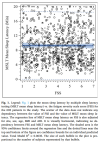
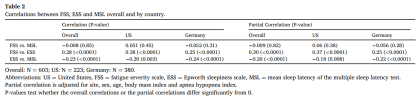
Table 2 shows the correlations between objective EDS (MSL), subjective EDS (ESS) and fatigue (FSS), overall and by site. MSL is uncorrelated with the FSS, overall (r = - 0.008, p = 0.85) and by site. In contrast, the FSS and the ESS are mildly correlated (r = 0.28, p <0.0001), and somewhat higher in the US (0.38) vs. Germany (0.25). Partial correlations adjusting for site, sex, age, BMI and AHI are also reported and are almost identical to the simple overall correlation with very similar p-values. For completeness, a correlation of - 0.23 (p <0.0001) is reported between the ESS and MSL. Fig. 1 graphically illustrates the lack of correlation between MSL and FSS. FSS values scatter randomly from 1 to 7. The vertical spread of MSL values does not vary as a function of the FSS value. The horizontal regression line further illustrates the lack of a relationship between MSL and the FSS in Fig. 1. Thus, knowing the FSS value conveys no information about the likely value of MSL.

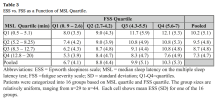
If fatigue and objective EDS are largely independent, then their impacts on subjective EDS are largely independent and can be assessed simultaneously. Table 3 is a simple display of the joint impacts of MSL and FSS on ESS. Patients are categorized into 16 groups based on MSL quartile and FSS quartile. The group sizes are relatively uniform, ranging from n = 29 to n = 44. Each cell in Table 3 shows mean ESS (SD) for one of the 16 groups. Clearly, across any given MSL quartile row, as FSS quartile increases (lower to higher severity), mean ESS generally increases, Correspondingly, going down any given FSS quartile column, as MSL quartile increases (higher to lower severity), mean ESS generally decreases, In fact, comparing the change in mean ESS across the rows against the change in mean ESS down the columns, the impact of increasing fatigue (FSS) on the ESS appears comparable to the impact of decreasing objective EDS (MSL) on the ESS.

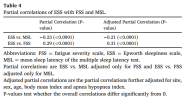
Mathematically, Table 4 presents two partial correlations, (a) the partial correlation of the ESS with MSL adjusted for the FSS (- 0.23) and (b) the partial correlation of the ESS with the FSS adjusted for the MSL (0.29). Both were highly statistically significant. Additionally, two adjusted partial correlations were computed, (a) the partial correlation of the ESS with MSL adjusted for the FSS, site, sex, age, BMI and AHI (- 0.21) and (b) the partial correlation of the ESS with the FSS adjusted for MSL, site, sex, age, BMI and AHI (0.31). These results confirm the results from the simpler model and are consistent with modest and roughly equal impacts of fatigue and objective EDS on subjective EDS.

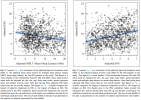
Figs. 2 and 3 use linear regression to compare the dependence of the ESS on the FSS vs, MSL after adjusting for site, sex, age, BMI and AHI. Fig. 2 illustrates the linear relationship between the ESS and MSL when both have been adjusted for site, sex, age, BMI, AHI and FSS. Fig. 3, correspondingly, illustrates the linear relationship between the ESS and the FSS when both have been adjusted for site, sex, age, BMI, AHI and MSL. Note that because ESS is adjusted for the various variables above, it does not take strictly integer values in either figure. Figs. 2 and 3 look like mirror images, i.e. the change in the ESS over the range of FSS values in Fig. 3 is roughly the same as the change in ESS over the range of MSL values in Fig. 2, like the pattern noted in Table 3. We could fit models that would provide a specific regression equation, but that is not the point of this exercise. Our results indicate that (1) fatigue and objective sleepiness are independent symptoms (Fig. 1, Table 2) and (2) that fatigue and objective EDS have distinct and roughly equal impacts in determining the severity of subjective EDS (Fig. 2 vs. Fig. 3, Tables 3 and 4).
1774981192305.png1774985306124.png1774984624123.png
1774982525704.png
1774982571952.png
 
Last edited:
Discussion excerpts:
The objective of this study was to assess the role of fatigue in distinguishing subjective EDS from objective EDS. First, we showed that fatigue (as measured by FSS) and objective EDS (as measured by MSL from the MSLT) are uncorrelated, i.e. have no linear relationship. Indeed, Fig. 1 clearly shows there is no relationship of any kind.

Therefore, we can simultaneously assess the separate impacts of objective EDS and fatigue on subjective EDS. Second, we demonstrated that these separate impacts on subjective EDS are roughly equal. The clear separation of these two impacts demonstrated by partial Pearson correlations in Table 4 is validated by the robustly consistent trends along rows and down columns in the simple summary statistics of Table 3.
To be clear, our finding that subjective EDS is a mix of EDS and fatigue is not the driver of the low correlation between the subjective and objective EDS [3]. That is caused by the poor reproducibility of the ESS in patients with OSA [31]. This corresponds in our data to the considerable vertical scatter of the individual ESS values around the regression lines in Figs. 2 and 3 or to the large standard deviations in the cells of Table 3. The extensive variability and associated lack of reproducibility in ESS is the primary cause of its low correlation with MSL of the MSLT. Our finding that subjective EDS is a mix of EDS and fatigue is important for a different reason. We have demonstrated that even if one could reduce the variability of ESS by, for instance, computing a sample mean ESS over a population of patients with OSA, the information in that sample mean about symptoms of OSA would still be an uninterpretable mix of information about two uncorrelated symptoms, objective EDS and fatigue. Thus, there now are two good reasons to not assess ESS, (1) its excessive variability/lack of reproducibility and (2) its lack of interpretability.
In our study, more than half of participants experienced clinically significant fatigue (FSS ≥4), a proportion comparable to those with clinically significant EDS (MSL <8 min; demonstrated in Table 1). Yet clinical guidelines issued in 2009 by the American Academy of Sleep Medicine [32] recommend routine use of the ESS, while omitting fatigue, tiredness, and related symptoms from the list of features to be assessed in OSA. Guidelines should therefore be updated to recommend assessing these two components separately: EDS with the MSLT and fatigue with the FSS. Although the MSLT is not currently reimbursed in the United States to measure EDS in patients with OSA, we concur with prior recommendations [6–10] that sleep disorders centers should return to its use. We differ, however, in our view of the ESS, which—despite capturing a patient-reported experience—offers little clinical utility. We instead recommend substituting the FSS, or another validated measure of fatigue demonstrated to be independent of MSLT, in place of the ESS. Likewise, if a simpler measure of EDS is to be adopted, it must be demonstrably uncorrelated with fatigue assessments.
The etiology of fatigue in patients with OSA remains poorly understood. Fatigue is sometimes attributed to sleep fragmentation, supported by evidence that CPAP therapy can partially relieve it. Objective EDS is also widely ascribed to the same mechanism. Yet, despite sharing this proposed pathology, our data demonstrate that the two symptoms are completely uncorrelated. This paradox highlights a critical gap: if both fatigue and EDS stem from sleep fragmentation, how do they remain independent of one another? To date, no convincing etiology of fatigue in OSA has emerged within the sleep fragmentation framework. If sleep fragmentation cannot account for the lack of correlation, then an alternative mechanism underlying fatigue must be identified. Supporting this view, Chen and colleagues reported that sympathetic nerve activity (SNA) was significantly elevated in patients with MSL≤8 min but was significantly depressed in patients with ESS≥10. They concluded that “it appears that objective EDS and self-reported EDS reflect different central neural processes … … MSLT assesses physiological sleep propensity which associates with increased SNA …. ESS captures the self-reported complaint of daytime sleepiness or fatigue which may possibly result from relatively lower SNA.” [7]. Our study sheds further light on the findings of Chen and colleagues, i.e., the ESS captures the complaints of both daytime sleepiness and fatigue, which are very different complaints. It may be that by using the FSS to focus specifically on fatigue, a better understanding of lower SNA in patients with OSA could be developed.
 
Re: the pathophysiology of objective excessive daytime sleepiness (EDS) vs. subjective EDS and fatigue in OSA patients:
In recent years, a series of studies in patients with OSA have considered whether the presence of objective EDS (MSLT) and subjective EDS (ESS) correlated with the following parameters:
• inflammation – levels of IL-6 and cortisol [6].
• sympathetic activation – urinary norepinephrine and blood pressure measurements [7].
• glucose metabolism - blood glucose, insulin, HOMA-IR, serum metabolomics, fecal microbiota [8].
• all cause and cardiovascular mortality [9].
• hypertension [10].
• psychomotor vigilance testing (PVT) [11].
Pathological elevations in the first five of these parameters were significantly associated with objective EDS and not with subjective EDS. In contrast, a decrease in psychomotor vigilance [11*] and, correspondingly, a decrease in sympathetic activation [7**], were associated with subjective EDS and not with objective EDS. These studies tell us far more about what subjective EDS isn't than about what it is.
Relevant studies (S4ME links):
*Psychomotor Vigilance Test and Its Association With Daytime Sleepiness and Inflammation in Sleep Apnea: Clinical Implications, 2017, Li et al.
**Implications of sympathetic activation for objective versus self-reported daytime sleepiness in obstructive sleep apnea, 2022, Chen et al.
Marked decrease in sleepiness in patients with sleep apnea by etanercept, a tumor necrosis factor-alpha antagonist, 2004, Vgontzas et al.
 
Last edited:
Objective versus subjective excessive daytime sleepiness in OSA: Quantifying the impact of fatigue
Morris S Gold, Riccardo A Stoohs, Avram R Gold
https://www.sciencedirect.com/science/article/abs/pii/S1389945726001061

Background
In patients with obstructive sleep apnea (OSA), excessive daytime sleepiness (EDS) is typically measured either objectively with the mean sleep latency (MSL) of the multiple sleep latency test (MSLT), or subjectively with the Epworth sleepiness scale (ESS). These measures correlate only mildly with each other and differ greatly in their correlations with comorbidities and outcomes associated with OSA. To improve our rudimentary understanding of the differences between objective and subjective EDS, we compared the quantitative impact of fatigue on objective and subjective EDS using the fatigue severity scale (FSS) to measure fatigue.

Methods
We identified 603 patients with OSA in a US site and a German site who had completed a MSLT, ESS and FSS between 2008 and 2023. The relationships of FSS with MSL and ESS were assessed with simple summary statistics, correlation and linear regression.

Results
MSL and the FSS were uncorrelated, i.e. fatigue has no impact on objective EDS. This allowed us to simultaneously quantify distinct impacts of objective EDS (MSL) and fatigue (FSS) on subjective EDS (ESS). MSL and FSS were found to have separate and roughly equal impacts on ESS. Thus, whereas MSL is a pure measure of EDS, ESS measures a roughly equal mix of EDS and fatigue.

Conclusions
In patients with OSA, EDS should be measured with the MSLT. A fatigue scale should replace the ESS, which measures an uninterpretable mix of EDS and fatigue. The role of fatigue in the clinical profile of patients with OSA must be fully established.
I know there are always a lot of bps papers newly being pushed out but is anyone else feeling this week like there’s a ‘something coordinated going on’ feeling as there are new angles from new players

Such as the paper trying to create a new market for antidepressants (that just so happens at the moment seem to at least on social media, media etc be finally getting a cynical eye cast over them for the conditions like depression they’ve been dished out for so many over so many years)
Which to me felt like a business case for trying to make their new target market ‘fatigue’

And I sort of feel like coffi and certain other ‘collectives’ have been specifically obviously behind that term as a mission for x recent years as a mission and now we know.

And the things like this

Where initially reading the abstract I thought great this might be setting an example for me/cfs from another area about how subjective scales needed a cynical and measuring eye cast on ‘what do they actually measure’ as a question because external validity seems such an issue in bps area (they only test for internal consistency not ‘how does it relate to the thing you say it is representing)

But it seems to turn out to be something entirely different by the conclusion - which is so definitive from one look and so random an interpretation I have to assume it was the actual aim of the paper ‘to prove/argue that the fatigue scale should replace the reports sleepiness scale’

When at no point did they show that the former is more accurate than the latter.

So trying to scrape fatigue into sleep apnea? Instead of the one measure they say is a pure measure or even the one that is different and certainly no worse than fatigue - and the aspects that flagged up from it certainly weren’t pulled out from the scale to be discussed either (plus there is overlap in their questions somewhat)
 
Discussion excerpts:
That last citation needs reading as it is concerning as it seems to read as a manifesto type section to me

Trying to use merely words (rhetoric) to ‘prove’ fatigue has ‘a different mechanism/cause’ in sleep apnea than the apnea (and wakenings) that logically causes daytime sleepiness


I’ve seen this sort of thing in so many illnesses badly done by by the supposed professionals that first claims they are zooming in with such changes ‘because they want up help’ so people shouldn’t worry about the specifics of what they actually intended to do with them being made less opaque and more honest and the science being the basis such knowledge should follow rather than storylines and appeals
 
And these two together make me feel these suspicions of this being a swoop to take it out of looking into impacts of actual apnea downstream medically and into the more bps feeling familiar territory of suggesting ‘sympathetic activation’ and whatever angle they mean on psychomotor vigilance (because I doubt it’s being able to spot potential road hazards)
 
I know there are always a lot of bps papers newly being pushed out but is anyone else feeling this week like there’s a ‘something coordinated going on’ feeling as there are new angles from new players

Such as the paper trying to create a new market for antidepressants (that just so happens at the moment seem to at least on social media, media etc be finally getting a cynical eye cast over them for the conditions like depression they’ve been dished out for so many over so many years)
Which to me felt like a business case for trying to make their new target market ‘fatigue’

And I sort of feel like coffi and certain other ‘collectives’ have been specifically obviously behind that term as a mission for x recent years as a mission and now we know.

And the things like this

Where initially reading the abstract I thought great this might be setting an example for me/cfs from another area about how subjective scales needed a cynical and measuring eye cast on ‘what do they actually measure’ as a question because external validity seems such an issue in bps area (they only test for internal consistency not ‘how does it relate to the thing you say it is representing)

But it seems to turn out to be something entirely different by the conclusion - which is so definitive from one look and so random an interpretation I have to assume it was the actual aim of the paper ‘to prove/argue that the fatigue scale should replace the reports sleepiness scale’

When at no point did they show that the former is more accurate than the latter.

So trying to scrape fatigue into sleep apnea? Instead of the one measure they say is a pure measure or even the one that is different and certainly no worse than fatigue - and the aspects that flagged up from it certainly weren’t pulled out from the scale to be discussed either (plus there is overlap in their questions somewhat)
I'm not quite sure what you're trying to get at here. The authors of this paper were not trying to show anything about ME/CFS, they were looking further into an issue that had arisen in the sleep medicine literature regarding the Epworth Sleepiness Scale (ESS) - which is pretty much the one assessment tool used in mainstream clinical practice - and how it does not actually just measure what it purports to (sleepiness), but rather an uninterpretable mix of true objective sleepiness and fatigue in OSA patients.
We are not the first to report the independence of objective EDS and fatigue among patients with sleep disorders. In 1997, Lichstein and associates reported on 206 patients with various sleep disorders diagnosed in a sleep disorders center [25]. Patients completed the FSS and an MSLT. The authors found no correlation between the FSS score and MSL from the MSLT and suggested that EDS was not related to fatigue in this population of patients with various sleep disorders. In a follow-up study by the same group in 1998 [26], each of 32 patients with OSA underwent an MSLT, completed the FSS and performed a maximal exercise test as an objective measure of fatigue. The authors again concluded that fatigue and EDS are independent symptoms of OSA. Our study is the first subsequent study to consider this question, and it validates the conclusions of Lichstein's group [25,26]. Nor are we the first to report correlation between subjective EDS and fatigue in patients with OSA. In several studies, ESS and FSS were moderately correlated, with estimates ranging from 0.30 to 0.4827- 30. We are, however, the first to show that the correlation of ESS with FSS and the correlation of ESS with MSL of the MSLT reflect two separate relationships. In sum, our work advances prior findings [27–30]2 by showing that FSS and MSL explain separate aspects of ESS variability

But it seems to turn out to be something entirely different by the conclusion - which is so definitive from one look and so random an interpretation I have to assume it was the actual aim of the paper ‘to prove/argue that the fatigue scale should replace the reports sleepiness scale’

When at no point did they show that the former is more accurate than the latter.
Are you saying you have an issue with the Fatigue Severity Scale not actually accurately capturing fatigue? Because fatigue is a subjective symptom - there is no objective correlate for it, so I'm not sure how to prove what you are suggesting (as you can with a subjective rating scale and objective sleepiness as measured by MSLT) - the authors suggest not using the Epworth Sleepiness Scale at all because it is clinically uninterpretable (you don't know whether it's actually reflecting objective sleepiness, fatigue, or a mixture of the two in a respondent), and just using MSLT to assess sleepiness and a fatigue rating scale to assess fatigue in sleep-disordered breathing patients.
 
Last edited:
Trying to use merely words (rhetoric) to ‘prove’ fatigue has ‘a different mechanism/cause’ in sleep apnea than the apnea (and wakenings) that logically causes daytime sleepiness
I think you should have a look at this data from the study below if you think that apneas/arousals are the primary cause of (self-reported) sleepiness in OSA patients. Also, here's the AI summary of Dr. Gold's theory of what is driving the symptoms in UARS and (many/most cases of) OSAS.

S4ME link: Somatic arousal and sleepiness/fatigue among patients with sleep-disordered breathing, 2016, Gold et al.
 
Back
Top Bottom