Objective versus subjective excessive daytime sleepiness in OSA: Quantifying the impact of fatigue, 2026, Gold et al.

nataliezzz

Senior Member (Voting Rights)
Objective versus subjective excessive daytime sleepiness in OSA: Quantifying the impact of fatigue
Morris S Gold, Riccardo A Stoohs, Avram R Gold
https://www.sciencedirect.com/science/article/abs/pii/S1389945726001061

Background
In patients with obstructive sleep apnea (OSA), excessive daytime sleepiness (EDS) is typically measured either objectively with the mean sleep latency (MSL) of the multiple sleep latency test (MSLT), or subjectively with the Epworth sleepiness scale (ESS). These measures correlate only mildly with each other and differ greatly in their correlations with comorbidities and outcomes associated with OSA. To improve our rudimentary understanding of the differences between objective and subjective EDS, we compared the quantitative impact of fatigue on objective and subjective EDS using the fatigue severity scale (FSS) to measure fatigue.

Methods
We identified 603 patients with OSA in a US site and a German site who had completed a MSLT, ESS and FSS between 2008 and 2023. The relationships of FSS with MSL and ESS were assessed with simple summary statistics, correlation and linear regression.

Results
MSL and the FSS were uncorrelated, i.e. fatigue has no impact on objective EDS. This allowed us to simultaneously quantify distinct impacts of objective EDS (MSL) and fatigue (FSS) on subjective EDS (ESS). MSL and FSS were found to have separate and roughly equal impacts on ESS. Thus, whereas MSL is a pure measure of EDS, ESS measures a roughly equal mix of EDS and fatigue.

Conclusions
In patients with OSA, EDS should be measured with the MSLT. A fatigue scale should replace the ESS, which measures an uninterpretable mix of EDS and fatigue. The role of fatigue in the clinical profile of patients with OSA must be fully established.
 
EDS = excessive daytime sleepiness, ESS = Epworth Sleepiness Scale, FSS = Fatigue Severity Scale, MSLT = multiple sleep latency test, MSL = mean sleep latency on MSLT

Subjects:
This retrospective, cross-sectional study included 603 patients: 380 patients seen at Somnolab Dortmund in Germany and 223 patients seen at the Stony Brook University Sleep Disorders Center in the US. The German sample includes all patients with an initial diagnosis of OSA who completed the FSS, the ESS, and a MSLT (The MSLT is a standard measure of EDS in Somnolab Dortmund and was not obtained selectively). Patients previously treated for OSA or with symptoms of restless legs syndrome were excluded. Recruitment in Germany started when administration of the FSS began in October 2019 and continued through April 2023.

Patients were generally middle-aged and mostly male (Table 1). German patients bordered on obesity, whereas US patients were obese. About half of all patients had clinically significant objective EDS (MLS <8 min), overall and by site. Only about 1/3 of patients overall had subjective EDS (ESS >10). The German rate (27.6%) was appreciably lower than the US rate (42.1%). Mean FSS in the overall population and at each clinical site was approximately 4; at least 50% of patients in each clinical site had clinically significant fatigue.
Results:
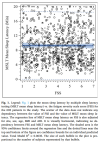
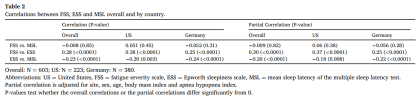
Table 2 shows the correlations between objective EDS (MSL), subjective EDS (ESS) and fatigue (FSS), overall and by site. MSL is uncorrelated with the FSS, overall (r = - 0.008, p = 0.85) and by site. In contrast, the FSS and the ESS are mildly correlated (r = 0.28, p <0.0001), and somewhat higher in the US (0.38) vs. Germany (0.25). Partial correlations adjusting for site, sex, age, BMI and AHI are also reported and are almost identical to the simple overall correlation with very similar p-values. For completeness, a correlation of - 0.23 (p <0.0001) is reported between the ESS and MSL. Fig. 1 graphically illustrates the lack of correlation between MSL and FSS. FSS values scatter randomly from 1 to 7. The vertical spread of MSL values does not vary as a function of the FSS value. The horizontal regression line further illustrates the lack of a relationship between MSL and the FSS in Fig. 1. Thus, knowing the FSS value conveys no information about the likely value of MSL.

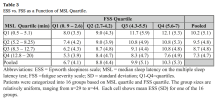
If fatigue and objective EDS are largely independent, then their impacts on subjective EDS are largely independent and can be assessed simultaneously. Table 3 is a simple display of the joint impacts of MSL and FSS on ESS. Patients are categorized into 16 groups based on MSL quartile and FSS quartile. The group sizes are relatively uniform, ranging from n = 29 to n = 44. Each cell in Table 3 shows mean ESS (SD) for one of the 16 groups. Clearly, across any given MSL quartile row, as FSS quartile increases (lower to higher severity), mean ESS generally increases, Correspondingly, going down any given FSS quartile column, as MSL quartile increases (higher to lower severity), mean ESS generally decreases, In fact, comparing the change in mean ESS across the rows against the change in mean ESS down the columns, the impact of increasing fatigue (FSS) on the ESS appears comparable to the impact of decreasing objective EDS (MSL) on the ESS.

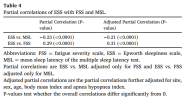
Mathematically, Table 4 presents two partial correlations, (a) the partial correlation of the ESS with MSL adjusted for the FSS (- 0.23) and (b) the partial correlation of the ESS with the FSS adjusted for the MSL (0.29). Both were highly statistically significant. Additionally, two adjusted partial correlations were computed, (a) the partial correlation of the ESS with MSL adjusted for the FSS, site, sex, age, BMI and AHI (- 0.21) and (b) the partial correlation of the ESS with the FSS adjusted for MSL, site, sex, age, BMI and AHI (0.31). These results confirm the results from the simpler model and are consistent with modest and roughly equal impacts of fatigue and objective EDS on subjective EDS.

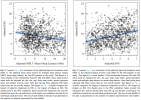
Figs. 2 and 3 use linear regression to compare the dependence of the ESS on the FSS vs, MSL after adjusting for site, sex, age, BMI and AHI. Fig. 2 illustrates the linear relationship between the ESS and MSL when both have been adjusted for site, sex, age, BMI, AHI and FSS. Fig. 3, correspondingly, illustrates the linear relationship between the ESS and the FSS when both have been adjusted for site, sex, age, BMI, AHI and MSL. Note that because ESS is adjusted for the various variables above, it does not take strictly integer values in either figure. Figs. 2 and 3 look like mirror images, i.e. the change in the ESS over the range of FSS values in Fig. 3 is roughly the same as the change in ESS over the range of MSL values in Fig. 2, like the pattern noted in Table 3. We could fit models that would provide a specific regression equation, but that is not the point of this exercise. Our results indicate that (1) fatigue and objective sleepiness are independent symptoms (Fig. 1, Table 2) and (2) that fatigue and objective EDS have distinct and roughly equal impacts in determining the severity of subjective EDS (Fig. 2 vs. Fig. 3, Tables 3 and 4).
1774981192305.png1774985306124.png1774984624123.png
1774982525704.png
1774982571952.png
 
Last edited:
Discussion excerpts:
The objective of this study was to assess the role of fatigue in distinguishing subjective EDS from objective EDS. First, we showed that fatigue (as measured by FSS) and objective EDS (as measured by MSL from the MSLT) are uncorrelated, i.e. have no linear relationship. Indeed, Fig. 1 clearly shows there is no relationship of any kind.

Therefore, we can simultaneously assess the separate impacts of objective EDS and fatigue on subjective EDS. Second, we demonstrated that these separate impacts on subjective EDS are roughly equal. The clear separation of these two impacts demonstrated by partial Pearson correlations in Table 4 is validated by the robustly consistent trends along rows and down columns in the simple summary statistics of Table 3.
To be clear, our finding that subjective EDS is a mix of EDS and fatigue is not the driver of the low correlation between the subjective and objective EDS [3]. That is caused by the poor reproducibility of the ESS in patients with OSA [31]. This corresponds in our data to the considerable vertical scatter of the individual ESS values around the regression lines in Figs. 2 and 3 or to the large standard deviations in the cells of Table 3. The extensive variability and associated lack of reproducibility in ESS is the primary cause of its low correlation with MSL of the MSLT. Our finding that subjective EDS is a mix of EDS and fatigue is important for a different reason. We have demonstrated that even if one could reduce the variability of ESS by, for instance, computing a sample mean ESS over a population of patients with OSA, the information in that sample mean about symptoms of OSA would still be an uninterpretable mix of information about two uncorrelated symptoms, objective EDS and fatigue. Thus, there now are two good reasons to not assess ESS, (1) its excessive variability/lack of reproducibility and (2) its lack of interpretability.
In our study, more than half of participants experienced clinically significant fatigue (FSS ≥4), a proportion comparable to those with clinically significant EDS (MSL <8 min; demonstrated in Table 1). Yet clinical guidelines issued in 2009 by the American Academy of Sleep Medicine [32] recommend routine use of the ESS, while omitting fatigue, tiredness, and related symptoms from the list of features to be assessed in OSA. Guidelines should therefore be updated to recommend assessing these two components separately: EDS with the MSLT and fatigue with the FSS. Although the MSLT is not currently reimbursed in the United States to measure EDS in patients with OSA, we concur with prior recommendations [6–10] that sleep disorders centers should return to its use. We differ, however, in our view of the ESS, which—despite capturing a patient-reported experience—offers little clinical utility. We instead recommend substituting the FSS, or another validated measure of fatigue demonstrated to be independent of MSLT, in place of the ESS. Likewise, if a simpler measure of EDS is to be adopted, it must be demonstrably uncorrelated with fatigue assessments.
The etiology of fatigue in patients with OSA remains poorly understood. Fatigue is sometimes attributed to sleep fragmentation, supported by evidence that CPAP therapy can partially relieve it. Objective EDS is also widely ascribed to the same mechanism. Yet, despite sharing this proposed pathology, our data demonstrate that the two symptoms are completely uncorrelated. This paradox highlights a critical gap: if both fatigue and EDS stem from sleep fragmentation, how do they remain independent of one another? To date, no convincing etiology of fatigue in OSA has emerged within the sleep fragmentation framework. If sleep fragmentation cannot account for the lack of correlation, then an alternative mechanism underlying fatigue must be identified. Supporting this view, Chen and colleagues reported that sympathetic nerve activity (SNA) was significantly elevated in patients with MSL≤8 min but was significantly depressed in patients with ESS≥10. They concluded that “it appears that objective EDS and self-reported EDS reflect different central neural processes … … MSLT assesses physiological sleep propensity which associates with increased SNA …. ESS captures the self-reported complaint of daytime sleepiness or fatigue which may possibly result from relatively lower SNA.” [7]. Our study sheds further light on the findings of Chen and colleagues, i.e., the ESS captures the complaints of both daytime sleepiness and fatigue, which are very different complaints. It may be that by using the FSS to focus specifically on fatigue, a better understanding of lower SNA in patients with OSA could be developed.
 
Back
Top Bottom