Jonathan Edwards
Senior Member (Voting Rights)
My vote goes to @dave30th in a bathtub as presenter while JE is sitting next to him eating After Eight.
Choco Leibniz please. The chocolate is thicker and Swiss quality.

My vote goes to @dave30th in a bathtub as presenter while JE is sitting next to him eating After Eight.

Splendid, it looks like we’ve got the maestro on board for our project!Choco Leibniz please. The chocolate is thicker and Swiss quality.

The Long Covid Online Clinic is a specialized medical contact point for people with Long Covid, ME/CFS, MCAS, POTS, and other complex post‑infectious and multisystemic illnesses.
Under the medical direction of Dr. Corinna Geiger – specialist in internal medicine, gastroenterology, and hepatology – we combine evidence‑based medicine with a deep understanding of the reality faced by chronically ill patients.
On this channel, we share well‑founded information on diagnostics, pathophysiology, and therapeutic options – clearly presented, scientifically supported, and without false promises of cures.
Our content is aimed at affected individuals and their families as well as medical colleagues.
What guides us: Taking patients seriously instead of trivializing. Pacing instead of pushing. Science instead of miracle cures. Speisingerstr. 25/9, 1130 Vienna longcovidklinik.at
Pacing bei ME/CFS – Praktische Strategien für den Alltag | Long Covid Online Klinik
Pacing für Kinder mit ME/CFS – Was Eltern wissen müssen | Long Covid Online Klinik
Was tun im Crash? Soforthilfe bei ME/CFS | Dr. Corinna Geiger und Dr. Alina Kleinecke
ME/CFS und Schule – Wie Teilhabe gelingen kann | Long Covid Online Klinik

Sharing a translation of this article from the swiss-german state broadcaster because in my opinion it’s very good.ME/CFS-Schwerstbetroffene kämpfen um ihre IV-Rente
Untersuchungen auf Kosten der Gesundheit? ME/CFS-Patienten müssen oft ein für sie unzumutbares IV-Verfahren durchlaufen.www.srf.ch
Chronic Illness ME/CFS
Severely Ill – and the Disability Insurance Process an Ordeal
Examinations at the cost of one’s health? ME/CFS patients often have to go through disability insurance procedures that become a burden to them.
Author: Svenja Rimle — Today, 06:48
A one-room flat, lit only by a single red light bulb. The windows are covered, the kitchen has gone unused for some time. This is where Luisa lives — though she herself describes it more as “existing and vegetating.” Luisa wishes to remain anonymous, so she goes by a different name here.
Once a day, at 8 in the morning, a home-care nurse visits — that is Luisa’s only social contact. She can only speak a little, and quietly. She is fed and ventilated artificially. On good days, she manages the trip to the toilet.
“This is not a life”
Luisa is one of around 80,000 patients in Switzerland who have the neuroimmunological condition ME/CFS. She used to work as a care professional supporting people with severe disabilities. Today she can no longer even care for herself.
ME/CFS – What exactly is it?
Myalgic Encephalomyelitis/Chronic Fatigue Syndrome, or ME for short, is a severe chronic illness. Characteristic of it is extreme exhaustion following minimal exertion. Further symptoms can include severe muscle pain, sleep disorders, and cognitive impairments. In serious cases, those affected are bedridden and permanently dependent on care.
After contracting an infection at work in 2019, she developed ME. Three years later the illness had progressed to a severe stage. Work was no longer possible, and overnight the 36-year-old became bedridden. “This is not a life. It is pitiful. How do I feel? No longer like a human being,” she says.
No assessment, no money
To determine whether she is entitled to a disability pension, Luisa must undergo several external medical assessments. Although her doctors have confirmed she cannot be transported, and although these examinations can irreversibly worsen her symptoms, the regional medical service responsible in the canton of St. Gallen deemed the whole thing reasonable.
Having the assessment carried out at Luisa’s home is not considered an alternative. In a written statement, IV St. Gallen explained that certain tests and examinations are not possible in a private setting — though in individual cases an assessment could be waived.
Between existence and health
Luisa must choose: does she accept a deterioration in her condition in exchange for financial support? Many ME patients in Switzerland face this question, says Jonas Sagelsdorff, director of the Swiss Society for ME & CFS.
It is not only the assessment itself — the entire disability insurance process can have consequences for those affected. “In 90 percent of cases, patients experience a worsening of their health in the course of the procedure,” says Sagelsdorff. For one in five, that deterioration is severe and irreversible.
For a long time it looked as though the disability insurance office would not waive the external assessment in Luisa’s case. With the help of a lawyer, she fought for an assessment that would be manageable without transport. She won in court, whereupon those responsible at the IV office in St. Gallen dropped the external assessment. She has been receiving her pension since this year.
A life in isolation
Not all ME patients win in court. Many lack the strength to fight back. Luisa is glad she managed it. “It was a great relief,” she says when asked how she felt when her disability pension was approved.
Even so, it is cold comfort. Because what Luisa actually wants is her old life back. If she were suddenly healthy again, she would, for the first time in years, put on proper clothes and shoes, leave the flat, and run — to all the places she misses so deeply in her current state.
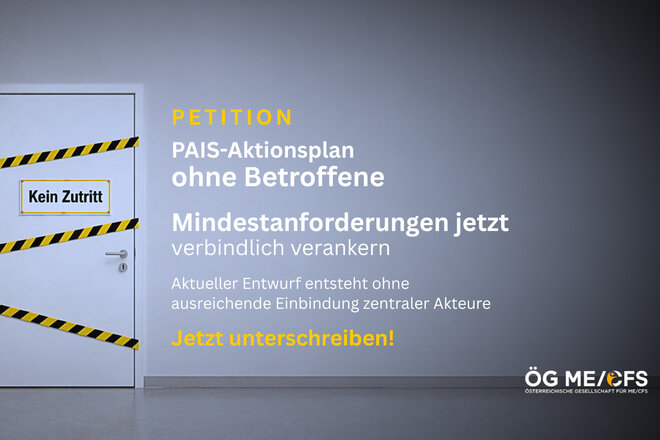
PAIS Action Plan Without Patient Representation: These Minimum Requirements Must Be Included in the Action Plan
Petition addressed to: Federal Government, Federal Ministry of Social Affairs, Health, Care and Consumer Protection, Federal States, Social Insurance Institutions
We call on the Federal Government, the federal states, and the social insurance institutions to rapidly and bindingly incorporate key minimum measures into the action plan on post-acute infection syndromes (PAIS). Many severely ill people are currently living with little to no access to adequate healthcare. This particularly concerns improvements in healthcare provision, education and training, social protection, biomedical research, as well as independent scientific structures and robust data foundations.
Rationale
The National Action Plan on Post-Acute Infection Syndromes (PAIS) was originally developed with broad participation from experts, patient advocacy groups, and institutions. Representatives of the Austrian Society for ME/CFS were officially part of the working groups and were substantively responsible for individual fields of action.
In the current process, this involvement is no longer taking place. The action plan is being revised without renewed structured participation of the originally involved patient representatives and professional experts. Parliamentary inquiry responses also indicate that external expertise is currently not being systematically considered in the process. Furthermore, according to current knowledge, key professional structures are not involved and themselves have no information about the current status.
As part of a request for information under the Freedom of Information Act (IFG), it also became apparent that key foundations for the planning and implementation of measures in the field of PAIS and ME/CFS are currently either still under development or are not being made accessible. According to information provided by the responsible federal ministry, for example, no further results regarding the reprioritization of measures are available, while essential decision-making documents have not been disclosed.
This underscores the existing deficits in transparency, governance, and participation and contradicts political statements claiming that adequate or nationwide care structures already exist.
There is therefore reason to fear that the action plan, scheduled for adoption at the end of June within the framework of the Federal Target-Based Governance system, will fall significantly short of the originally developed version, with key measures weakened and necessary content removed. In the current process, there is a risk that political and structural considerations will take precedence over the actual healthcare needs of those affected.
For this reason, we believe that at the very least those minimum requirements that are necessary for a real improvement in the care and living conditions of affected individuals must be bindingly included in the action plan.
Key Minimum Requirements That Must Be Included in the Action Plan
1. Healthcare Provision
Establishment of specialized, interdisciplinary contact points and treatment structures for PAIS, particularly ME/CFS, in all federal states, including outreach-based and telemedical care services.
2. Education and Training
Integration of PAIS, particularly ME/CFS, into the education, continuing education, and training of all health, nursing, and social care professions, as well as the development of corresponding standardized training content, since lack of expertise frequently leads to severe misdiagnosis and inadequate care.
3. Social Protection
Independent, quality-assured assessment bodies to ensure fair social security protection for affected individuals, as well as effective independent complaint mechanisms, including the establishment of appropriate independent bodies or the further development of existing institutions (e.g. expansion of competencies and powers of the Ombudsman Board, patient advocacy services, or comparable independent complaint structures).
4. Research
A coordinated national research initiative in line with international standards, with structural and long-term funding, modeled on Germany’s multi-year research funding framework in the multi-million-euro range, adjusted to Austria’s population size at a minimum of €5 million annually over a period of ten years, as well as a federal government initiative for a European research focus aimed at the targeted mobilization of EU research funding.
5. Scientific Structure
Safeguarding and sustainable further development of the National Reference Center for Postviral Syndromes (NRZ) as the central coordinating structure for healthcare provision, research, and education in the field of PAIS, including ME/CFS.
This includes in particular:
- permanent funding and institutional anchoring
- the development of evidence-based guidelines for PAIS and ME/CFS
- coordination of updates to existing guidelines (e.g. the S1 guideline “Management of Postviral Conditions Using Post-COVID-19 as an Example”) as well as the development of specific guidelines for ME/CFS
- training of professionals from various healthcare disciplines at specialized PAIS and ME/CFS centers
- development and establishment of standardized curricula in medical education and training
- mandatory training for relevant healthcare professions
- establishment and further development of central data foundations (e.g. on prevalence)
6. Participation and Transparency
Binding, structured, and legally anchored involvement of patient representative organizations in the development and implementation of medical guidelines and relevant measures in accordance with international standards (e.g. NICE).
Thank you for your support,
Austrian Society for ME/CFS
PAIS-Aktionsplan ohne Betroffene: Diese Mindestanforderungen müssen im Aktionsplan verankert werden
Petition richtet sich an: Bundesregierung, Bundesministerium für Soziales, Gesundheit, Pflege und Konsumentenschutz, Bundesländer, Sozialversicherungsträger
Wir fordern die Bundesregierung, die Bundesländer und die Sozialversicherungsträger auf, im Aktionsplan zu postakuten Infektionssyndromen (PAIS) zentrale Mindestmaßnahmen rasch und verbindlich zu verankern. Viele schwer erkrankte Menschen leben derzeit weitgehend ohne gesundheitliche Versorgung. Dazu gehören insbesondere Verbesserungen in Versorgung, Aus- und Weiterbildung, sozialrechtlicher Absicherung, biomedizinische Forschung sowie unabhängige wissenschaftliche Strukturen und belastbare Datengrundlagen.
Begründung
Der Nationale Aktionsplan zu postakuten Infektionssyndromen (PAIS) wurde ursprünglich unter breiter Beteiligung von Expert:innen, Betroffenenvertretungen und Institutionen erarbeitet. Vertreter:innen der Österreichischen Gesellschaft für ME/CFS waren offiziell Teil der Arbeitsgruppen und haben einzelne Handlungsfelder inhaltlich verantwortet.
Im aktuellen Prozess findet diese Einbindung nicht mehr statt. Der Aktionsplan wird ohne erneute strukturierte Beteiligung der ursprünglich eingebundenen Betroffenenvertretungen und fachlichen Expert:innen überarbeitet. Auch parlamentarische Anfragebeantwortungen zeigen, dass externe Expertise im Prozess derzeit nicht systematisch berücksichtigt wird. Zudem sind zentrale fachliche Strukturen nach aktuellem Kenntnisstand nicht eingebunden und verfügen selbst über keine Informationen zum aktuellen Stand.
Im Rahmen eines Informationsbegehrens gemäß Informationsfreiheitsgesetz (IFG) wurde zudem deutlich, dass zentrale Grundlagen für die Planung und Umsetzung von Maßnahmen im Bereich PAIS und ME/CFS derzeit entweder noch in Bearbeitung sind oder nicht zugänglich gemacht werden. So liegen laut Auskunft des zuständigen Bundesministeriums unter anderem keine weiterführenden Ergebnisse zur Neupriorisierung von Maßnahmen vor, während wesentliche Entscheidungsunterlagen nicht offengelegt werden.
Dies unterstreicht die bestehenden Defizite in Transparenz, Steuerung und Einbindung und steht im Widerspruch zu politischen Aussagen über eine bereits bestehende oder flächendeckende Versorgung.
Daher ist zu befürchten, dass der für Ende Juni geplante Beschluss des Aktionsplans im Rahmen der Bundeszielsteuerung deutlich hinter dem ursprünglich erarbeiteten Stand zurückbleibt, zentrale Maßnahmen abgeschwächt und notwendige Inhalte gestrichen werden. Im aktuellen Prozess besteht die Gefahr, dass politische und strukturelle Erwägungen Vorrang vor den tatsächlichen Versorgungsbedarfen der Betroffenen erhalten.
Gerade deshalb müssen aus unserer Sicht zumindest jene Mindestanforderungen verbindlich im Aktionsplan enthalten sein, die für eine reale Verbesserung der Versorgung und Lebenssituation von Betroffenen notwendig sind.
Zentrale Mindestanforderungen, die im Aktionsplan enthalten sein müssen
1. Versorgung
Aufbau spezialisierter, interdisziplinärer Anlaufstellen und Behandlungsstrukturen für PAIS, insbesondere ME/CFS, in allen Bundesländern, einschließlich aufsuchender und telemedizinischer Versorgungsangebote.
2. Aus- und Weiterbildung
Verankerung von PAIS, insbesondere ME/CFS, in der Aus-, Fort- und Weiterbildung aller Gesundheits-, Pflege- und Sozialberufe sowie die Entwicklung entsprechender standardisierter Ausbildungsinhalte, da fehlendes Fachwissen häufig zu schwerwiegender Fehl- und Unterversorgung führt.
3. Soziale Absicherung
Unabhängige, qualitätsgesicherte Begutachtungsstellen zur fairen sozialrechtlichen Absicherung von Betroffenen sowie effektive unabhängige Beschwerdemöglichkeiten, einschließlich der Schaffung geeigneter unabhängiger Stellen bzw. der Weiterentwicklung bestehender Einrichtungen (z. B. Kompetenz- und Befugniserweiterung der Volksanwaltschaft, Patientenanwaltschaft oder vergleichbare unabhängige Beschwerdestrukturen).
4. Forschung
Koordinierte nationale Forschungsoffensive nach internationalen Standards mit struktureller und langfristiger Finanzierung, orientiert am deutschen Modell einer mehrjährigen Forschungsförderung im Millionenbereich, entsprechend der Bevölkerungsgröße Österreichs im Umfang von zumindest 5 Millionen Euro jährlich über einen Zeitraum von zehn Jahren, sowie Initiative der Bundesregierung für einen europäischen Forschungsschwerpunkt zur gezielten Mobilisierung von EU-Forschungsmitteln.
5. Wissenschaftliche Struktur
Absicherung und nachhaltige Weiterentwicklung des Nationalen Referenzzentrums für postvirale Syndrome (NRZ) als zentrale koordinierende Struktur für Versorgung, Forschung und Ausbildung im Bereich PAIS, einschließlich ME/CFS.
Dazu gehört insbesondere:
6. Beteiligung und Transparenz
- die dauerhafte Finanzierung und institutionelle Verankerung
- die Entwicklung evidenzbasierter Leitlinien für PAIS und ME/CFS
- die Koordination der Aktualisierung bestehender Leitlinien (z. B. S1-Leitlinie “Management postviraler Zustände am Beispiel Post-COVID-19) sowie Entwicklung spezifischer Leitlinien zu ME/CFS
- die Schulung von Mitarbeiter:innen verschiedener Gesundheitsberufe an spezialisierten PAIS- und ME/CFS-Anlaufstellen
- die Entwicklung und Etablierung standardisierter Curricula in der medizinischen Aus- und Weiterbildung
- die verpflichtende Schulung relevanter Gesundheitsberufe
- der Aufbau und Weiterentwicklung zentraler Datengrundlagen (z. B. zur Prävalenz)
Verbindliche, strukturierte und gesetzlich verankerte Einbindung von Betroffenenvertretungen bei der Entwicklung und Umsetzung medizinischer Leitlinien und relevanter Maßnahmen nach internationalen Standards (z. B. NICE).
Vielen Dank für Ihre Unterstützung, Österreichische Gesellschaft für ME/CFS, Wien
 www.openpetition.eu