Zooming in on the Saunders et al. 2018 paper that discovered eMSN.
Molecular Diversity and Specializations among the Cells of the Adult Mouse Brain - PubMed
This was a major study where they built a brain-wide cell atlas of mice by extracting tissue and profiling individual cells' RNA using Drop-seq. They measured 690,000 individual cells from 9 major regions of the adult mouse brain. Then they used a statistical technique (independent component analysis) to see how the RNA data of the cells grouped together. These groups correspond to different cell types of which they found 565. The results are made visible on the website
Dropviz.
They were a bit surprised to find a new cell type in the striatum because that region has been well-studied in the past.
In the striatum, where neuronal diversity is well charted, we nonetheless identify a novel group of principal neurons that had been overlooked in decades of research.
So these were eMSN, although in the paper they are called eccentric spiny project neurons (eSPN). Here's the section about their discovery, starting with what was known about SPNs.
Molecular Specializations of Striatal Principal Neurons
Spiny projection neurons (SPNs) represent 95% of neurons in rodent striatum. Two principal categories distinguish SPN subsets. The first—based on divergent axonal projections and dopamine signalling—assigns SPNs to similarly numerous‘‘direct’’ (dSPN) and ‘‘indirect’’ (iSPN) pathways (Albin et al.,1989). The second—based on processing limbic versus sensory/motor information—groups SPNs into spatial compartments, the so-called ‘‘patch’’ and ‘‘matrix’’ (Gerfen, 1992; Graybiel and Ragsdale, 1978). Both dSPNs and iSPNs are present in the patch and matrix.
So SPNs were grouped into two types based on their dopamine receptor. In this study, Drd1 is the gene for the dopamine-1 receptor of the direct SPN. While Adora2a was used for the indirect SPN. It doesn't code for the dopamine-2 receptor directly but for a related receptor that is used as a proxy for D2. Another classification of SPN is based on their spatial compartment, with the matrix being the largest chunk and patches more like isolated islands.
Then they found a small group (around 4%) of cells that had the marker typical of SPN (Ppp1r1b+) but expressed the markers of both subgroups (Drd1 and Adora2a). That is why they were called eccentric
‘Eccentric’’ SPNs: A Novel, Third Axis of SPN Diversity
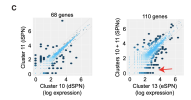
Surprisingly, about 4% of SPNs (Ppp1r1b+) were observed in a third, smaller cluster that also expressed Adora2a and Drd1(cluster 13: n = 2,744 cells; 4.5% of Ppp1r1b+ neurons; Figures7A and 7B). These SPNs differed in expression from dSPNs and iSPNs by 110 genes (more than the 68 that distinguished dSPNs and iSPNs from each other; Figure 7C) and expressed many genes that had little expression in the rest of the striatum(Figure 7D). Due to their transcriptional divergence from canonical SPNs, we call this population ‘‘eccentric’’ SPNs (eSPNs).eSPNs were intermixed with other SPNs in the striatum with no obvious spatial organization (Figures 7E and 7F). Our data account for all known striatal interneuron types (3.9% of total neurons) (Tepper and Bolam, 2004), suggesting by exclusion that eSPNs are not interneurons. We conclude that eSPNs are striatal principal neurons.
The authors suggest that these cells have been overlooked because studies have used Drd1 and Adora2a to subgroup. So the eSPN would not have been picked up but just thrown in one of the other groups.
Expression of markers associated with canonical SPNs suggests eSPNs have been molecularly ‘‘camouflaged,’’ including in studies using mice that have employed Drd1- and Adora2a- driven transgenes to label and manipulate dSPNs or iSPNs
And it wasn't just that this eccentric subgroup had both Drd1- and Adora2a; they had many more genetic differences that differentiated them from the other SPNs. In fact, there were more differences between the eSPN and other SPN (110 genes) than between the known SPN subgroups of dSPN versus iSPN (68 genes).
Despite sharing markers, Adora2a+ eSPNs and Drd1+ eSPNs are distinguished from their canonical SPN counterparts by expression levels of many genes(Adora2a+ SPNs: 35 genes; Drd1+ SPNs: 96 genes; Figure S7I).
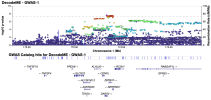
The paper gives four examples (Casz1, Otof, Cacng5, Pcdh8), but It's not clear how these were selected: whether these were most discriminatory versus the other SPNs, or just good for illustrative purposes. Pcdh8 is likely a genetic hit in both the fibromyalgia and ME/CFS GWAS.
They also mention that they found an even rarer (0.3% of total) subgroup within the eSPN. This group expressed Tyrosine Hydroxylase (TH), which converts the amino acid L-tyrosine into L-DOPA, which is made into dopamine.
We validated additional eSPN diversity predicted by Drop-seq, including an ultra-rare eSPN Adora2a+/Th+/Npffr1+ subtype(13-5) that accounts for just 0.3% of all SPNs (n = 88 cells) (Figure 7J). One clue about the anatomical identity of eSPNs comes from this small Th+ population, as spiny Th+ principal cells with similar spatial arrangement to eSPNs have been observed in striatum and appear to be dynamically regulated by dopamine(Darmopil et al., 2008).
Normally, the striatum's SPN are supposed to receive dopamine from other regions, not make it. So this group might point to a small source of dopamine inside the striatum.