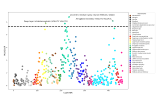
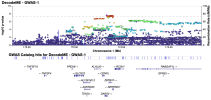
Eccentric medium spiny neuron (eMSN)

The Human protein atlas gives a list of 114 genes with elevated expression in Eccentric medium spiny neuron compared to other brain cell clusters.
Search: sc_brain_region_category_rna:Eccentric medium spiny neuron;Cell type enriched,Group enriched,Cell type enhanced AND sort_by:tissue specific score - The Human Protein Atlas

I recognize POU3F2 which was near the hit on chromosome 6 (6:98,537,145). It's involved in "neuronal differentiation and enhances the activation of corticotropin-releasing hormone regulated genes."
POU3F2 POU class 3 homeobox 2 [Homo sapiens (human)] - Gene - NCBI

So perhaps another clue that these eMSN cells are producing CRH and that this is relevant to ME/CFS.
 
I also found a study that suggest that these eMSN might produce corticotropin releasing factor (CRF) as co-transmitter. More precisely it found that some spiny projection neurons in the nucleus accumbens produce CRF and that most of these have more markers typical of eMSN.
Havent had a chance to read the whole thread so apologies if this is a redundant point:

Recently had a chance to chat with a colleague who does work related to CRH in other conditions. Long story short, CRH is expressed all over the brain, in tons of different circuits. Whole brain mapping study in mice here:

Could still be a relevant, but it does mean the connection here to the autopsy study is probably less salient if you can blindly throw a coin and hit a CRH-expressing neuron population
 
it does mean the connection here to the autopsy study is probably less salient if CRH expression is happening more or less everywhere in the brain to some extent.
Thanks for sharing this. My counterpoint would be that the genetic data is pointing to eMSN cells (all over the body) as key to ME/CFS pathology. The CRH is just an extra bonus that could make the autopsy findings fit.

So it doesn't matter that match if other cells can make CRH as well, because the genetic data isn't pointing to them but mostly to eMSN.

EDIT: but if the genetic data pointed to a cell type that had no CRH link, we would probably be wondering how it would fit with the autopsy findings.
 
Thanks for sharing this. My counterpoint would be that the genetic data is pointing to eMSN cells (all over the body) as key to ME/CFS pathology. The CRH is just an extra bonus that could make the autopsy findings fit.

So it doesn't matter that match if other cells can make CRH as well, because the genetic data isn't pointing to them but mostly to eMSN.
Yes that point makes sense, just wanted to clarify that a potential connection to CRH doesnt really add another point of support to their relevance in light of the autopsy study [edit: both because of widespread CRH production, and also because of the difficulty tying any of this in this other neuron type to a downstream epigenetic/transcriptional regulation issue in the hypothalamus]
 
just wanted to clarify that a potential connection to CRH doesnt really add another point of support to their relevance in light of the autopsy study
Hmm, think this overstates it a little because there are likely tons of cell types that do not produce CRH as prominently as eMSN.

Genetic data suggests that eMSN are the main cell type that is overfiring and they probably have CRH as co-factor. So if this theory is true, there would be too much CRH + spillover which would have an inhibitory effect on other CRH producing cells, the most prominent being those in the hypothalamus.

Wouldn't this work?
 
@jnmaciuch When you have time/energy, would also be interested in your opinion on the brain imaging studies on fatigue during sickness behavior pointing to the left nucleus accumbens and putamen.
When it comes to fatigue in humans, some papers have pointed to the basal ganglia and more specifically the left nucleus accumbens and putamen. I think this fits well with the striata region that seems to come out of the ME/CFS data and the main location of eMSN. A main paper on this is Capuron 2007 which found:
Basal ganglia hypermetabolism and symptoms of fatigue during interferon-alpha therapy - PubMed

Some other studies:
Dopaminergic mechanisms of reduced basal ganglia responses to hedonic reward during interferon alfa administration - PubMed
IFN-alpha-induced cortical and subcortical glutamate changes assessed by magnetic resonance spectroscopy - PubMed
The ME/CFS genetic data seems to highlight the striatal region with genes such as TSHZ3, GPR52, HTT and the eMSN who are prominently there too.
 
That’s a good point @Utsikt talking about neurological conditions and some of these topics could worry people. The way I see it we can have these genes or pathways involved or implicated by them involved in ME/CFS without any need for ongoing tissue damage or a degenerative condition.

It’s a topic we’ve discussed before but good to mention it again probably. To me at least, it all ties in to a picture of different factors with a balance shifted slightly this way or that so under certain circumstances multiple feedback loops perpetuate some dodgy signalling.
I always caveat that I’m not a scientist (I’m trying to learn!) what reading the forum has done is made me aware of my lack of knowledge “consciously unconscious”.
Lay people are so used to being fed a simplistic soundbite or headline, so like the paper on sodium pump calcium channel, people were jumping on it asking about eating more salt because sodium is salt and so just piling more into the system will surely fix the issue? Just like red wine prevents heart attacks…
 
So if this theory is true, there would be too much CRH + spillover which would have an inhibitory effect on other CRH producing cells, the most prominent being those in the hypothalamus.
It’s a logical thought process, though it relies on the assumption that CRH coming from other places in the brain would or could inhibit CRH production long term in a given neuron somewhere else.

The studies that have assessed this suggest CRH neurons in the PVN actually increase CRH in response to artificially administered CRH [edit: at least in the short term]. And there are negative regulatory mechanisms downregulating CRH production with repeated stimulation, but crucially they are active transcriptomic feedback loops and not permanent epigenetic shifts (otherwise animals would be losing CRH responsiveness quite easily with just a little too much stress). So to explain something like this you’d need constantly high CRH (would’ve been picked up in CSF studies). Also, those spiny neurons would have to be producing a Large amount of CRH for it to diffuse through the brain and saturate hypothalamic neurons. People would be experiencing symptoms similar to an ACTH stimulation test if that was the case, at least for a long enough period of time for people to comment on it repeatedly

The more likely explanations for the CRH neuron depletion would be some other [edit: unrecognized trigger constantly stimulating those neurons] or a very strong one-time signal that causes a peculiar epigenetically shift (one that CRH itself isnt capable of inducing).
 
Last edited:
Question for moderators: Could we make this thread members-only so that AI (mostly Google's gemini) doesn't use read it? It messes up replies when you ask questions about it, strengthening confirmation bias. Thanks in advance,
Mods will not be making forum discussions of science members only. That would go against our aim of open discussion of science. Users of AI are advised to seek the sources of information used by the AI and check the validity at source themselves rather than relying on AI to guide their approach to a topic.
 
From what I understand eMSN are inhibitory. The regular MSNs come in two types, one promotes the other suppresses movement in response to various inputs.

I wonder if eMSN suppress movement by causing a sensation of fatigue and malaise?
 
@tralfamadorian97 is also doing interesting analyses using the DecodeME data, including the MAGMA analysis that links DNA results of ME/CFS patients to gene expression (scRNAseq) data from the Human Brain Atlas. So this is similar to what Paolo did, but with only the DecodeME data (not those from the veterans program).

He also found the most significant results for eMSN. I think this is confirmation that the eMSN result isn't due to some possible fluke in the veterans data or an error in the meta-analysis that Paolo did. It's largely in DecodeME data.
1779439982848.png

The signal for eMSN in the veterans data seems rather weak (p = 10^-3 or 10^-2). So I think it mainly added statistical power, mostly from the controls.
 
So from the genetic data we have, this is the type of neuron that is likely to be causing MECFS pathology?

If thats the case, obviously that could be as part of an immune/brain loop or a brain only loop. And we don't know the specific dynamics of the pathology.

But just in terms of drugs that target these neurons directly, as far as I can find there's nothing currently that targets this cell type. Can you make specific neurons chill out via drugs? Without horrible side effects that is.

Am I wrong in thinking this is like a major breakthrough if it stands up?
 
So from the genetic data we have, this is the type of neuron that is likely to be causing MECFS pathology?

I think that is putting it too strongly. The message is that this type of neuron looks the best candidate to look into further but that the genetic signal may reflect involvement of quite a range of neuron types.

However:
Am I wrong in thinking this is like a major breakthrough if it stands up?

This is not wrong. If the story firms up it will be a major breakthrough. My guess is that it may firm up but not quite as it seems at present. We got interested in BTN2A2 and then realised it was probably BTN2A1. There is likely to be quite a lot more shaking down to do.
 
A paper describing a 'map' of the striatum in mice using scRNA-seq -

A Spatiomolecular Map of the Striatum
This cluster displayed marker expression similar to a striatal cluster in a recent study (Saunders et al., 2018), which classified these neurons as “eccentric” SPNs (eSPNs) and defined them as a separate SPN population based on co-expression of Casz1, Otof, Cacng5, and Pcdh8. The marker Otof was described as a marker for eSPNs (Saunders et al., 2018), and it labels Col11a1+ SPNs in our snRNA-seq data, although it also labels the cluster containing Npy+ striatal interneurons (Figure 4B).
Additional background on striatal projection neurons -

Striatal projection neurons coexpressing dopamine D1 and D2 receptors modulate the motor function of D1- and D2-SPNs

Activation of Direct and Indirect Pathway Medium Spiny Neurons Drives Distinct Brain-wide Responses
 
Zooming in on the Saunders et al. 2018 paper that discovered eMSN.
Molecular Diversity and Specializations among the Cells of the Adult Mouse Brain - PubMed

This was a major study where they built a brain-wide cell atlas of mice by extracting tissue and profiling individual cells' RNA using Drop-seq. They measured 690,000 individual cells from 9 major regions of the adult mouse brain. Then they used a statistical technique (independent component analysis) to see how the RNA data of the cells grouped together. These groups correspond to different cell types of which they found 565. The results are made visible on the website Dropviz.

They were a bit surprised to find a new cell type in the striatum because that region has been well-studied in the past.
In the striatum, where neuronal diversity is well charted, we nonetheless identify a novel group of principal neurons that had been overlooked in decades of research.
So these were eMSN, although in the paper they are called eccentric spiny project neurons (eSPN). Here's the section about their discovery, starting with what was known about SPNs.
Molecular Specializations of Striatal Principal Neurons
Spiny projection neurons (SPNs) represent 95% of neurons in rodent striatum. Two principal categories distinguish SPN subsets. The first—based on divergent axonal projections and dopamine signalling—assigns SPNs to similarly numerous‘‘direct’’ (dSPN) and ‘‘indirect’’ (iSPN) pathways (Albin et al.,1989). The second—based on processing limbic versus sensory/motor information—groups SPNs into spatial compartments, the so-called ‘‘patch’’ and ‘‘matrix’’ (Gerfen, 1992; Graybiel and Ragsdale, 1978). Both dSPNs and iSPNs are present in the patch and matrix.
So SPNs were grouped into two types based on their dopamine receptor. In this study, Drd1 is the gene for the dopamine-1 receptor of the direct SPN. While Adora2a was used for the indirect SPN. It doesn't code for the dopamine-2 receptor directly but for a related receptor that is used as a proxy for D2. Another classification of SPN is based on their spatial compartment, with the matrix being the largest chunk and patches more like isolated islands.

Then they found a small group (around 4%) of cells that had the marker typical of SPN (Ppp1r1b+) but expressed the markers of both subgroups (Drd1 and Adora2a). That is why they were called eccentric
‘Eccentric’’ SPNs: A Novel, Third Axis of SPN Diversity
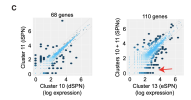
Surprisingly, about 4% of SPNs (Ppp1r1b+) were observed in a third, smaller cluster that also expressed Adora2a and Drd1(cluster 13: n = 2,744 cells; 4.5% of Ppp1r1b+ neurons; Figures7A and 7B). These SPNs differed in expression from dSPNs and iSPNs by 110 genes (more than the 68 that distinguished dSPNs and iSPNs from each other; Figure 7C) and expressed many genes that had little expression in the rest of the striatum(Figure 7D). Due to their transcriptional divergence from canonical SPNs, we call this population ‘‘eccentric’’ SPNs (eSPNs).eSPNs were intermixed with other SPNs in the striatum with no obvious spatial organization (Figures 7E and 7F). Our data account for all known striatal interneuron types (3.9% of total neurons) (Tepper and Bolam, 2004), suggesting by exclusion that eSPNs are not interneurons. We conclude that eSPNs are striatal principal neurons.
The authors suggest that these cells have been overlooked because studies have used Drd1 and Adora2a to subgroup. So the eSPN would not have been picked up but just thrown in one of the other groups.
Expression of markers associated with canonical SPNs suggests eSPNs have been molecularly ‘‘camouflaged,’’ including in studies using mice that have employed Drd1- and Adora2a- driven transgenes to label and manipulate dSPNs or iSPNs
And it wasn't just that this eccentric subgroup had both Drd1- and Adora2a; they had many more genetic differences that differentiated them from the other SPNs. In fact, there were more differences between the eSPN and other SPN (110 genes) than between the known SPN subgroups of dSPN versus iSPN (68 genes).
Despite sharing markers, Adora2a+ eSPNs and Drd1+ eSPNs are distinguished from their canonical SPN counterparts by expression levels of many genes(Adora2a+ SPNs: 35 genes; Drd1+ SPNs: 96 genes; Figure S7I).
1779451900654.png

The paper gives four examples (Casz1, Otof, Cacng5, Pcdh8), but It's not clear how these were selected: whether these were most discriminatory versus the other SPNs, or just good for illustrative purposes. Pcdh8 is likely a genetic hit in both the fibromyalgia and ME/CFS GWAS.

They also mention that they found an even rarer (0.3% of total) subgroup within the eSPN. This group expressed Tyrosine Hydroxylase (TH), which converts the amino acid L-tyrosine into L-DOPA, which is made into dopamine.
We validated additional eSPN diversity predicted by Drop-seq, including an ultra-rare eSPN Adora2a+/Th+/Npffr1+ subtype(13-5) that accounts for just 0.3% of all SPNs (n = 88 cells) (Figure 7J). One clue about the anatomical identity of eSPNs comes from this small Th+ population, as spiny Th+ principal cells with similar spatial arrangement to eSPNs have been observed in striatum and appear to be dynamically regulated by dopamine(Darmopil et al., 2008).
Normally, the striatum's SPN are supposed to receive dopamine from other regions, not make it. So this group might point to a small source of dopamine inside the striatum.
 
The paper gives four examples (Casz1, Otof, Cacng5, Pcdh8), but It's not clear how these were selected: whether these were most discriminatory versus the other SPNs, or just good for illustrative purposes. Pcdh8 is likely a genetic hit in both the fibromyalgia and ME/CFS GWAS.
PCDH8, which plays a role in synaptic reorganization and down-regulation of dendritic spines.
PCDH8 Gene - GeneCards | PCDH8 Protein | PCDH8 Antibody

It's on chromosome 13. We thought that the DecodeME signal there pointed to OLFM4, as it is closer, but the fibromyalgia GWAS also found a signal there (a bit more to the right at chr13:53,343,095), but the FLAMES tool suggested PCDH8 as the causal gene. So perhaps the DecodeME signal also points to PCDH8.

1779349576647.png
 
According to Komatsu et al (2014) Gpr52 (the gene for which came up in the fibromyalgia GWAS) is enriched in medium spiny neurons of the striatum & has been suggested as a drug target in both Huntington's and in schizophrenia & other psychiatric disorders -

Anatomical Transcriptome of G Protein-Coupled Receptors Leads to the Identification of a Novel Therapeutic Candidate GPR52 for Psychiatric Disorders

Targeting Gpr52 lowers mutant HTT levels and rescues Huntington’s disease-associated phenotypes
 
According to Komatsu et al (2014) Gpr52 (the gene for which came up in the fibromyalgia GWAS) is enriched in medium spiny neurons of the striatum & has been suggested as a drug target in both Huntington's and in schizophrenia & other psychiatric disorders -
Yes, but it also came up in DecodeME itself

It's in the RABGAP1L region, but given what we know now about eMSN , GPR52 might be a more likely candidate.

1779454757009.png

From what I understand, it's a receptor that modulates dopamine signalling pathways and co-localizes with the dopamine 2 receptor that is on MSNs. Here's what its Gene Card says:
Gs-coupled receptor activated by antipsychotics reserpine leading to an increase in intracellular cAMP and its internalization (PubMed:24587241). May play a role in locomotor activity through modulation of dopamine, NMDA and ADORA2A-induced locomotor activity. These behavioral changes are accompanied by modulation of the dopamine receptor signaling pathway in striatum (PubMed:24587241). Modulates HTT level via cAMP-dependent but PKA independent mechanisms throught activation of RAB39B that translocates HTT to the endoplasmic reticulum, thus avoiding proteasome degradation
GPR52 Gene - GeneCards | GPR52 Protein | GPR52 Antibody
 
Back
Top Bottom