ME/CFS Science Blog
Senior Member (Voting Rights)
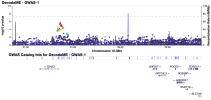
On the topic of links to the striatum, next to eMSN, HTT, and GPR52, there's also TSHZ3, which was a significant hit in Paolo's meta-analysis (not DecodeME alone).
A bit more speculative perhaps, but knockout experiments of these genes in mice found changes in corticostriatal glutamatergic transmission. This was in the context of autism research.
A bit more speculative perhaps, but knockout experiments of these genes in mice found changes in corticostriatal glutamatergic transmission. This was in the context of autism research.
Postnatal Tshz3 Deletion Drives Altered Corticostriatal Function and Autism Spectrum Disorder-like Behavior - PubMedThese conditional Tshz3 knockout mice exhibit altered cortical expression of more than 1000 genes, ∼50% of which have their human orthologue involved in ASD, in particular genes encoding for glutamatergic synapse components. Consistently, we detected electrophysiological and synaptic changes in CPNs and impaired corticostriatal transmission and plasticity. Furthermore, these mice showed strong ASD-like behavioral deficits.