Here is an updated/edited version of the
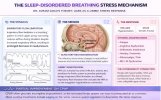
original AI summary of the UARS theory with links (most of the links are to S4ME threads, but a few are to Bluesky threads of mine). I have also included an infographic at the end that I made to help others understand the theory and a YouTube talk by Dr. Denise Dewald on inspiratory flow limitation.
Abstract
This document outlines the
theory, primarily developed by
Dr. Avram Gold (medical director of Stony Brook University Sleep Disorders Center), that many "complex chronic illnesses"—including
Myalgic Encephalomyelitis/Chronic Fatigue Syndrome (ME/CFS),
fibromyalgia (FM), and
Gulf War Illness (GWI)—are driven by a physiological stress response in the central nervous system (CNS) to obstructive sleep-disordered breathing. The core of this theory posits that the brain's limbic system becomes sensitized to
inspiratory flow limitation (IFL) during sleep following a significant physiological or psychological stressor (e.g., infection, trauma, surgery, chemical exposure, etc.). This sensitization transforms previously benign IFL into a chronic, pathological stressor that perpetuates symptoms like
fatigue, pain, cognitive dysfunction,
insomnia and autonomic instability. This framework challenges the conventional understanding of sleep-disordered breathing by shifting the focus from
apnea-hypopnea events and arousals to the neurological response to IFL. The evidence presented, drawn from clinical studies, case reports, and population data, suggests this mechanism is a factual cause for at least some cases of fibromyalgia and GWI, and warrants serious investigation for ME/CFS and other related conditions. (it's quite possible that some of these diagnoses like GWI actually represent multiple different disorders; e.g. some GWI patients may have a true neurotoxic chemical injury, but many cases of GWI do not fit that presentation - e.g. have dramatic symptom fluctuations over time, etc.)
A central tenet of this hypothesis is that the current diagnostic paradigm for sleep-disordered breathing (SDB) is flawed and overlooks the primary driver of symptoms in many patients.
- The Inadequacy of the Apnea-Hypopnea Index (AHI): The AHI, which measures complete and partial cessations of breathing, correlates poorly with symptoms like fatigue and sleepiness. This is underscored by the fact that over 50% of individuals with obstructive sleep apnea (OSA, AHI ≥5) are asymptomatic. If apneas, hypopneas, and the resulting arousals were the primary cause of symptoms, a stronger correlation would be expected.
- The Central Role of Inspiratory Flow Limitation (IFL): The hypothesis proposes that the crucial pathological event is not necessarily apnea but IFL—the subtle, often inaudible "fluttering" (rapid opening and closing) of the upper airway (pharynx) during inhalation. This includes snoring but also non-audible fluttering. Large-scale epidemiological data supports this, showing that snoring (a proxy for IFL) - not AHI - is the factor most strongly associated with excessive daytime sleepiness* (most people with an AHI ≥5 snore). Two large sample size studies showed that increased IFL was associated with excessive daytime sleepiness* and psychomotor vigilance task lapses (even after for controlling for arousals). However, IFL alone is not enough to cause symptoms; one study comparing UARS patients to matched controls found that even controls rigorously screened to be free of any medical conditions, any chronic fatigue/pain/etc. can have high levels of IFL.
*
A recent study identified that the Epworth Sleepiness Scale - which is used to assess daytime sleepiness - actually measures an uninterpretable mix of objective sleepiness and fatigue (which are uncorrelated symptoms in OSA patients).
Dr. Gold's theory is not that inspiratory flow limitation itself causes these illnesses, but that the
brain's reaction to it does.
- A Two-Step Process:
- Pre-existing Condition: An individual has a baseline level of IFL during sleep, which their brain does not perceive as a threat.
- Sensitizing Event: A significant stressor—such as an infection, physical trauma, surgery, chemical exposure, or severe psychological stress—activates the body's primary stress pathway, the hypothalamic-pituitary-adrenal (HPA) axis.
- The Sensitization Mechanism: This HPA axis activation leads to the sensitization of the limbic system (the brain's emotional and stress-response center). The hypothesis suggests this may occur via the olfactory nerve, which senses changes in nasal airflow and pressure and has direct connections to the limbic system (during IFL there are prolonged decreases in nasal pressure compared to non-flow-limited breathing).
- Pathological Consequence: Post-sensitization, the brain begins to interpret the previously ignored IFL as a noxious, threatening stimulus. This triggers a recurring, nightly stress response that drives the diverse symptoms of chronic illness, from profound fatigue and body-wide pain to autonomic dysfunction and cognitive impairment.
- A study by Dr. Gold of consecutive SDB patients at a sleep clinic found that there was an inverse relationship between AHI and symptoms like sleep-onset insomnia, headaches, and IBS (as well as alpha-delta sleep), with UARS patients having the highest prevalence of these signs/symptoms and patients with moderate-severe OSA having the lowest. This could be explained by the fact that as frequency of apneas (complete/near-complete cessation of airflow) increases, exposure to IFL decreases.
Multiple lines of evidence support the connection between IFL and complex chronic illnesses.
A controlled study of Gulf War illness (GWI) patients provides the strongest direct evidence for this theory:
- Objective Sleep Findings: 18 veterans with GWI were compared to 11 asymptomatic, age- and BMI-matched Gulf War veterans. The GWI group experienced IFL during 96% ± 5% of their sleep, whereas the control group experienced it only 36% ± 25% of the time. This difference was highly statistically significant (p<0.0001).
- Treatment Efficacy: When treated with therapeutic CPAP, the GWI patients experienced significant improvements in fatigue, pain, and cognitive function. This subjective improvement was directly correlated with an objective finding: a decrease in sleep stage shifts. The control group, which received sham CPAP, did not improve and in fact worsened slightly.
The link to fibromyalgia is supported by physiological data, prevalence studies, and case reports:
- Increased Airway Collapsibility: A study by Dr. Gold found that female fibromyalgia patients had a more collapsible upper airway (comparable to those of female UARS patients), measured by the pharyngeal critical closing pressure (Pcrit). This anatomical predisposition provides a physical basis for increased IFL.
- High Prevalence of OSA in fibromyalgia: One study found that when polysomnography was offered to consecutive female fibromyalgia patients in a rheumatology clinic, 100% of the 23 who agreed to testing had OSA, with 83% having an AHI >15. This prevalence is drastically higher than the ~17% found in the general female population.
- High Prevalence of fibromyalgia in OSA: A meta-analysis found a 21% prevalence of fibromyalgia in OSA patients (vs. a meta-analysis that found a 1.78% prevalence of fibromyalgia in the general population).
- Symptom Resolution with Treatment: At least two independent case reports from different countries document the near-complete resolution of severe, long-standing fibromyalgia symptoms following treatment for SDB (one with CPAP, one with a mandibular advancement device). Critically, one report documented that alpha-delta sleep—an objective biomarker associated with fibromyalgia—disappeared along with the patient's symptoms after treatment.
Orthostatic intolerance/dysautonomia: The theory may also explain the different autonomic presentations between UARS and classic OSA:
- UARS and Hypotension: One study found that 93 out of 400 consecutive UARS patients at Stanford had low blood pressure, and of those, all 15 who underwent tilt-table testing had orthostatic hypotension. In contrast, only 2 out of 3,369 OSA patients had low blood pressure.
- Mechanism of Divergence: In some UARS patients, effortful IFL may be associated with abnormal autonomic regulation. A study found higher parasympathetic activity in UARS patients compared to controls, especially during breaths with increased inspiratory effort. By contrast, in classic OSA, recurrent hypoxemia and arousal-related pressor responses are thought to be major drivers of daytime hypertension. A case report documented a man with OSA who developed progressively worsening low blood pressure and orthostatic hypotension symptoms upon temporarily stopping his CPAP therapy which resolved with reinstatement of CPAP.
Chronic insomnia, a common symptom in ME/CFS, fibromyalgia, and GWI, has been shown to be very strongly associated with SDB:
- In a study of chronic insomnia patients who believed their sleep problems were due to psychological, psychiatric, behavioral, or environmental factors, after excluding hundreds of patients with OSA signs/symptoms and risk factors, only 1/62 chronic insomnia patients who underwent polysomnography (PSG) did not meet criteria for OSA/UARS. Of the 40 final patients, 90% met criteria for OSA and 10% UARS (the prevalence of OSA in the general population is ~20%).
This theory provides a unifying framework that could explain many puzzling aspects of ME/CFS and related illnesses.
- The Hypermobility Connection: It can explain why people with hypermobility are more likely to develop ME/CFS, fibromyalgia, and related disorders (more lax connective tissue = more collapsible upper airway). A meta-analysis found that patients with EDS (all types, including hypermobile) and Marfan syndrome were ~6 times more likely to have OSA than the general population. A parallel cohort study of EDS patients (various types, including hypermobile) and matched controls found that the impact of EDS on AHI was comparable to that of a 11 kg/m2 BMI gain.
- Diverse Triggers: It can account for how any type of stressor—not just infections—can trigger an identical syndrome by focusing on HPA axis activation as the common pathway to sensitization.
- Symptom Variability/Fluctuations: It can account for both gradual and rapid onsets, and why symptoms in ME/CFS and related disorders often show significant variability and fluctuations, even within relatively short time periods (e.g. by the day/hour). It also provides a plausible explanation for remissions and relapses, and why recovery is more likely early on, especially with rest/pacing (stress response less ingrained). It can even account for mind-body/"brain retraining" recoveries (for some, this may be enough to turn off the UARS stress response).
- Post-Exertional Malaise (PEM): In this theory, PEM could be understood as a manifestation of a dysfunctional CNS stress response. Exertion (physical, cognitive, emotional or sensory) acts as an additional stressor on an already over-taxed system, leading to a crash. This aligns with observations that CNS depressants (e.g., benzodiazepines, dextromethorphan) can sometimes prevent or reduce PEM, and that PEM (severity) does not always correspond to energy expenditure, but rather seems to be more about how much "stress" (negative/positive) the activity/stimulus places on us.
- Partial Efficacy of Treatment: It can explain why treatments like CPAP/BiPAP often provide significant (~35-50%) but incomplete relief. While these therapies reduce IFL, the device itself (pressure, mask) can act as a new stressor on a highly sensitized nervous system, preventing full recovery. More curative treatments may involve surgery or, for some, nervous system regulation techniques that aim to desensitize the stress response itself.
"I think of flow limitation as a really important thing to look at when you're looking at a PSG [polysomnogram] and deciding is this a normal study or not? Spoiler alert: just about everyone who's referred for a sleep complaint does not have a normal study. After thousands of sleep studies, I have yet to see an actual normal study [i.e. no flow limitation during non-REM sleep] in someone who was symptomatic. The only normal studies I've seen are people who are referred because they needed a sleep study for bariatric surgery or because they work in transportation...Oh, and there was one guy who was sent by his cardiologist because he developed atrial fibrillation, and so of course he needed a sleep study, but he had rheumatic valvular disease." - Denise Dewald, MD
Physiology/physics of IFL (and Pcrit) is discussed at 5:45.