United Kingdom: ME Research UK (MERUK) News

Altered neurometabolite levels in the brains of people with ME/CFS​

13 August 2025
Kiana Kothe is a PhD student working with Prof. Zack Shan at the University of the Sunshine Coast on an ME Research UK-funded project using magnetic resonance imaging to investigate brain neuroinflammation in ME/CFS.

Kiana recently presented some of her initial results at the annual conference of the Organisation for Human Brain Mapping in June 2025, which was attended by more than 2,000 neuroimaging researchers, and she is currently preparing a research paper reporting her findings. Kiana very kindly recorded a video of her presentation for us, showing her results so far.

In brief, Kiana used previously collected magnetic resonance spectroscopy images to assess levels of a number of neurometabolites in the brains of 48 people with ME/CFS and 52 healthy controls. Neurometabolites are the products of metabolism in the brain, and indicate neural activity.

Of the five metabolites she analysed, levels of two of them were significantly altered in people with ME/CFS compared with healthy controls.

Specifically, glutamine/glutamate concentrations were increased in ME/CFS, while total choline levels were decreased, and these findings suggest the involvement of excitotoxicity (damage to nerve cells), abnormal cellular membrane turnover and neuroinflammatory activation.

In short, these findings provide evidence of neuroinflammation in ME/CFS, and Kiana and the team next plan to track how these neurometabolites change over time while the participants perform cognitive tasks.
 

Altered neurometabolite levels in the brains of people with ME/CFS​

13 August 2025
Kiana Kothe is a PhD student working with Prof. Zack Shan at the University of the Sunshine Coast on an ME Research UK-funded project using magnetic resonance imaging to investigate brain neuroinflammation in ME/CFS.

Kiana recently presented some of her initial results at the annual conference of the Organisation for Human Brain Mapping in June 2025, which was attended by more than 2,000 neuroimaging researchers, and she is currently preparing a research paper reporting her findings. Kiana very kindly recorded a video of her presentation for us, showing her results so far.

In brief, Kiana used previously collected magnetic resonance spectroscopy images to assess levels of a number of neurometabolites in the brains of 48 people with ME/CFS and 52 healthy controls. Neurometabolites are the products of metabolism in the brain, and indicate neural activity.

Of the five metabolites she analysed, levels of two of them were significantly altered in people with ME/CFS compared with healthy controls.

Specifically, glutamine/glutamate concentrations were increased in ME/CFS, while total choline levels were decreased, and these findings suggest the involvement of excitotoxicity (damage to nerve cells), abnormal cellular membrane turnover and neuroinflammatory activation.

In short, these findings provide evidence of neuroinflammation in ME/CFS, and Kiana and the team next plan to track how these neurometabolites change over time while the participants perform cognitive tasks.
Apologies, if this is a stupid question. But could an elevated glutamine level explain why I responded very badly to taking l-glutamine?
 
ME Research UK and the Daphne Jackson Trust are delighted to announce that they have awarded a Fellowship to Dr Alkisti Manousaki at the University of Leicester, for a project investigating the genetic and cellular clues that may explain why ME/CFS affects more women than men.

This Daphne Jackson Trust Fellowship is jointly funded by ME Research UK and the Medical Research Council. The Daphne Jackson Trust is dedicated to supporting research returners. ME Research UK is a charity which commissions and funds high-quality scientific (biomedical) investigation into the causes, consequences and treatment of ME/CFS.

Read more: https://bit.ly/manousaki001

"It is such a privilege to work with funders like ME Research UK to help people return to their research careers. Our funders make these fellowships possible. When combined with the unique structure, retraining, and mentorship provided by the Daphne Jackson Trust, our funders truly do help transform lives and careers.” Elaine Hunt, Fellowship Officer, The Daphne Jackson Trust

“It is an honour to return to research with the support of ME Research UK, MRC UKRI and the Daphne Jackson Trust. ME/CFS remains a deeply misunderstood condition, and I am passionate about using my skills in genetics and cell biology to uncover answers that could make a real difference for people living with the illness.” Dr Alkisti Manousaki
 
From Facebook:

ME Research UK and the ME Association are excited to announce second-phase funding to advance the development of a diagnostic test for ME/CFS. The new grant has been awarded to Dr Fatima Labeed and Dr Jacqueline Cliff, with the research taking place at Brunel University of London.

This next phase will refine and expand on their initial study exploring electrical differences in blood cells from people with ME/CFS. The investigators plan to test a larger cohort, improve the preparation and processing of samples, and investigate the biological basis of the electrical changes, with the aim of moving closer to a reliable and low-cost diagnostic test.

Read more: https://www.meresearch.org.uk/new-f...-development-of-a-diagnostic-test-for-me-cfs/
 
Last edited by a moderator:
Here’s the webpage with more details
 
From Facebook:

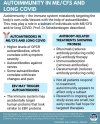
ME Research UK is delighted to announce that we have awarded funding to Prof. Bhupesh Prusty at Riga Stradins University in Latvia for a project investigating the role of autoimmunity in ME/CFS.

Following on from his previous work, Prof. Prusty will look at the mechanisms through which immunoglobulins from ME/CFS patients can cause dysfunction of the mitochondria (which are responsible for generating energy in cells).

As well as providing a better understanding of the role of autoimmunity in ME/CFS, the findings may also help in the design or selection of suitable treatments for the disease.

Find out more: https://bit.ly/prusty070
 

Objectives​

The researchers will first take immunoglobulin samples from people with ME/CFS and from healthy volunteers, and then culture them for 12 hours with healthy muscle and nerve cells, both of which are known to be affected in the disease.

The human brain is particularly complicated and experiments using single cells do not always reflect this. So immunoglobulins will also be cultured with three-dimensional brain tissue to fully understand the pathogenic processes.

Sequencing methods will be used to assess how the genes of these cells and tissues change their activity level in response to being exposed to the immunoglobulins, which will help to identify which cellular pathways are involved.

Immunoglobulins can have specific protein targets on the cells with which they interact, and a second part of the study is to investigate the exact molecular mechanism by which this interaction occurs.

Proteins will be extracted from a number of different cell types, including muscle, nerve, endothelial and immune cells, and then these proteins will be exposed to the immunoglobulins. Various techniques will be used to identify potential target proteins for the pathogenic immunoglobulins

Potential benefits​

The researchers anticipate that their findings will provide a better understanding of the role of autoimmunity in ME/CFS, and specifically the molecular mechanism by which immunoglobulins can cause mitochondrial dysfunction. This could help in the design or selection of suitable treatments to target this pathway.
 
From Facebook:

Thanks to the continued support of our generous donors and fundraisers, ME Research UK is delighted to mark our 25th year by surpassing a total of £5 million in research investment.

The charity relies entirely on public donations to support our goal of commissioning and funding rigorous scientific research into the causes, consequences and treatment of ME/CFS.

So we have reached this milestone due to the generosity and hard work of our supporters who share our mission of making a real, long-term difference to the lives and prospects of people with the disease.

Thank you!

Read more about the research we have supported: https://meres.uk/projects

Find out more about making a donation and fundraising: https://bit.ly/4qYjmWU

 
Last edited:
immunoglobulin samples

culture them

with healthy muscle and nerve cells

known to be affected in the disease.

I don't know how this is known, I know my brain and muscle don't work properly, so I was very inclined to agree .. except its a big claim to be reporting as if endorsed. The specifics given got me thinking - maybe my brain cells and muscle cells work fine, if something else went wrong.
have i missed something? do we have reliable replicated evidence of this?

I like ME Research UK because they facilitated people who could not use the internet, but needed information to help differentiate ME / CFS from the alleged mental illness. So I was inclined to accept their endorsement, and I hope they still have the funds to extend their provisions off-line.

I can't find their reference to research concluding that brain and muscle cells are impacted, but this charity did clarify that auto-immune research remains inconclusive. So maybe they pick words carefully, but omitted the link to "known" research on brain & muscle cells. They do link a lot.

So its worth asking them to give the link or amend the wording.

I can't hop around the websites that much, and its taken 5 days to restore access to that circuit in working memory dedicated to and containing this matter.

Just to finish this draft. It only needed 3 more paras. Cells all there. But some mounting or connectivity got used up as I wrote a 2nd post and got side-tracked finding recent Scottish news linked on their Prusty page.

Others will know better than me if ME Research UK usually use correct words. I'd assume so, but there is this pressure in research to establish an evidence gap justifying more research, but based on more than is known.

Anyway there appears to be some scrupulous editorial discipline for the production of Postcards from Nevada, which seem readable, precise and scientific enough to publish, if capably submitted to MERUK's guidance.

Are these Postcards all remarkably correct, and well-behaved? I was much informed and relieved to read the report on brain connectivity, and very intrigued by the report on the anomalous RAAS system.
 
So maybe they pick words carefully
In my experience they tend to overstate the evidence a little. But I don’t have energy to dig up references.

Of course they also do great work. But I wouldn’t uncritically assume their research summaries as true.
 
In my experience they tend to overstate the evidence a little. But I don’t have energy to dig up references.

Of course they also do great work. But I wouldn’t uncritically assume their research summaries as true.
Thankyou. I wonder - if no-one overstated the evidence, not even a little - would everyone have got more focused on narrowing down the scatter and progressing the research, a lot further, and conclusively. A little overstatement can skew a lot. Its not great if research proposals are not all critically assessed, to be sure there is sufficient evidence to follow up.

Judging by the state of medical journals, as reported here, there seems to be a vast scarcity of discernment on show. ME/CFS research needs lots of it.

An engineer once told me that in a mega-corporation, the meetings of different departments were all angled to compete for the R&D funding, with no objectivity at all as to value. Another engineer told me that the inaccuracy of instruments produced and traded could not be exposed, and that a basic grasp of the technical science was scarce on the ground

To get published, qualified, reputed, employed and subsidised are pre-requisite goals which do not appear to tally with purported goals

Such a cultivated, baseless, venal edifice was constructed in academic, clinical and research fields, its amazing that some discipline survived
 
Shared on their facebook page:

IMG_0476.jpeg
 
Back
Top Bottom