The possibility of autoimmunity or auto-reactivity in ME/CFS

Which is what Jo Cambridge, Vikki Abrahams and I published in 1999 before we even had the results of treatment. But none of this has anything to do with profiles of low affinity noise autoantibodies that don't cause disease anyway, as far as i can see. I am not convinced that any of the recent interventions have actually told us more than we knew in 2005.
Ok it’s one thing to say “you haven’t found the culprit autoab target yet” (true) and another for you to say a datatype you’re not familiar with only represents “low affinity noise autoantibodies that don’t cause disease anyways” - this sounds like a bad faith blanket dismissal. Reduction in this “noise” almost 1:1 correlates with SF score improvement and fits a known function of the therapy. It’s a small trial sure but you treat people with something known to deplete plasma cells, the magnitude of autoantibody change correlates to response - that does sound like an interesting direction to keep following yes?
 
Reduction in this “noise” almost 1:1 correlates with SF score improvement and fits a known function of the therapy. It’s a small trial sure but you treat people with something known to deplete plasma cells, the magnitude of autoantibody change correlates to response - that does sound like an interesting direction to keep following yes?
Could you explain why this particular function of the therapy would be worthwhile to explore over others?

I’m also having a hard time understanding how aabs at normal levels would contribute to disease. Or were the pre-treatment levels clearly abnormally high, and I’ve missed that part?
 
Could you explain why this particular function of the therapy would be worthwhile to explore over others?

I’m also having a hard time understanding how aabs at normal levels would contribute to disease. Or were the pre-treatment levels clearly abnormally high, and I’ve missed that part?
I’m not sure anyone knows what “normal” levels of autoabs are yet. Everyone has autoabs. I think we don’t know very well which harm and which are benign yet. The theory is pathogenic ones of to be determined identity cause ME/CFS exist at baseline in responder and would get depleted / go away by plasma cell depletion. A lot of this is still speculative and it’s not my trial - I study autoabs a lot more than ME/CFS
 
Could you explain why this particular function of the therapy would be worthwhile to explore over others?
I think because of the correlation with improvement. which provides a bit more evidence that it's the antibody depleting mechanism of dara that is relevant to improvement. Before, we knew that the more NK cells someone had, the more they improved, but we couldn't be sure that the people with more NK cells were actually able to kill more plasma cells.

I don't fully understand the technology, but that plot shared previously seems compelling:
1778400041026.png

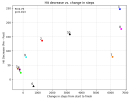
I was curious how change in step count correlates to this antibody change metric. In terms of baseline NK count, the correlation with step change was even stronger than with change in SF-36.

I grabbed the "hit decrease" values from that plot and plotted them against change in steps from start to end of study. Interestingly, it's a weaker correlation in this case (R=0.75, p=0.013):
1778536510902.png

@Tyler Hulett Do you know how specifically the SF 36PF Delta is calculated in that plot above?
 
I think because of the correlation with improvement. which provides a bit more evidence that it's the antibody depleting mechanism of dara that is relevant to improvement. Before, we knew that the more NK cells someone had, the more they improved, but we couldn't be sure that the people with more NK cells were actually able to kill more plasma cells.

I don't fully understand the technology, but that plot shared previously seems compelling:


I was curious how change in step count correlates to this antibody change metric. In terms of baseline NK count, the correlation with step change was even stronger than with change in SF-36.

I grabbed the "hit decrease" values from that plot and plotted them against change in steps from start to end of study. Interestingly, it's a weaker correlation in this case (R=0.75, p=0.013):
View attachment 32282

@Tyler Hulett Do you know how specifically the SF 36PF Delta is calculated in that plot above?
It’s change in score from baseline to month 12 - as I understand it. I have of course also done correlation to steps, etc and yes not as good. Also other metrics like baseline autoab. What is plotted is the cherry-picked best correlation of several tested things and directions so take with that caveat but it is a clean simple metric. And all trends support the same general story for now. Wish I could show the summary plot of all the other correlations that is the best one. The real test will be whether this reproduces or not on the larger study. The N is so so small…

My personal intellectual excitement is a bit beyond this room and group - I think these autoab signatures matter a great deal (I am also in the middle of several other studies from lupus, TBI, schizophrenia, cancer, etc - other scientists think these profiles matter and bring these studies to us) - and I think for some of them (maybe including ME/CFS) could really benefit from an “autoantibody profile reset therapy” like CD38 seems to partially provide in this data. It’s also simpler than BCMA CART another approach being tested.

Also this is not “my data” (my lab generated it under contract, using technology we build, and I have done most of the analysis) - but I can only comment right now on what was presented publicly. I’ve already prepared a stack of other figures which would be very useful to bring into this discussion and perhaps it has made me argumentative because I have additional data to support some of my claims / comments here but I unfortunately cannot yet share them.
 
It’s change in score from baseline to month 12 - as I understand it.
Thanks. Maybe I'm looking at the wrong data, or it's been updated? In the Table 1 spreadsheet file from the paper supplementary files, only some of the participants have an SF36 score at week 52. If I subtract Week -12 from Week 40 (so still 12 months, but it's the latest point where everyone has data), the calculated delta doesn't match the plot for a few of the participants.
 
Thanks. Maybe I'm looking at the wrong data, or it's been updated? In the Table 1 spreadsheet file from the paper supplementary files, only some of the participants have an SF36 score at week 52. If I subtract Week -12 from Week 40 (so still 12 months, but it's the latest point where everyone has data), the calculated delta doesn't match the plot for a few of the participants.
Maybe just been updated as trial wasn’t as far out yet? Everything I plotted was in a table direct from them I just layered on top of my antibody stuff - got that spreadsheet in March and was not the literal one from paper. I can ask am meeting with Bergen team tomorrow.
 
All this needs to be replicated again, in the P2. Assuming blood samples can last a a long way... having 60 more samples or data points would really help prove or disprove anything.
 
It’s change in score from baseline to month 12 - as I understand it. I have of course also done correlation to steps, etc and yes not as good. Also other metrics like baseline autoab. What is plotted is the cherry-picked best correlation of several tested things and directions so take with that caveat but it is a clean simple metric. And all trends support the same general story for now. Wish I could show the summary plot of all the other correlations that is the best one. The real test will be whether this reproduces or not on the larger study. The N is so so small…

My personal intellectual excitement is a bit beyond this room and group - I think these autoab signatures matter a great deal (I am also in the middle of several other studies from lupus, TBI, schizophrenia, cancer, etc - other scientists think these profiles matter and bring these studies to us) - and I think for some of them (maybe including ME/CFS) could really benefit from an “autoantibody profile reset therapy” like CD38 seems to partially provide in this data. It’s also simpler than BCMA CART another approach being tested.

Also this is not “my data” (my lab generated it under contract, using technology we build, and I have done most of the analysis) - but I can only comment right now on what was presented publicly. I’ve already prepared a stack of other figures which would be very useful to bring into this discussion and perhaps it has made me argumentative because I have additional data to support some of my claims / comments here but I unfortunately cannot yet share them.

My worry is that if it’s nothing to do with NK cells, then it could really just be pure luck whether the Dara hits the bad LLPC or not. Even with say the same amount of NK cells you could have one patient where the Dara molecules attach to the bad LLPC and one patient where it misses it

Or worse the Dara attaches to the cd38, but the NK cell is not there to kill.
 
Last edited:
Here is the figure I am referring to which FM shared.


We can note that 05 had no reduction in hit decrease which actually tells us she was a placebo responder, and this correlates as the SF36 bounced up and down but step count did not.

07 is a responder, 09 is not, but my guess is the trend is so strong its likely due to the type of aabs that were hit. Clearly 07 hit the right ones, 09 did not. Nonetheless, the trend is quite decent.

So there is alot of work to be done finding out which are the antibodies causing the problem. Problem is p >> n but if P2 bloods can be use we have n=60 which is quite an upgrade.
View attachment 32259

Would love to see this kind of analysis for an IA trial.

EDIT:
Do you happen to have the previous slide as well? Because if I recall correctly, it was not the more antibodies, the sicker you are, but the more they decrease, the better you feel.

EDIT2:
I now realize that might actually be what Sawitsky tried with her clustering. I couldn't watch the talk, just see the slides.
 
Last edited:
I think because of the correlation with improvement. which provides a bit more evidence that it's the antibody depleting mechanism of dara that is relevant to improvement. Before, we knew that the more NK cells someone had, the more they improved, but we couldn't be sure that the people with more NK cells were actually able to kill more plasma cells.

I think this is a cogent point. When I saw the claim that improvement after rituximab correlated with a fall in anti-GPCR antibodies I was unimpressed by that as evidence for anti-GCPR being important. We can see they aren't from the initial levels in patients and controls.

But, as for the NK cell number data, it does lend some support to the idea that antibodies are contributing to mediation of symptoms. In other words that F&M are on the right track in broad terms. That is not trivial, even if it is another piece of soft data.

But one possibility here is that antibodies in general, or perhaps certain subtypes, are one of the things that can feed signals in to hyper-responsive neuro-immune pathways and that ME/CFS is the hyper-responsiveness, not the antibodies. Maybe normal spectra of antibodies contribute to making people with the neuroimmune signalling problem, just as light and touch do. In a way that is what we proposed in the Qeios paper.

One possibility is that over time we accumulate an increasing number of 'dirty' antibody species in our long lived plasma cell compartment and that a dose of Daratumumab is like a spring clean. It does nothing to the ME/CFS state per se but makes life easier for the person with ME/CFS. The received wisdom has been that antibodies only do harm if they are directed against specific self antigens. But a wide spectrum of apparent autoantibodies does not fit with generating one type of illness. Each autoantibody we know of that goes with a disease has a separate clinical syndrome. What I think people forget is that antibodies bind to other things - like Fc receptors - and can interact with molecular shapes that are not strictly either self or foreign. Anti-citrullinated protein antibodies are a good example. The antibody recognises a degradation of lots of proteins.

Modern lab science focuses a lot on what you can measure and generate vast banks of data but almost of all of those data tell us nothing useful. Having seen knowledge of autoantibodies develop from the findings of my departmental mentors, like Doniach and Roitt, to the highly detailed findings on variious anti-synthetase antibodies in myositis and spent hours pouring over pharmacodynamic profiles of VH gene usage in rheumatoid patients I am sceptical that broad profiles of ubiquitous low level autoantibodies will tell us much.
 
How do you square that with the fact that the 5 dara pilot improvers are still in remission years later according to Fluge? Surely if it is as you hypothesise here the improvement would be partial...

People can get better and, despite the apparent unlikelihood, they do get better following treatments that we don't think work. In other words this may have been a coincidence or the sort of trial unpredictables we know we have to take into account. But I agree that it doesn't fit well. It raises the possibility that the neuroimmune hyper-responsiveness can switch back to normality with a reduction of input antibody noise. That input noise may still be normal noise
 
It raises the possibility that the neuroimmune hyper-responsiveness can switch back to normality with a reduction of input antibody noise. That input noise may still be normal noise

That might fit with the significant changes in illness severity (i.e., level of hyper-responsiveness) that seem to be reasonably common, and the spontaneous remissions experienced by a minority who're not on any kind of treatment.

People have experienced rapid and sustained improvement for no apparent reason, but something must have shifted to produce such a dramatic result.
 
People can get better and, despite the apparent unlikelihood, they do get better following treatments that we don't think work. In other words this may have been a coincidence or the sort of trial unpredictables we know we have to take into account. But I agree that it doesn't fit well. It raises the possibility that the neuroimmune hyper-responsiveness can switch back to normality with a reduction of input antibody noise. That input noise may still be normal noise
I think we can rule out the placebo effect here..
 
Not possible to go from 2k to 8k steps over a year lol. You only know this if you experience it

That is non sequitur. Experience can only provide insight into the dynamics of your own illness. How heterogeneous ME/CFS is, nobody knows. We have seen people going back to full time work from being housebound after treatments that none of us now believes have any specific therapeutic effect. I think Jen Brea recounted about three miracle cures in her case, ranging from antivirals to surgery or whatever.
 
That is non sequitur. Experience can only provide insight into the dynamics of your own illness. How heterogeneous ME/CFS is, nobody knows. We have seen people going back to full time work from being housebound after treatments that none of us now believes have any specific therapeutic effect. I think Jen Brea recounted about three miracle cures in her case, ranging from antivirals to surgery or whatever.
If you know the case you do realize she didn’t have ME CFS. Someone actually did a deep dive here and explained. But that’s beside the point.

Now, we have actually seen what happens in a placebo style effect or even a temporary response. The green line. The fact that the numbers went up then down tell you a lot. That is how a placebo would look like.
 
Back
Top Bottom