Risks for Developing ME/CFS in College Students Following Infectious Mononucleosis: A Prospective Cohort Study, 2020, Jason et al

I'm not sure if I've understood your question.

The group is selected based on those meeting the category at 6 months, e.g. S-ME/CFS at 6 months. The scores at baseline and IM (the single measurement point within 6 weeks of symptom onset) are the scores at those timepoints for those that end up in the 6-month category. So things works backwards from the selection at 6 months.

Let me know if this isn't what you asked
Hi Simon, I got that part. Maybe I misunderstood the study, but I was wondering if similar data existed for the groups that are being classified by diagnostic criteria without working backwards 6 months after IM infection. For example I was wandering how many people in the whole student population (including those that never developed IM) would be in the S-ME/CFS group at time 1 to get a feel for how this matches other prevalence estimates and I thought something similar for the ME/CFS group would be interesting to get a hunch at how often Fukuda might be diagnosing problems not necessarily related to IM or ME/CFS. Does that data exist?
 
Last edited:
What's the true rate of ME/CFS post IM? (2)

The three other studies I mentioned earlier all have ME/CFS post-IM rates of about 12%. But looking more carefully, they also support higher rates.

1. Katz, 2009 ME/CFS post mono in adolescents
Published rate 13%, corrected rate 17%, Canadian criteria (probably).

13% is an uncorrected figure that does not adjust for losses:.

The study diagnosed 39 cases out of 301 people they tried to contact. However, they were only able to contact 286 (95%) and of the 70 people (24%) of people who did not recover fully, 53 (76% of these) were clinically assessed. 39 of those assessed (74%) were diagnosed with ME/CFS. Correcting for losses, 39/(286x 76%)= 17% of IM cases resulted in ME/CFS at 6 months.

Criteria and thresholds for fatigue and function
"We used the Jason et al. (15) revision (PDF) of the Fukuda (1) criteria to diagnose CFS." Looking at this reference, it appears to be a paediatric implementation of the Canadian criteria, with mandatory components, unlike Fukuda.

Fatigue is assessed by a 7 item frequency and 7 item severity scale, requiring a score of at least 4 on both. Every study seems to have its own approach to assessing fatigue. This seems reasonable. I'm not sure how function is assessed, but there doesn't seem to be a specific scale for consistency.

Overall, the 17% seems reasonable. If these are Canadian criteria (views?), then this 17% would be comparable with the 8% for S-CFS, since almost all ME/CFS cases are Fukuda only. On the other hand, the 23% for the Jason study is significantly higher, and the posts above suggest it includes non-ME/CFS cases. Things look a bit muddy or inconsisent to me.

Comments on Dubbo & Pedersen studies to follow (spoiler: I'm not sure we have any figures we can truly trust).
 
Hi Simon, I got that part. Maybe I misunderstood the study, but I was wandering if similar data existed for the groups that are being classified by diagnostic criteria without working backwards 6 months after IM infection. For example I was wandering how many people in the whole student population (including those that never developed IM) would be in the S-ME/CFS group at time 1 to get a feel for how this matches other prevalence estimates and I thought something similar for the ME/CFS group would be interesting to get a hunch at how often Fukuda might be diagnosing problems not necessarily related to IM or ME/CFS. Does that data exist?
No. Diagnosis involves clinical examination, and was only done for those who didn't recover from IM. But it is an interesting point.

The prevalence of ME/CFS of people under 20 (almost all in this stiudy) is probably aboiut 0.3%, and I doubt many of those are able to attend university. I would be very interested to know how many of the S-ME/CFS group would have qualified for it at baseline, givem that about half had moderate fatigue then, and their symptom rate was high (marginally higher than the ME/CFS group at 6 months (21.2 vs 19.6).
 
No. Diagnosis involves clinical examination, and was only done for those who didn't recover from IM. But it is an interesting point.

The prevalence of ME/CFS of people under 20 (almost all in this stiudy) is probably aboiut 0.3%, and I doubt many of those are able to attend university. I would be very interested to know how many of the S-ME/CFS group would have qualified for it at baseline, givem that about half had moderate fatigue then, and their symptom rate was high (marginally higher than the ME/CFS group at 6 months (21.2 vs 19.6).
Thanks!
 
What's the true rate of ME/CFS post IM? (3: Dubbo)

Dubbo (Hickie,
2006) Post-Infective Fatigue Syndrome and CFS post mono, Q fever and Ross River Virus
Published rate 11% Fukuda CFS and 12% for Post-Infective Fatigue Syndrome, PIFS
35% PIFS for the self-report-only cohort (not clinically assessed).

253 people with positive infection tests became study participants with cliical assessment and blood tests, and a further 177 agreed to take part through self-report only.

29 (12%) of study participants were identified as provisional post-infective fatigue syndrome (PIFS), and 28 of these (11%) were clinically assessed as having CFS. By contrast, 35% of the self report cohort nnnnn were identified as having provisional post-infective fatigue syndrome (PIFS), but these were not clinically assessed. This group also reported higher levels of disability at 6 months.

There is no clear explation of why the PIFS rate was roughly 3x times higher in the self-report group than those assessed. Perhaps the authors didn't understand this finding - they didn't mention it in the abstract. O

(One possibility is that those who didn't agree to be assessed were more sick than those who did, but the study reported only a non-significant trend towards higher baseline symptom scores and worsened disability parameters.)

So, Dubbo gave an unremarkable 11% rate of CFS after 3 different infective agents in its main cohort, but an unexplained much higher rate in the self report one.
 
Trying to work out the make up of the ME/CFS group (I)
OK, I have done my homework @Simon M! My brain is not working very well, so I have not done it as well as I would like, but hopefully it will still contribute to the conversation.

I agree with you that it is worth exploring the higher prevalence of ME/CFS at 6 months following infection reported in Jason 2020 compared to Katz 2009, Hickie 2006 and Pedersen 2019. Jason 2020 themselves write:
Another difference between our study and previous reports [2–5] was the high rate (23%) of ME/CFS following IM; this may be related to very close surveillance in our confined population of college students or high levels of baseline fatigue seen in college students [33].

Putting aside their proposed explanations for now, I think you’re right that the questions used to establish substantial reduction in functioning would allow people who do not have ME/CFS to meet the threshold. However, I'm not convinced that there is a threshold that can be established from questions like that, that would distinguish people who are recovering from IM slowly from people who have been ME/CFS'd.

I think you’re right that the “(moderate) ME/CFS” group in Jason 2020 is likely composed of a mix of those with ME/CFS and other chronic fatigue, and that that may have artificially boosted the prevalence in Jason 2020. Your figures in post 55 showing the baseline fatigue/DSQ etc of each group is particularly helpful here, though knowing what’s going on is a bit more complicated. Is there a premorbid subclinical difference between people who go on to develop ME/CFS and those who do not? Are some actually prodromal without knowing it? Or overexerting?

Having looked at all of the papers, I wonder if the problem starts further back, namely with the decision to give an ME/CFS diagnosis to people who fulfill any of these criteria: Fukuda/IOM/Canadian. I’ll walk through my thinking on this.

Jason 2020’s methodology was most similar to that of Katz 2009 – unsurprising, as Katz was in both teams. Both studies had no initial exclusion criteria - meaning if you got IM, you were in, regardless of what other health issues you brought with you - a telephone screen at 5-6 months, and then a clinical examination of those not recovered.

In the telephone screen stage, in Jason 2020, 34.0% (81/238) were considered not fully recovered or had symptoms at 5 months vs 24.5% (70/286) at 6 months in Katz 2009.

In Jason 2020, 32.1% (26/81) had symptoms but were not considered to have Fukuda, IOM or Canadian-ME/CFS with substantial reduction in functioning, vs 44.3% (31/70) with symptoms but not considered to have Jason’s revision of Fukuda-CFS in Katz 2009. One possibility is that it was easier to get a diagnosis in Jason 2020, because you could get it with IOM criteria alone.

Edited to add this bit which somehow hadn't copied over:

In Jason 2020, we get no breakdown of how many met each set of criteria. All we know is this:
Note that in most cases the ME/CFS group only met the Fukuda criteria [20], while the S-ME/CFS group always met the Fukuda criteria [20] and either the Canadian [21] or IOM [22] criteria.
“Most” could mean anything from 51%-99%. So clarification from the authors on how many cases were diagnosed by IOM criteria alone (and Canadian criteria alone) would be welcome, as it would outrule one possible reason for the higher prevalence in Jason 2020.

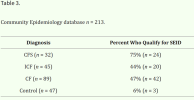
The IOM criteria have been demonstrated, by Jason’s team (Jason 2015), to be met by hefty proportions with other disorders:
33% with MS, 47% with lupus, 27% with major depression, 44% of those with idiopathic chronic fatigue not meeting Fukuda criteria and 47% with chronic fatigue due to other disorders.

The last two figures there are the most relevant for this case. You can see from this table that chronic fatigue that does not meet Fukuda criteria is extremely common:
1774613395670.png

Now, you can argue that anyone with those disorders would be weeded out by the physician assessment at 6 months. But establishing many of those alternative diagnoses would require a lot of consulations, and they might be in the early undiagnosable stages in college students. By contrast, Pedersen 2019 excluded 125 people with IM right off the bat, before they even entered the pool for the study:
Exclusion criteria were a) more than 6 weeks since debut of symptoms suggesting acute EBV infection; b) Any chronic disease that needed regular use of medication; c) Pregnancy.

In the Jason 2015 study just discussed:
A team of four physicians and a psychiatrist were responsible for making a final diagnosis with two physicians independently rating each file using the current U.S. case definition of CFS [2]. Where physicians disagreed, a third physician rater was used [3].

In Jason 2020, participants had “a comprehensive medical and psychiatric examination”, but we don’t get granular information on how many were diagnosed with other conditions, or how many fulfilled each set of criteria, or how many fulfilled certain criteria but were ruled out on the basis of not meeting reduced functioning thresholds, which would help us answer the questions you and I have raised.

Getting back to Katz, 12 of those 31 [from this figure 44.3% (31/70)] with symptoms but not considered to have Jason’s revision of Fukuda-CFS in Katz 2009 refused assessment, and one couldn’t do it in the right timeframe, so in theory, Katz’s prevalence could have been higher. For example, if 6 of them were diagnosed, then Katz’s prevalence would have been 15% (39+6)/301. [I see you covered this in a later post.]

What’s a bit tricky is that Katz 2009 accounts for each individual, but Jason 2020 does not. Here’s Katz et al.’s account:

Based on the screening interview, 70 of these adolescents (24%) were assessed as not fully recovered. A clinical evaluation was completed on 53 (76%) of these 70 not fully recovered adolescents; 12 refused, 3 had exclusionary diagnoses (primary depression, transverse myelitis, anorexia) and 2 did not meet study criteria (the fatigue predated the IM or the subject was not able to complete the 6 month evaluation in a timely fashion)…

Following the 6 month clinical evaluation, 39 of the 53 not fully recovered subjects who underwent clinical evaluation were classified as having CFS (13% of the original sample of 301 adolescents)…

Among the 14 other subjects completing the 6 month clinical evaluation, 1 had recovered between the time of the phone interview and the time he/she was seen in Clinic and 13 were classified as CFS explained (1 abused drugs, on more careful questioning 1 subject’s fatigue predated the mononucleosis, 1 had an eating disorder, 1 had an unrelated medical illness, 6 had underlying psychiatric diagnoses, 2 had psychiatric and sleep disorders, and 1 had an intercurrent acute parvovirus infection following IM, so symptoms could not be solely explained by infectious mononucleosis).

In Jason 2020 we don’t get that breakdown.

So I think it’s possible that some relatively small differences in how many alternative explanations were identified and considered exclusionary, and the ease of fulfilling IOM criteria with those unidentified alternative explanations, could contribute to a larger group being given the label ME/CFS than is warranted.

I'll have to come back to the explanations Jason et al. propose when brain working better.
 
Last edited:
Some other Jason studies have very relevant info. They’re all on people who already have a clinical diagnosis of ME/CFS.

From Jason 2015b:
Of the 795 [ME/CFS] patients in the study, 70.2% met both IOM and Canadian, 18.1% only met the IOM criteria, 11.1% met neither criteria, and 0.6% met the Canadian criteria but not the IOM criteria.
So most of those patients would be in Jason et al. 2020's "severe" group. I'm guessing that an even higher percentage would meet Fukuda + (IOM or Canadian). But there's a chunk meeting only IOM. They would be of significantly longer duration than 6 months.

Jason 2017 is relevant to severity:
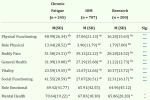
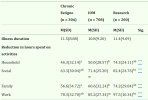
58.4% (n = 708) met the IOM criteria, but were not homebound. This group is referred to as the IOM subgroup. 16.5% (n = 200) met the IOM criteria and were homebound. This group is referred to as the Research subgroup. The remaining 25.1% (n = 304) did not meet the IOM [9] criteria. This group is referred to as the Chronic Fatigue subgroup.

So the “Research” column in the table below refers to patients who both fulfil the IOM criteria and are homebound.
1774614048726.png

It would help if we had that breakdown for the Jason 2020 cohort.
 
The authors reported no statistically significant result at time 1 for anxiety (BAI questionnaire) and depression (BDI-II) but I think this is because they arbitrarily split the ME/CFS group into two. I believe that if the 49 ME/CFS patients were taken as a whole and compared to the recovered control group, many of the baseline values would show a statistically significant difference as the difference are quite obvious (see calculations below).
Now to come back to @ME/CFS Science Blog's point, which is that Jason's entire ME/CFS cohort would have had statistically higher anxiety and depression at baseline than controls.

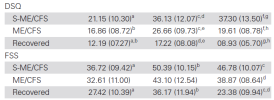
@Simon M has demonstrated above that despite similar Physical Component Scores, those who fulfilled one or more sets of ME/CFS criteria at 6 months in Jason 2020 had worse fatigue and De Paul Symptom Questionnaire scores at baseline than those who recovered, with that being particularly true of those who fulfilled more than one set of criteria (Fukuda/IOM/Canadian). In other words, there was something amiss at baseline.

As a reminder, here are the figures.
The columns are Group - Time 1 (before IM) - Time 2 (within 6 wks of IM diagnosis) - Time 3 (6 months after IM)

1774623424952.png

So before getting IM, were those with 2xcriteria-ME/CFS and at least some with 1xcriteria-ME/CFS already brewing what would go on to be ME/CFS once triggered? Or were some of them depressed/anxious? And others not leading a healthy lifestyle e.g. not sleeping enough, not eating well, partying too much, studying +/- working too much?

The real question is whether the relationship would persist if the potential problems with the 1xcriteria-ME/CFS group identified by @Simon M were sorted.
 
Back
Top Bottom