
You are using an out of date browser. It may not display this or other websites correctly.
You should upgrade or use an alternative browser.
You should upgrade or use an alternative browser.
PEM discussion thread - post-exertional malaise
- Thread starter JaimeS
- Start date

Jonathan Edwards
Senior Member (Voting Rights)
I think it confirms that subjective sense of how much one has exerted is not causative in any way for the eventual development of PEM. It doesn’t matter how much activity my brain “thinks” I did.
But surely there is likely to be a difference between what you think you did and what certain parts of the brain think you did. Inferences in the brain go through many stages and the most accurate ones tend not to be the ones that we can give a conscious account of.
Because those of us who have experienced the milder end of the spectrum know quite well that PEM does not happen without actual activity.
But what about PEM after emotional or other mental events? In what sense does one know there is 'activity' other than the subjective sense that one did something.
I am afraid I find all these accounts inconsistent. Clearly I don't have the subjective experience to draw on but within the thread there are opinions all over the place it seems. And the task is to find something other than a subjective account of 'I know how it works', surely.
Jonathan Edwards
Senior Member (Voting Rights)
I have to object that calories per hour is a biologically coherent concept either. Calories in a biological context are inherently an estimation, not necessarily indicative of anything actually happening at the molecular level.
Absolutely.
I don’t think that the search for an objective marker of “exertion” will be fruitful, but not because it’s an empty concept—simply because it encompasses hundreds of various changes, any one of which individually is insufficient to represent the whole.
Which basically means that it is scientifically a useless concept? And that all we have is the subjective sense of 'doing'.
If what we are trying to pin down involves hundreds of various changes isn't it unlikely to be anything as simple as 'using energy' and much more dependent on signals that the body uses to tell itself that some rest might be needed to avoid injury - or something of that sort?

jnmaciuch
Senior Member (Voting Rights)
sure, maybe. I don’t see any reason to invoke an unknown mechanism of “brain accounting” in PEM, though. We’ve been through this before, I don’t think it’s particularly useful to rehash.But surely there is likely to be a difference between what you think you did and what certain parts of the brain think you did. Inferences in the brain go through many stages and the most accurate ones tend not to be the ones that we can give a conscious account of.
We’ve hashed this out before as well. There are absolutely cognitive tasks that would be more metabolically demanding than others. And there are tons of ways for brain activity to lead to a biological state that needs to be recovered from even if it doesn’t look exactly like what’s happening in skeletal muscle.But what about PEM after emotional or other mental events? In what sense does one know there is 'activity' other than the subjective sense that one did something.
I think people generally speak of using energy as a short hand for those hundreds of changes. Certainly signaling pathways are involved. But they are also signaling pathways that are directly intertwined with the processes of generating and using ATP and all the related upstream/downstream processes. The byproducts of metabolism are themselves the intermediaries of those signals in every single case.If what we are trying to pin down involves hundreds of various changes isn't it unlikely to be anything as simple as 'using energy' and much more dependent on signals that the body uses to tell itself that some rest might be needed to avoid injury - or something of that sort?
So I agree that talk of using energy is overly simplistic if one is trying to use that term literally—but I don’t think anyone who has knowledge of metabolism is using it in that way. And I think it is a useful shorthand unless you want us to start listing processes involving several hundred metabolites every time I want to speak on the semantic concept of physical or cognitive activity.

poetinsf
Senior Member (Voting Rights)
Allow me to pile on. That PEM is difficult to predict -- because it is complicated with multiple factors -- doesn't have mean it is subjective. When people couldn't predict weather, they thought it was subject to God's whim and prayed. Now we predict weather, often 7 days out with amazing accuracy.Which presumably confirms just how subjective the whole thing is?
People in severe/moderate stage are like ISO 256000 film. They are sensitive to all kinds of signals and noises making it hard for them to make out the picture. People in mild/recovering stages, with their sensitivity lowered to 3000 or less, have better luck. I for example have "prediction" column in my activity log and my TSLD (time spent lying down) is usually within 1 hour of the prediction. How I feel in the morning often turns out wrong and TSLD tracks the prediction instead of how I feel in the morning.
poetinsf
Senior Member (Voting Rights)
Responding to deleted post saying that calories are inherently an estimation, and not necessarily an indicator of molecular mechanisms.
You could be missing the point by focusing too much on molecular level. You can view exertion, or damage from it, at macro level simply as something that you need recovery from. And the damage could be modeled as a function of Metabolic Equivalent of Task (cal/time) which is the standard measure for intensity of activity.
You could be missing the point by focusing too much on molecular level. You can view exertion, or damage from it, at macro level simply as something that you need recovery from. And the damage could be modeled as a function of Metabolic Equivalent of Task (cal/time) which is the standard measure for intensity of activity.
Last edited by a moderator:

Sorry if I have missed it, but how do you calculate your prediction?I for example have "prediction" column in my activity log and my TSLD (time spent lying down) is usually within 1 hour of the prediction. How I feel in the morning often turns out wrong and TSLD tracks the prediction instead of how I feel in the morning.
poetinsf
Senior Member (Voting Rights)
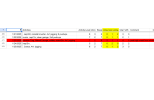
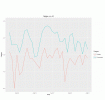
At the recovery stage I'm in now, I don't need to look back too far to predict my fatigue level; I can predict by what I did today and still be fairly accurate. (In the first pic, you see that the red row that is out of whack from the prediction which constitutes a crash). Before, however, I had to look back 3 days prior for the total of 4 days of accumulation (d4 in the second pic from 2015). I was less successful back then even with the aid of s/w.Sorry if I have missed it, but how do you calculate your prediction?
Last edited by a moderator:

poetinsf
Senior Member (Voting Rights)
I'm not quite sure what you are asking, but I predict my fatigue level (in terms of TSLD or time spent lying down) and I usually try to stay below 2 hours or less. But I don't always stick to it; I regularly do more (and predict higher fatigue), like going on a biking or taking 20,000 steps in NYC. I pay the price, but consequence is obviously not as devastating now as it used to be. Back in 2015, I was spending 7-8 hours lying down and tried to stay below 5 on my subjective scale. (5 used to mean that I was able to do the dishes back then).@poetinsf is this a recovery stage or predicting and staying within your threshold and adding a little 'wait and see' prediction.
poetinsf
Senior Member (Voting Rights)
It's probably a whole separate topic. I've been postponing it till I get it to a publishable shape. I'll have to restore it to working form, deposit it in GitHub or something with a paper explaining the model, so that others can test it. It's probably no more than a meaningless hand-waving till then. In a gist though, I compute the "stress" at any given moment by adding up the cumulative effect of calorie expenditure (exponentially aged according to the half-life) and then "damage" for working against that stress. (Stress level goes up and down with activity/rest, but the damages pile up). 4 days' worth damages are then added up to make the forecast.Thanks for the pictures @poetinsf. Can you explain a bit more how you calculate the prediction?
If you are well enough, the activity log could be enough to estimate the "damage". But that's not going to apply to the majority of the patients because most of them are too sensitive and the estimates are too crude. It also takes some "ear training", to get good at estimating the activity level. I estimate the activity level on an exponential scale. 30 minutes of slow walk equals 5, for example. 2x8 pushups in the evening pushes up the level to 6. Do twice as much, it is 7 and so on. Then the activity level and how well I feel today predicts how I'm going to feel tomorrow. It's more of an experience-based art than science.
I've also fiddled with using MET table rather than relying on fitbit. Fitbit can only discern about half a dozen activities, mostly for healthy people, like walking, biking or skiing. It needs to discern dozens ADLs, like washing dishes, for it to be truly useful for ME/CFS. Just relying on wrist motion and heart rate is too crude and inaccurate. You can manually configure dozens of ADLs in MET table and then use those values to compute the damage for activities from the activity log. But that's too complex for average people, let alone ME/CFS patients suffering brain fog. So I left that just as a proof of concept.
Thanks @poetinsf. Clearly predicting PEM/a crash is really complicated, but I agree it's a puzzle no more complicated than weather forecasting. If we could crack it, if we could make fairly good predictions, I think the model would give us some clues about the pathology. It just takes a lot of data and insight.
What do you think about my idea that adrenalin may be contributing to PEM - not necessarily because adrenaline levels are unusual, but because of downstream impacts which at some point are not normal? Do you think that novelty or a time sensitive activity can initially improve capacity but contribute to PEM? Same for caffeine, nicotine, other stimulants, things that are exciting in a good or bad way, being upright, having an infection? Do you think those sorts of things that increase adrenalin might account for the times when your normal calculations of the impact of activity level don't give a good prediction?
What do you think about my idea that adrenalin may be contributing to PEM - not necessarily because adrenaline levels are unusual, but because of downstream impacts which at some point are not normal? Do you think that novelty or a time sensitive activity can initially improve capacity but contribute to PEM? Same for caffeine, nicotine, other stimulants, things that are exciting in a good or bad way, being upright, having an infection? Do you think those sorts of things that increase adrenalin might account for the times when your normal calculations of the impact of activity level don't give a good prediction?

Peter T
Senior Member (Voting Rights)
@poetinsf, it is interesting to read of your approach to predicting PEM. I am currently struggling to hold enough information to be sure I understand what you say, welcome finding out more. (Sorry, what follows has become something of a ramble.)
When I spent a year recording all my activity in fifteen minute blocks, it helped me understand some of my patterns and highlighted some of the things I needed to consider when predicting PEM. It also helped me focus on looking for reasons why previous activity failed for me as a predictor. The big thing to come out of this for me was identifying some of my food intolerances. This was some twenty years ago when wearable devices were less common, and certainly now being more severely impaired I would not have the capacity to devote the amount of energy/time to doing something like this without it interfering with self care activities.
Also when I undertook this I was not aware of orthostatic issues, which now helps me in my informal subjective guesstimates for predicting future PEM. And I still have some unexpected fluctuation that does not seem to related to previous activity, diet or time spent upright, though for me novelty of an activity and concurrent sensory load seem also relevant. So your attempt to quantify effort is particularly interesting.
Your process of producing a combined score gives a figure that makes testing predictions more practical, but does it also make it harder for an individual to tease out individual components which needs to happen if they are to change behaviour to minimise triggering PEM. From my previous experience I would want it to be possible to break down any combined score into contributing components. If I was following on from my previous approach I would want to separate out previous activity, diet, sensory load, time upright and cognitive demands. So that you have the simple visual of a spike in one being followed predictably but a trough in activity being indicative of some form of causation.
We need a good observational study of activity patterns in people with ME/CFS that could then serve as a baseline for looking at what then results in triggering PEM or in eliminating as much as possible triggering overall reduction in activity levels. Producing predictive models, then means we can test the hypotheses it is based on.
Having a relapsing and remitting form of ME/CFS I experience periods of increasing activity levels and reducing activity levels that subjectively seem out of my control. All my relapses, even when associated with a new viral infection, were preceded by increases in activity, but I can not unambiguously conclude a causal relationships as I can not rule out some underlying fluctuation in a biological disease process unrelated to my activity levels, given by definition any relapse is preceded by a remission which inherently involves increased activity.
If we discover the underlying biological processes and have a treatment this becomes redundant, but until then being able quantify the relationship between activity levels/types and the future course of your condition, enables us to be clearer in advising on rest, pacing, etc. which in turn means new patients don’t have to spend the years or in my case decades learning how to manage their activity to minimise PEM and/or deterioration.
For most people ongoing activity monitoring would be an unhelpfully burden, but withe the right model and appropriate wearable devices, intermittent auditing for a week or a fortnight might be practical.
When I spent a year recording all my activity in fifteen minute blocks, it helped me understand some of my patterns and highlighted some of the things I needed to consider when predicting PEM. It also helped me focus on looking for reasons why previous activity failed for me as a predictor. The big thing to come out of this for me was identifying some of my food intolerances. This was some twenty years ago when wearable devices were less common, and certainly now being more severely impaired I would not have the capacity to devote the amount of energy/time to doing something like this without it interfering with self care activities.
Also when I undertook this I was not aware of orthostatic issues, which now helps me in my informal subjective guesstimates for predicting future PEM. And I still have some unexpected fluctuation that does not seem to related to previous activity, diet or time spent upright, though for me novelty of an activity and concurrent sensory load seem also relevant. So your attempt to quantify effort is particularly interesting.
Your process of producing a combined score gives a figure that makes testing predictions more practical, but does it also make it harder for an individual to tease out individual components which needs to happen if they are to change behaviour to minimise triggering PEM. From my previous experience I would want it to be possible to break down any combined score into contributing components. If I was following on from my previous approach I would want to separate out previous activity, diet, sensory load, time upright and cognitive demands. So that you have the simple visual of a spike in one being followed predictably but a trough in activity being indicative of some form of causation.
We need a good observational study of activity patterns in people with ME/CFS that could then serve as a baseline for looking at what then results in triggering PEM or in eliminating as much as possible triggering overall reduction in activity levels. Producing predictive models, then means we can test the hypotheses it is based on.
Having a relapsing and remitting form of ME/CFS I experience periods of increasing activity levels and reducing activity levels that subjectively seem out of my control. All my relapses, even when associated with a new viral infection, were preceded by increases in activity, but I can not unambiguously conclude a causal relationships as I can not rule out some underlying fluctuation in a biological disease process unrelated to my activity levels, given by definition any relapse is preceded by a remission which inherently involves increased activity.
If we discover the underlying biological processes and have a treatment this becomes redundant, but until then being able quantify the relationship between activity levels/types and the future course of your condition, enables us to be clearer in advising on rest, pacing, etc. which in turn means new patients don’t have to spend the years or in my case decades learning how to manage their activity to minimise PEM and/or deterioration.
For most people ongoing activity monitoring would be an unhelpfully burden, but withe the right model and appropriate wearable devices, intermittent auditing for a week or a fortnight might be practical.
poetinsf
Senior Member (Voting Rights)
Yeah, it's really hard to build a model with all the variables like diet, sensory stimuli and others. Add to that the tolerance variability like you have, it would be next to impossible. No wonder some people think that the PEM triggers are subjective.Your process of producing a combined score gives a figure that makes testing predictions more practical, but does it also make it harder for an individual to tease out individual components which needs to happen if they are to change behaviour to minimise triggering PEM. From my previous experience I would want it to be possible to break down any combined score into contributing components. If I was following on from my previous approach I would want to separate out previous activity, diet, sensory load, time upright and cognitive demands. So that you have the simple visual of a spike in one being followed predictably but a trough in activity being indicative of some form of causation.
I'm dealing with the physical exertion only and treating all others as noises. That will limit the predictive power of the model, but it still sticks out according to my data. I personally think physical exertion is the biggest component for majority of people, at least for those who are not severely ill. For other variables, all I can think of is to record them like you seem to be already doing so that you can look back and guess what triggered PEM. In my experience, just explaining does not lead to ability to predict though, no matter how many times you do it. You have to actually predict, and fail most of the times, to eventually develop the "ear" for it.

Utsikt
Senior Member (Voting Rights)
I don’t think it has been argued that PEM triggers are subjective per se, rather that we don’t have any objective model for them yet.No wonder some people think that the PEM triggers are subjective.
Peter T
Senior Member (Voting Rights)
Looking at multiple variables is a bit of a bootstrap operation, but once you start identifying the relevant variables you can control for them. Now I am managing my food intolerances they can be ignored in any calculation. If I was trying now to quantify activity to predict PEM I would need a measure of time spent upright as orthostatic intolerance has become much more significant over the last ten years when overall I am much worse.
However, your tool is something that could be used by others who may need to tweak it for the aspects important to them, such as OI or sensory intolerances.
However, your tool is something that could be used by others who may need to tweak it for the aspects important to them, such as OI or sensory intolerances.
poetinsf
Senior Member (Voting Rights)
Responding to deleted post asking if poetinsf has any insights regarding adrenaline.
I think I've said this before somewhere, but adrenergic or dopaminergic environment seems to protect me from PEM. Whatever wakes my brain up, including pseudoephedrine and caffeine, seems to help. I remember back in 2012 of having to walk fast with luggage to make the connecting flight. The flight attendants met us at the gate and shoved us through what seems to be about 1km between terminals. I was darn sure that I'd keel over the next day. I didn't. It happened over and over since then.
That said, the response could be different from patient to patient. I have heard of similar experiences from only a few patients; it certainly is not universal by any means. But I keep thinking about norepinephrine/dopamine level being correlated to symptom severity in Walitt's deep phenotyping paper. The level varied in healthy controls as well, but it had no effect on them. So maybe it's possible that norepinephrine/dopamine act like fire retardant against PEM fire. Just something I've been musing about for a while.
I think I've said this before somewhere, but adrenergic or dopaminergic environment seems to protect me from PEM. Whatever wakes my brain up, including pseudoephedrine and caffeine, seems to help. I remember back in 2012 of having to walk fast with luggage to make the connecting flight. The flight attendants met us at the gate and shoved us through what seems to be about 1km between terminals. I was darn sure that I'd keel over the next day. I didn't. It happened over and over since then.
That said, the response could be different from patient to patient. I have heard of similar experiences from only a few patients; it certainly is not universal by any means. But I keep thinking about norepinephrine/dopamine level being correlated to symptom severity in Walitt's deep phenotyping paper. The level varied in healthy controls as well, but it had no effect on them. So maybe it's possible that norepinephrine/dopamine act like fire retardant against PEM fire. Just something I've been musing about for a while.
Last edited by a moderator:
poetinsf
Senior Member (Voting Rights)
Responding to deleted post about high accuracy in predicting symptoms when doing analysis with regression analysis with various lifestyle variables.
0.85 is absolutely phenomenal. I was getting more like 10-40% range on average. But that was still a lot compared to other model including heart rates and plain calorie expenditures. They sometimes gave me negative correlation, lol. That's why I said it stuck out like a sore thumb despite the low correlation. The inaccuracies of fitbit minute-by-minute data contributed to the low score, I'm sure. I was able to raise it to as high as 80% by removing outliers, but that felt like cheating because there usually were more than a few outliers.
The performance of model is likely to vary from people to people. We need to get the model out there for other people to try and see how it performs. A few weeks is probably too short though. I ran mine for almost 2 years, both on monthly basis and in rolling windows. Some windows would come up occasionally with higher correlations of 50% or more. But they were fairly consistent in 10-40% range while other models were about zero.
0.85 is absolutely phenomenal. I was getting more like 10-40% range on average. But that was still a lot compared to other model including heart rates and plain calorie expenditures. They sometimes gave me negative correlation, lol. That's why I said it stuck out like a sore thumb despite the low correlation. The inaccuracies of fitbit minute-by-minute data contributed to the low score, I'm sure. I was able to raise it to as high as 80% by removing outliers, but that felt like cheating because there usually were more than a few outliers.
The performance of model is likely to vary from people to people. We need to get the model out there for other people to try and see how it performs. A few weeks is probably too short though. I ran mine for almost 2 years, both on monthly basis and in rolling windows. Some windows would come up occasionally with higher correlations of 50% or more. But they were fairly consistent in 10-40% range while other models were about zero.
Last edited by a moderator:
poetinsf
Senior Member (Voting Rights)
Yep, that's what I've been saying: a black box approach can provide clues about what's inside the box.Thanks @poetinsf. Clearly predicting PEM/a crash is really complicated, but I agree it's a puzzle no more complicated than weather forecasting. If we could crack it, if we could make fairly good predictions, I think the model would give us some clues about the pathology. It just takes a lot of data and insight.
Actually, that hasn't been my experience. When I'm on the road living in my car, my tolerance boost stays up indefinitely. It's when I return home that I crash before returning to steady state. My guess is that some brain chemicals are protecting me by downregulate brain immune system. Then, when that chemical dips after returning, the bottom falls off. I think it's a similar process as post-trip blue. Dopamine dips when people return from trips and they feel depressed for a few days.Do you think that novelty or a time sensitive activity can initially improve capacity but contribute to PEM?
3.5mg of nicotine boosts me without any adverse effect the next day. Caffeine and Sudafed also works for me without adverse effect. But 7mg nicotine did crash me badly the next day. So, maybe it's about the dosage? Higher dosage could be depleting the natural chemicals leading to crash.Same for caffeine, nicotine, other stimulants, things that are exciting in a good or bad way, being upright, having an infection?