
Peter T
Senior Member (Voting Rights)
Careful observation, careful language.
I second that.

Careful observation, careful language.

A question for those who experience immediate PEM, does your immediate PEM include the features that don’t occur as part of normal fatigue, such as swollen glands, symptoms unrelated to the triggering activity, etc?

Thanks for this. This has helped me to understand my immediate PEM which was most intense naturally in my severer years. I would get an immediate headache, nausea, exhaustion came with it. I don't know whether OI has the exhaustion as well as PEM. I also got immediate aching of sinuses, flu like symptoms (maybe that one was immediate PEM). There were other so many other symptoms but I cannot remember them all right now.If you experience a worsening of orthostatic intolerance with nausea and headache while you are still involved in some exertion does that have to be excluded from the topic of PEM? If you experience these things the next morning for just one day is that to be excluded?


They go into more detail about the onset of PEM on p.79:PEM is an exacerbation of some or all of an individual’s ME/CFS symptoms that occurs after physical or cognitive exertion and leads to a reduction in functional ability (Carruthers et al., 2003). As described by patients and supported by research, PEM is more than fatigue following a stressor. Patients may describe it as a post-exertional “crash,” “exhaustion,” “flare-up,” “collapse,” “debility,” or “setback.”2 PEM exacerbates a patient’s baseline symptoms and, in addition to fatigue and functional impairment (Peterson et al., 1994), may result in flu-like symptoms (e.g., sore throat, tender lymph nodes, feverishness) (VanNess et al., 2010); pain (e.g., headaches, generalized muscle/joint aches) (Meeus et al., 2014; Van Oosterwijck et al., 2010); cognitive dysfunction (e.g., difficulty with comprehension, impaired short-term memory, prolonged processing time)(LaManca et al., 1998; Ocon et al., 2012; VanNess et al., 2010); nausea/gastrointestinal discomfort; weakness/instability; lightheadedness/vertigo; sensory changes (e.g., tingling skin, increased sensitivity to noise) (VanNess et al., 2010); depression/anxiety; sleep disturbances (e.g., trouble falling or staying asleep, hypersomnia, unrefreshing sleep) (Davenport et al., 2011a); and difficulty recovering capacity after physical exertion (Davenport et al., 2011a,b). In some cases, patients experience new symptoms as part of the PEM response. [A patient quote follows]
And here’s what they say about duration/how prolonged PEM is, also p.79:Onset
Although PEM may begin immediately following a trigger, patients report that symptom exacerbation often may develop hours or days after the trigger has ceased or resolved.4 Likewise, some studies have shown that PEM may occur quickly, within 30 minutes of exertion (Blackwood et al., 1998), while others have found that patients may experience a worsening of symptoms 1 to 7 days after exertion (Nijs et al., 2010; Sorensen et al., 2003; Van Oosterwijck et al., 2010; White et al., 2010; Yoshiuchi et al., 2007). The delayed onset and functional impairment associated with PEM also is supported by actigraphy data. ME/CFS participants enrolled in a walking program designed to increase their steps by about 30 percent daily were able to reach this goal initially, but after 4 to 10 days their steps decreased precipitously (Black and McCully, 2005).
The word “delay” does not appear in the Summary or Key Facts documents, but I found one mention of “delay” in the Clinicians’ Guide (not prominent):Duration
PEM is unpredictable in duration, potentially lasting hours, days, weeks, and even months (FDA, 2013; Nijs et al., 2010). After maximal exercise tests, ME/CFS patients experience greater fatigue compared with healthy controls (Bazelmans et al., 2005; LaManca et al., 1999b), and their fatigue and other symptoms last much longer relative to healthy active (Bazelmans et al., 2005) and sedentary controls (Davenport et al., 2011a,b; LaManca et al., 1999b; VanNess et al., 2010). In several studies, healthy controls declared themselves recovered within 24 to 48 hours after physical or cognitive exertion, whereas fewer than 31 percent of ME/CFS subjects had returned to their prestressor baseline state by this time, and as many as 60 percent were still experiencing multiple symptoms after 1 week (Cockshell and Mathias, 2014; Davenport et al., 2011b; VanNess et al., 2010).
PEM may be delayed related to the trigger.
there were very many subjects with ME/CFS and a few CTL subjects whose SSS scores peaked, declined and then went back up again. In such individuals, it is very difficult to ascertain whether or not there is truly a bi-phasic peak in SSS scores in response to a 2-day CPET stimulus. Other patterns we occasionally observed were what appeared to be a delayed onset of PEM symptoms, with symptoms not increasing until days after the 2-day CPET. Such phenomena are difficult to explain with the known acute physiologic responses to acute exercise. One issue could well be that subjects feel recovered, but are not, and thus increase their activities and unwittingly provoke a worsening of symptoms. In addition, external variables beyond our control could increase stress and bring about such symptoms. Controlling rest more rigorously after a 2-day CPET would be difficult and costly. Thus, while there were unquestionably subjects whose SSS scores were higher several days after the 2-day CPET, we conclude that these response curves were most likely noise and variability in external stimuli. Neither the spline curves nor either of the pharmacokinetic models shows even a trace of bi-phasic behavior. If there are such persons, it seems likely that they are reflecting more external variables and personal behaviors rather than normative traits of persons with ME/CFS.
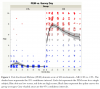

I wonder if the intensity or nature of the exertion might impact the delay. Exercise with a CPET is pretty extreme, and might on average produce a quicker response in terms of PEM compared to less intense exertion. Maybe there is some kind of dose response relationship here.I looked at Moore et al. 2023 again - this is the study from Hanson's group called "Recovery from Exercise in Persons with Myalgic Encephalomyelitis/Chronic Fatigue Syndrome (ME/CFS)" available here https://www.mdpi.com/1648-9144/59/3/571.
It's relevant for this discussion because it focuses on symptoms of PEM rather than physiological correlates of PEM following a 2-day CPET in people with ME/CFS (well assessed by a physician, met CCC criteria and were not doing any regular exercise) and sedentary controls.
The issue of delayed onset only comes up in the limitations part of the discussion (I added the bolding):
So while they saw delayed onset of PEM, it was not the norm. The average pattern was this:
View attachment 25606
I'm actually not sure if the two CPETS were done on days 0 and 1 or days 1 and 2, but I think it was days 0 and 1. I may have missed this in the paper.

I wonder if the intensity or nature of the exertion might impact the delay. Exercise with a CPET is pretty extreme, and might on average produce a quicker response in terms of PEM compared to less intense exertion. Maybe there is some kind of dose response relationship here.
Really good question.A question for those who experience immediate PEM, does your immediate PEM include the features that don’t occur as part of normal fatigue, such as swollen glands, symptoms unrelated to the triggering activity, etc?
Today I went out for lunch with my goddaughter and her family. I drove there myself (30 min each way). This is much more activity than I would normally undertake. When I got back I fell asleep for three hours and at present I feel tired, a little achy including a mild headache, a little bit befuddled but no more than I was before setting of this morning, and have a runny nose (however I have just had tea and a runny nose often follows eating). It would not occur to me to call this PEM.
At present I could just be exhausted from the increased activity, especially if it goes away with further rest and/or sleep.
However if in the morning I still feel like this or worse I would then consider if I am experiencing PEM, particularly if other symptoms emerge or reemerge over night. Does that mean for me some degree of delay is necessary for me to regard something as PEM and I am defining PEM differently to others, or do others go into the weird and wonderful symptom tangents of PEM without delay?
I agree, if something is quickly eased by rest within a few minutes then that is not PEM. It doesn't meet the prolonged criterion.Thanks, @Evergreen, those are useful resources. It's a while since I read the IOM report. The Moore one I have on my list for factsheet refs. I agree it's useful.
I think the confusion over when PEM starts is partly because some people have referred to every effect of exertion even short lived symptoms that start during an exertion and are quickly eased by rest within minutes, so for example someone who has OI and starts to feel unwell and is able to lie down straight away may find the feel back to their normal within a few minutes. To me that's not PEM.
Also someone whose leg muscles start feeing weak and heavy after walking 2O metres if they are able to sit down those symptoms may ease off after a few minutes.
If we called those transient minor increases PEM, many of us would be straight into in PEM every time we move.
On the other hand if someone continues with activity and the immediate symptoms build up to the extent we can't ease them with rest, and instead become the lead in to much worse symptoms for hours or more, then it makes sense to call that PEM.
for example someone who has OI and starts to feel unwell and is able to lie down straight away may find the feel back to their normal within a few minutes. To me that's not PEM.
Yes, that's what I meant. Sorry I wasn't clear.But (assuming this is exertion induced) isn't it not PEM because it got better quickly, not because it came on quick?

But (assuming this is exertion induced) isn't it not PEM because it got better quickly, not because it came on quick?

We could define "prolonged" means "not relieved by rest". I don't know if immediate PEM is same as rapid fatiguability since I don't have an experience with immediate PEM. But the rapid fatigue is usually relieved by rest in my case, even if that doesn't necessarily prevent PEM the next day.A question on how you interpret prolonged.

Definitely isn’t for me. It changes something deeper. It’s like getting an allergic reaction or getting food poisoning when the PEM is immediate. (By that I mean showing up within an hour of overrexertion).I don't know if immediate PEM is same as rapid fatiguability
Thank you. I'll keep in mind that immediate PEM != rapid fatiguability from now on.Definitely isn’t for me. It changes something deeper. It’s like getting an allergic reaction or getting food poisoning when the PEM is immediate. (By that I mean showing up within an hour of overrexertion).
I'd say it's more positional than exertional, and it's not PEM because there's no delay.
PEM isn't necessarily long lasting—sometimes the worst of it can be over inside a day—but it's always delayed.
Moore et al. 2023 did something interesting on that score - they told subjects to rest, and it seemed to work, in that they had less PEM before they did the first CPET than they did when initially assessed:There is the added complication with interpreting the CPET studies that participants may have already gone over their PEM threshold in the days before the CPET, and in their journey to the test centre. So they may be building PEM on PEM already triggered.
But of course even in that semi-rested state prior to CPET, their symptom/PEM scores were still high compared to controls (eyeballing it from the figure in my post above, about 4.5 for pwME compared to about 0.3 for controls on a scale of 0 to 10).Subjects were instructed to rest prior to their 2-day CPET studies. Examining the baseline SSS scores to the pre-CPET1 scores, a prominent finding was that ME subjects were substantially more fatigued at baseline in their normal day-to-day lives than at the pre-test assessment prior to CPET1. Mean SSS scores—the mean of a subject’s SSS scores for all nine domains—at baseline were significantly higher than at pre-CPET1 (5.70 +/- 0.16 vs. 4.02 +/- 0.18, p < 0.0001).
The phenomenon of being deconditioned yet overtrained is supported by the striking observation that, at baseline in
their home environment, our ME subjects reported significantly higher symptoms on the SSS than they did prior to the first CPET. Using the quartile thresholds for the pre-CPET1 SSS survey (as in Figure 5), 52 of 80 subjects–fully two-thirds–exceeded the threshold to be in the “High” symptom group at their baseline survey. Twenty-seven of 80 were in the “Mid” pre-CPET1 symptom category (vs. 36 at the pre-CPET1 survey), and only one of 80 was in the “Low” pre-CPET1 symptom category (vs. 24 at pre-CPET1). We advised subjects to rest in the days prior to the 2-day CPET protocol, largely so that the ME subjects would not arrive at the study site already exhausted. While we do not believe any of our subjects typically exert themselves at home as vigorously as we had them do during the CPETs, it is likely that persons with ME constantly live in the long tail of the recovery response. While activities of daily living are not as stressful as the 2-day CPET, recovery from less intense activities of daily living is likely to follow a similar decay curve. Such a response to physical activity would be consistent with the ubiquitous complaint from persons with ME that they have constant and persistent PEM. Most persons with ME would constantly experience exertion falling on an incompletely recovered decay curve, and thus their symptoms would increase to a high steady-state level.
I agree that the fact that PEM is often delayed may be telling us something crucial about mechanism and it may also be a good diagnostic discriminator. But I think readers are going to get confused if they are told that PEM is only what we call delayed worsening