Neuroendocrine signature of ME/CFS: Meta-analytic evidence for bioactive cortisol deficit and exaggerated feedback sensitivity, 2026, Woo et al

forestglip

Moderator
Staff member
Neuroendocrine signature of ME/CFS: Meta-analytic evidence for bioactive cortisol deficit and exaggerated feedback sensitivity

Woo, Tae-Wook; Choi, Yu-Jin; Kim, Jun-Yeol; Lee, Jin-Seok; Son, Chang-Gue

Abstract
Myalgic encephalomyelitis/chronic fatigue syndrome (ME/CFS) is a major clinical challenge as a complex multisystemic disorder with no well-established pathophysiological mechanism, characterized by persistent fatigue and post-exertional malaise, along with unrefreshing sleep, cognitive impairment, and impaired stress recovery.

Despite decades of investigation into the hypothalamic-pituitary-adrenal (HPA) axis, a definitive neuroendocrine hallmark has remained elusive due to inconsistent findings across various cortisol matrices. Therefore, this systematic review and meta-analysis aimed to provide an integrated understanding of HPA-axis regulation in ME/CFS.

We identified 46 case–control studies (comprising 46 independent datasets, including 12 pharmacological challenge studies), involving 1388 ME/CFS patients (71.9% female; mean age 37.3 ± 6.2 years) and 1349 matched healthy controls.

Meta-analyses showed lower salivary cortisol at awakening and in the morning. Reductions were also observed in 24-h urinary cortisol and hair cortisol. In pharmacological challenge tests, patients exhibited impaired cortisol release in response to adrenocorticotropic hormone (ACTH) stimulation and exaggerated suppression following glucocorticoid administration.

Collectively, these alterations indicate reduced free cortisol availability and enhanced HPA-axis negative feedback sensitivity, consistent with a hyporeactive endocrine state in ME/CFS. This neuroendocrine hypo-reactivity may underlie hallmark clinical features such as unrefreshing sleep, post-exertional malaise, and severe fatigue, as well as cognitive slowing, emotional blunting, and diminished stress resilience frequently observed in ME/CFS and related functional disorders.

Integrating neuroendocrine and psychological perspectives may help clarify mechanisms of chronic stress maladaptation and inform psychobiological interventions for fatigue syndromes.

Web | DOI | PDF | Molecular Psychiatry | Paywall
 
Yeah, this isn't going to be helpful.

A Korean team, all from the Institute of Bioscience & Integrative Medicine, Daejeon University, Daejeon

A paywall, so I can't evaluate the content, but, knowing what we know about the individual studies, the finding makes no sense. The evidence available suggests that most individuals with ME/CFS have normal levels of cortisol and normal responses to ACTH stimulation. Differences in mean total cortisol and morning peak cortisol can probably be attributed to lifestyle differences including a typically later waking time and lower physical activity.

I note the last sentence in the abstract:
Integrating neuroendocrine and psychological perspectives may help clarify mechanisms of chronic stress maladaptation and inform psychobiological interventions for fatigue syndromes.
 
Introduction
Among these, dysregulation of the HPA axis has long been suggested as a key feature of ME/CFS [13, 14]. The HPA axis is an
evolutionarily well-conserved system for maintaining balance and adaptation against harmful stimuli, with cortisol serving as its principal effector [15]. In addition, a growing body of neuroendo-crine research points to the hypothalamic–pituitary–adrenal (HPA) axis as a potential biological substrate linking prolonged stress, neurocognitive symptoms, and emotional exhaustion in ME/CFS and related functional disorders. Some studies have reported reduced cortisol levels in ME/CFS patients [16, 17], and one found an association between PEM severity and an impaired cortisol awakening response (CAR) [18]. However, others observed no significant differences from healthy controls [19, 20].

Yet, findings on HPA axis activity in ME/CFS have been inconsistent. One prior systematic review found no meaningful difference in serum cortisol levels between ME/CFS patients and healthy individuals [21]. However, unlike that review, which was restricted to blood cortisol comparisons, a clinical study observed reduced urinary cortisol levels in ME/CFS patients despite no change in blood levels [22]. These discrepancies suggest that cortisol dynamics may depend on sampling time and biological matrix, although such detailed stratification is rarely feasible in clinical studies. Importantly, accumulating evidence highlights the dynamic nature of blood cortisol in relation to circadian rhythm or external stimulation, as well as the distinction between free and protein-bound forms [23, 24].
So, the authors seem to think the problem is that cortisol levels have only been considered in blood. It sounds like grasping at straws - "there must be something wrong with these people's cortisol! Because, you know, stress!"

Ethics
This systematic review and meta-analysis did not require ethical approval, as no new data were collected from human or animal subjects; all analyses were based on previously published peer reviewed studies.
It's interesting how a study like this can be done, which will materially impact on decisions about how scarce ME/CFS research funds are spent and beliefs about suitable therapies for people with ME/CFS, without ethics approval. I mean, assuming what they have presented in this paper is a low quality and biased assessment, and I think there is a very good chance of that, the paper causes harm to everyone with ME/CFS. But, ethics approval processes seem to be a lot more worried about any participants who might experience physical harm directly from a study intervention than indirect harm caused to a much bigger population.
 
The focus is on the comparison with the healthy controls - only studies with a healthy control comparison were included. ME/CFS data is standardised against the healthy controls. That is defendable, but it means cortisol levels could still be in normal ranges, just different to the selected controls. It also means that studies that have reported normal cortisol levels but did not have healthy controls are not considered.

Because cortisol concentrations vary considerably by assay methodology, sampling time, and population characteristics, normalization to each study’s control mean provides a more direct and comparable measure of relative HPA-axis cortisol output in ME/CFS than absolute concentrations.
46 studies met the inclusion criteria (Fig. 1). These studies collectively reported 68 datasets on basal cortisol levels derived from four sources (mainly blood, and/or saliva, urine, hair). In addition, 12 studies also reported ACTH (blood) and/or cortisol (blood or saliva) responses to hormonal challenge tests (Table 1). A total of 1388 ME/CFS patients and 1349 healthy individuals were included.
That's actually not a very big number of patients, and the criteria aren't great.
ME/CFS patients were mainly diagnosed with the Fukuda criteria (84.8%)

The review is actually looking to have been done carefully. I guess one question is around what studies were included and excluded, and the quality of the included studies, especially with respect to control matching.
Studies that were considered but excluded are listed in Supplementary Table. 3.
 
No difference in blood cortisol levels under basal conditions
Meta-analyses were conducted using 35 datasets for blood cortisol levels across three time domains (morning, n = 20; afternoon,
n = 11; and evening, n = 4). ...No significant differences were observed between ME/CFS patients and healthy controls at any time point ...Point estimates were consistently close to zero, indicating no directional trend across domains.
No differneces in blood.

Lower salivary cortisol levels at awakening and in the morning
A total of 22 saliva-derived datasets were meta-analyzed across four time domains (CAR, n = 4; morning, n = 7; afternoon, n = 5; and
evening, n = 6). ... Data showed significantly lower salivary cortisol levels in ME/CFS patients at both CAR (70.4%, lnRR= −0.35 [95% CI − 0.50 to −0.20]) (Fig. 3a) and morning (78.7%, lnRR =−0.24 [95% CI − 0.47 to −0.02]) (Fig. 3b). In contrast, afternoon (92.3%, lnRR = −0.08 [95% CI − 0.35 to 0.19]) (Fig. 3c) and evening (86.9%, lnRR= −0.14 [95% CI − 0.45 to 0.16]) (Fig. 3d) values were not significantly different. Effect sizes for afternoon and evening domains were close to zero, indicating no further directional trend across the day.
So, lower salivary cortisol at awakening and in the morning. This isn't surprising, given lifestyle factors, so it becomes a matter of what significance is put on the differences.

Lower urinary cortisol levels in 24-hour
Meta-analysis of eight datasets for urinary cortisol levels showed that ME/CFS patients had significantly lower cortisol excretion
compared with healthy controls (77.8%, lnRR = −0.25 [95% CI − 0.41 to −0.08]) (Fig. 4a).
Jerjes, 2006
Inder, 2005
Cleare, 2001a
Cleare, 2001b
Hamilos, 1998
Young, 1998
Scott, 1998
Demitrack, 1991

Reduced hair cortisol concentration
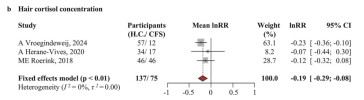
Meta-analysis of three datasets on hair cortisol concentration also revealed significantly lower levels in ME/CFS patients than in
healthy controls (82.7%, lnRR = −0.19 [95% CI − 0.29 to −0.08]) (Fig. 4b). Comparable results were obtained in MD: −0.7 pg/mg
[95% CI − 1.1 to −0.4] (Supplementary Fig. 3b). The raw data for lnRR and MD are provided in Supplementary Table. 5c.
Vroegindeweij, 2024
Herone, Vives, 2020
Roerink, 2018
 
Tackling the hair cortisol:

Screenshot 2026-04-25 at 9.11.14 PM.png


Vroegindeweij, 2024
This study had only 12 young people with CFS. There was much overlap of individual results with the control range. The controls were very different to the CFS group e.g. CFS group 83.3% female; control group 52.5% female.

Note that the authors of the review paper weighted this study (which had the greatest mean reduction compared to the controls of the three studies) much more than the others (63.1%, versus 8.2% and 28.7%). There does not seem to be any good argument for this weighting, given the small number of CFS participants and the poor control matching.

Vroegindeweij reported
To our knowledge, three studies have been conducted on HCC in ME/CFS. One study found a trend for lower HCC in adult females with ME/CFS when compared to female controls (Roerink et al., 2018). The second study observed similar levels in adults with ME/CFS when compared to adults with atypical depression and to controls (Herane-Vives et al., 2020). The third study pooled women with a diagnosis of ME/CFS, fibromyalgia, or irritable bowel syndrome together, and found that their HCC was higher compared to women with a somatic symptom disorder and equal to controls (Fischer et al., 2022).
So, it appears that this review has left out Fischer et al, 2022, which Vroegindeweij reported to have found hair cortisol levels equal to controls. And it has only weighted the Herane-Vives 2020 study, which Vroegindeweij also reported as finding similar levels to controls, with 8.2%.
 
Back
Top Bottom