

I found this from an old paper in Nature, about reference values for cortisol:
(To convert ug/L to nmol/L to ug/L, multiply by 2.76. To convert ug/dL to ug/L, multiply by 10.)
And a newer note in an Indian journalReference values for cerebrospinal fluid (CSF) cortisol could only be established on patients in whom a lumbar puncture was necessary for diagnosis. From all patients blood was collected for cortisol measurement before spinal puncture was performed. Patients with a normal number of cells and a normal level of glucose and proteins in the CSF served as reference group. It was found that the cortisol level is more or less independent from the age and lies in the range of 1–20 ug/l, or, if correlated to the plasma cortisol level, CSF cortisol lies below 6% of the plasma cortisol. In patients with cerebral alterations an increase in CSF cortisol was estimated.
The cutoff values of cerebrospinal fluid (CSF) cortisol could not be established as the sample size was small; however, initially normative data were obtained on 25 patients (15 males and 10 females) without any preexisting neurological disorders, and those who underwent spinal anesthesia were included as controls. The average mean CSF cortisol level for controls was 1.05 µg/dL, following which, the same was studied in patients with bacterial meningitis (BM) and viral meningitis (VM) whose mean CSF cortisol levels were 13.85 µg/dL and 3.47 µg/dL, respectively, and which were statistically significant. Thus, CSF cortisol is practically easy to use and apply in the clinical setting.
(To convert ug/L to nmol/L to ug/L, multiply by 2.76. To convert ug/dL to ug/L, multiply by 10.)
Normal values of cortisol seem to be reported to be about 3 to 55 nmol/L in cerebrospinal fluid, but I found surprisingly little depth to the data.
Here's the cortisol chart from this latest paper again:
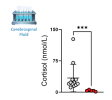
So, that doesn't help us a lot. There are two outliers in the healthy cohort, with abnormally high results that probably should have been excluded. Most of the results in both cohorts probably fit in that reported normal range. But, still, the difference between the two groups is odd. It makes me wonder if there was some degradation of the samples due to storage or collection problems.
Collection methods for cortisol assay mention collection in ice-chilled tubes, immediate freezing and lyophilisation as being necessary. It sounds as though it is quite susceptible to conversion to cortisone (and vice versa).
Thanks for looking. It is odd that there is no record for cortisol there as they looked at a wide range of metabolites (including cortisone). I'd be interested to ask the Walitt et al researchers why they didn't give a value for cortisol. Possibly, they had an issue with conversion between cortisol and cortisone.Cortisone is mentioned in supplementary data 14 for the CSF metabolites. Adrenocorticotropic hormone is mentioned in supplementary data 17.
CSF Cortisol is not mentioned anywhere as far as I can tell.


