Loss of CRH neurons and other neural changes in ME/CFS autopsy study - University of Amsterdam

I believe 17 has every CFS test they ran.
Hm, interesting. I am completely out of my depth, but to me it seems 17 is their Proteomics data, which I don't think would include cortisol? In their description file they say:
Supplementary Data 17: Individual data, univariate and multivariate analysis of aptamers measured on the SomaLogic platform in the serum and cerebrospinal fluid.
And in the main article SomaLogic is only mentioned in the proteomics section:
Proteomic analysis used the SOMAscan 1.3k Assay (SomaLogic). This is an aptamer-based assay able to detect 1305 protein analytes [...] Briefly, aptamers are short single-stranded DNA sequences modified to confer specific binding to target proteins [...] The proteins quantified include cytokines, hormones, growth factors, receptors, kinases, proteases, protease inhibitors, and structural proteins.
My non-biochem brain remembers cortisol being "lipid-ish" rather than "amino acid/protein-ish", so I think it might not be found in an analysis of proteins. Note that Cortisone is likewise not in file 17.
 
Hm, interesting. I am completely out of my depth, but to me it seems 17 is their Proteomics data, which I don't think would include cortisol? In their description file they say
Ah it would make sense that it is every test they ran with that particular method.

In any case, I think we are pretty sure that at no point did they ever test for Cortisol in CSF itself. It seems like there are a few related compounds but I don't know to what extent they would indicate a problem with Cortisol.
 
I found this from an old paper in Nature, about reference values for cortisol:
Reference values for cerebrospinal fluid (CSF) cortisol could only be established on patients in whom a lumbar puncture was necessary for diagnosis. From all patients blood was collected for cortisol measurement before spinal puncture was performed. Patients with a normal number of cells and a normal level of glucose and proteins in the CSF served as reference group. It was found that the cortisol level is more or less independent from the age and lies in the range of 1–20 ug/l, or, if correlated to the plasma cortisol level, CSF cortisol lies below 6% of the plasma cortisol. In patients with cerebral alterations an increase in CSF cortisol was estimated.
And a newer note in an Indian journal
The cutoff values of cerebrospinal fluid (CSF) cortisol could not be established as the sample size was small; however, initially normative data were obtained on 25 patients (15 males and 10 females) without any preexisting neurological disorders, and those who underwent spinal anesthesia were included as controls. The average mean CSF cortisol level for controls was 1.05 µg/dL, following which, the same was studied in patients with bacterial meningitis (BM) and viral meningitis (VM) whose mean CSF cortisol levels were 13.85 µg/dL and 3.47 µg/dL, respectively, and which were statistically significant. Thus, CSF cortisol is practically easy to use and apply in the clinical setting.

(To convert ug/L to nmol/L to ug/L, multiply by 2.76. To convert ug/dL to ug/L, multiply by 10.)

Normal values of cortisol seem to be reported to be about 3 to 55 nmol/L in cerebrospinal fluid, but I found surprisingly little depth to the data.


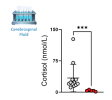
Here's the cortisol chart from this latest paper again:
1770524226522.png
So, that doesn't help us a lot. There are two outliers in the healthy cohort, with abnormally high results that probably should have been excluded. Most of the results in both cohorts probably fit in that reported normal range. But, still, the difference between the two groups is odd. It makes me wonder if there was some degradation of the samples due to storage or collection problems.

Collection methods for cortisol assay mention collection in ice-chilled tubes, immediate freezing and lyophilisation as being necessary. It sounds as though it is quite susceptible to conversion to cortisone (and vice versa).


Cortisone is mentioned in supplementary data 14 for the CSF metabolites. Adrenocorticotropic hormone is mentioned in supplementary data 17.

CSF Cortisol is not mentioned anywhere as far as I can tell.
Thanks for looking. It is odd that there is no record for cortisol there as they looked at a wide range of metabolites (including cortisone). I'd be interested to ask the Walitt et al researchers why they didn't give a value for cortisol. Possibly, they had an issue with conversion between cortisol and cortisone.
 
Thanks for looking. It is odd that there is no record for cortisol there as they looked at a wide range of metabolites (including cortisone). I'd be interested to ask the Walitt et al researchers why they didn't give a value for cortisol. Possibly, they had an issue with conversion between cortisol and cortisone.
It is a bit unclear if the data in 14 includes every test or just the tests that achieved some level of significance. I think that is something that would need to be asked because they certainly didn't report it.
 
I no longer have access to mapMECFS, the platform for sharing raw data for the deep phenotyping study. But I previously posted about doing statistical tests on all 435 CSF metabolites, and cortisol was in fact one of the chemicals that was in the data.

And in another post where I posted the results for the top 40 most significant metabolites out of these 435 based on Mann-Whitney testing, cortisol was not one of those with high significance.
 
I think James Baraniuk, Jonas Bergquist, Bjorn Bragee, Mady Hornig have all published studies on cerebrospinal fluid in ME/CFS patients in recent years but couldn't easily find cortisol being mentioned in their papers. If it's important, however, perhaps they could be contacted to ask if they made that measurement. As Jonathan mentioned, however, it may not be crucial to the main finding of reduced CRH producing neurons.

I found that Demitrack et al. 1991 (the paper that started the whole idea HPA-axis dysfunction in CFS) measured CRH in the cerebrospinal fluid in 19 patients and found it was normal compared to controls.
Both patients and controls showed similar levels ofCSF CRH (8.4 ± 0.6 vs. 7.7 ± 0.5 pmol/L; P = NS) andCSF ACTH (6.9 ± 0.3 vs. 7.3 ± 0.3 pmol/L; P = NS; see Table 5)
They nonetheless believed that their results of low cortisol and hyper-responsiveness of the adrenal gland to ACTH pointed to a problem with CRH secretion in the hypothalamus.
The weight of available evidence suggests that the mildhypocortisolism in the patients reported here reflects ad efect at or above the level of the hypothalamus, resulting in a deficiency in the release of either CRH and/orother secretogogues that serve to activate the pituitaryadrenal axis.
Evidence for Impaired Activation of the Hypothalamic-Pituitary-Adrenal Axis in Patients with Chronic Fatigue Syndrome | The Journal of Clinical Endocrinology & Metabolism | Oxford Academic
 
I am not sure that CSF cortisol is of great interest. If CRH cells are off-kilter the effect would be on the chain of signals ending with ACTH operating on adrenal to produce plasma cortisol. If that is normal. as we believe, then abnrmal CSF cortisol woud need to be due to some other factor in brain?
I think the relevance is mainly in the fact that CSF cortisol was measured in the NIH study and not found to be abnormal. That makes the result of abnormal CSF cortisol here less likely to be true, and contributes to the likelihood that something has gone wrong with the sampling that affected the integrity of the CRH cells.
 
I think the relevance is mainly in the fact that CSF cortisol was measured in the NIH study and not found to be abnormal. That makes the result of different levels of CSF cortisol here less likely to be true, and contributes to the likelihood that something has gone wrong with the sampling that affected the integrity of the CRH cells.

Not sure. I think the possibility that the CRH cell findings are artifactual is probably an independent issue relating to histological methodology (not particularly sampling).
 
Thanks @forestglip. Of course the Walitt Deep Phenotyping Study had a very small sample size too, but I think the fact that they didn't find any significant difference in cortisol levels throws some doubt on the findings of stark differences in this autopsy study.
I think it’s important to consider here though that most studies to date have not studied severe patients at all because of the ethical and logistical challenges. These autopsies will most probably represent more severe patients than we’ve seen data on so far. If the whole early stage boom then later stage bust idea just for example holds any water, we might be comparing apples to oranges anyways.
 
May be this study appears to be irrelevant but bare with me for now.

Title : Early-life stress lastingly impacts microglial transcriptome and function under basal and immune-challenged conditions

Link : https://www.nature.com/articles/s41398-022-02265-6

From the study :

(ELS = Early Life Stress)

The downregulation of synaptic phagocytosis by P200 ELS microglia might seem counterintuitive considering the literature on ELS-induced reduction of dendritic and synaptic complexity [99,100,101], which would imply increased phagocytosis. In fact, we previously demonstrated increased CD68 immunoreactivity in two separate cohorts of adult ELS-exposed mice [14, 38], and observed here the upregulation of genes regulating phagocytosis (e.g., C1qbp and Gas6) in our adult transcriptomic data. These are in line with the increased phagocytosis of bacterial particles observed in mice exposed to maternal separation [13], despite the difference in age. Our data, together with the reported findings by Delpech et al. [13] and Bolton et al. [96], suggest that ELS effects of phagocytosis, rather than being generalized, are complex and dependent on, e.g., specific substrates and possible eat-me signals. The identity of these different pathways, their regulators, and how ELS modulates them, is still unexplored and awaits future studies.\

and

One specific gene that we explored further is the opsonin Gas6. We demonstrated Gas6 to be increased not only in ELS-exposed microglia in mice, but also, importantly, in the post-mortem hippocampi of patients with a history of childhood abuse, both globally and specifically in microglia. GAS6 is a ligand for the tyrosine kinase receptors TYRO3, AXL, and MERTK (TAM) that stimulate microglial phagocytosis [102]. Its signaling is also known to dampen the LPS inflammatory response of primary cultured microglia [103], mediated by TGF-β expression [104], which was increased in ELS microglia. GAS6 is present at high levels in the brain throughout development, continues to be expressed in adulthood in rodents and humans [57, 105], and may act as a neurotrophic factor for hippocampal neurons [106]. The modulation of this pathway by ELS is in line with the findings by Bolton et al., where the impaired synaptic phagocytosis of hypothalamic excitatory neurons was mediated via the AXL and MERTK receptors [96]. While the increase in GAS6 might raise expectations towards increased microglial phagocytic capacity, it is important to note that GAS6 both activates and is secreted by microglia [56, 104]. Because activation of the GAS6 receptor MERTK has been shown to stimulate synaptic phagocytosis in astrocytes [107], the observed increase in microglial GAS6 might be a mechanism to recruit other phagocytes to compensate for their deficient functioning.

Are PwME primed for being individuals with higher perceived stress ? How about the study and discussion here :

https://www.s4me.info/threads/genom...hlights-gabaergic-signaling-2026-strom.48727/

Could phagocytosis be the culprit here?
 
Ten years is an insanely long time. PwME, especially severe, die all the time sadly. Just this week there have been something like 4 deaths reported.
I think they have funding for that amount of time, but I am sure they will be publishing findings in the meantime as well.

The speed at which they can study more brains depends on how many people are willing to donate theirs. The Dutch ME community is not that large, and many people outside the active online community will not even be aware of the study.

I have no idea what these findings actually mean or what other factors might have influenced them, but this brain bank just marked its 40th anniversary. They study many different diseases, so I am hoping that many of the possible factors that could have contributed to these findings will be compared with earlier results and be controlled for.

Let's see.
 
The speed at which they can study more brains depends on how many people are willing to donate theirs. The Dutch ME community is not that large, and many people outside the active online community will not even be aware of the study.
I have it in written at my GP’s practice that I want my brain to go to the brain bank.
But I don’t know if that is good enough so I need to find the form.

And I agree that most NL patients will not be aware of this.

this brain bank just marked its 40th anniversary. They study many different diseases, so I am hoping that many of the possible factors that could have contributed to these findings will be compared with earlier results and be controlled for.
This brain bank actually has a very good international reputation.
So while there might be some question marks about how the results have been established, these neuropathologists have a good reputation
 
Last edited:
These autopsies will most probably represent more severe patients than we’ve seen data on so far.
Why is that?

I guess it would be fair to assume that suicides are skewed towards the more severe, and that deaths from malnutrition are very skewed towards the more severe.

But there are more of the less severe patients, so they would be expected to make up the majority of the deaths of pwME/CFS in any given time period.
 
But there are more of the less severe patients, so they would be expected to make up the majority of the deaths of pwME/CFS in any given time period.

Autopsy is quite rare nowadays and most often is performed when there is genuine uncertainty about cause of death. It might be performed in people who have committed suicide or starved, on top of ME/CFS, as a way of finding out more but I doubt the very considerable cost involved would be justified on a health service basis.

There really needs to be a policy in place in perhaps two or three European countries for anyone dying with severe ME/CFS to have an autopsy if there is consent. It would need funds to be allocated in advance to a centre to handle the work. The cost would be very considerable but it would be very good value for money. There might be an argument for limiting it to neuropathology analysis but the administrative costs of the autopsy would still be there.
 
There really needs to be a policy in place in perhaps two or three European countries for anyone dying with severe ME/CFS to have an autopsy if there is consent.
That would be great, but how would you identify the patients in the first place? There are no registres as far as I’m aware, and I have little faith in asking a random department to set it up.
 
That would be great, but how would you identify the patients in the first place?

As it is, quite a lot of such people are known about by ME/CFS networks and if it was known that there was a policy within the community communication should not be impossible. If there were clinical research centres for severe ME/CFS, as we have suggested, then patients might well be known to those centres. I do not know how these systems work but often a coroner's referral is where needs for autopsy get picked up.
 
Why is that?

I guess it would be fair to assume that suicides are skewed towards the more severe, and that deaths from malnutrition are very skewed towards the more severe.

But there are more of the less severe patients, so they would be expected to make up the majority of the deaths of pwME/CFS in any given time period.
I’m quoting here (https://www.mdpi.com/2075-4418/6/2/...chene, McKenzie,for many individuals with CFS.)

“Likewise, Friedberg, Dechene, McKenzie, and Fontanetta [11] found that individuals who have had the illness for a longer period of time have significantly higher illness severity than those with shorter illness duration. Specifically, those who have had CFS for ten years or more had worse cognitive functioning than those who had been sick for seven years or less. Furthermore, van der Werf and colleagues [12] found that patients with an illness duration of two years or longer reported more concentration problems, greater fatigue, and more functional disability than patients with a shorter illness duration.”

These results are not definite and sometimes contested but it seems longer illness duration has a trend toward more severity. Which I would in turn expect for people at the end of their lives along with comorbidity. Should there be MAID cases or suicides among the autopsies you’d expect the same trend. So it’s an educated guess and we won’t definitively know until the study is published.
 
Autopsy is quite rare nowadays and most often is performed when there is genuine uncertainty about cause of death. It might be performed in people who have committed suicide or starved, on top of ME/CFS, as a way of finding out more but I doubt the very considerable cost involved would be justified on a health service basis.
Not that you necessarily need this clarified, but just to make this thread as clear as possible: the people in this study were autopsied because they signed up to donate to the brain bank's ME/CFS program before they passed. (At least that is my understanding.)

I don't think the researchers have released any info yet about the patients, such as if they passed due to euthanasia, or how severe their ME/CFS was. (But please let me know if I just missed it.) It's true more severe patients might be more likely to sign up for a study like this, and also true that there are far more mild patients, so hard to know how the math works out there.

The brain bank says that their patient samples are "anonymized". I don't know if that just means that their names are not included, or if things like cause of death are going to be impossible to find out.
 
Back
Top Bottom