Loss of CRH neurons and other neural changes in ME/CFS autopsy study - University of Amsterdam

terminal changes.... have I understood correctly you mean changes that related to the person dying or what they died of? would that not be accounted for by comparison with controls?

Yes, that is what I mean.
The problem is that people die in all sorts of different ways and the time before autopsy varies. If someone dies of starvation the changes may be very different from dying from a heart attack. And there really aren't that many autopsies done that would be controls. Ideally you need to process the samples in the same unit and so on. And brains deteriorate notoriously quickly in comparison to most other tissues.

The problem is particularly relevant to hypothalamic changes because demands on the hypothalamus during a period of dying are likely to be very particular and very variable between cases.
 
Why wouldn't you, though? Anyone who isn't familiar with the author and his tendency to weave fantastical stories from fragments might well be scared by it. I don't understand why people who claim to be advocates fail to consider that.
I'm late to this thread, but I want to echo Kitty's concern about that poor article by Cort. I'm concerned that many people who haven't been around long enough to see findings come and go might have made or might be making life-changing decisions based on an interpretation of an interpretation of findings that we can't know for sure will pan out to be true for even a subset of people with ME/CFS, let alone everyone with an ME/CFS diagnosis.

Urgh, it s bad for us... how is it possible to fix that ?
We should not assume that this is necessarily correct, or unfixable. We've seen people diagnosed with severe ME/CFS spontaneously recover a large amount of function. Even if the situation is bad, you may well not have what the people who were autopsied had.

I think it is quite likely that we are looking at an artefact. I also think that although apparent loss of CRH cells seems unlikely s secondary to sleep changes or whatever, it might reflect the mode of death. I have not looked into this further but I ownder if we now anything about how these people died? Death from inanition might be associated with CRH cell exhaustion for instance.
I have been wondering that too.

I think we have to consider the possibility that the people who were in a position to donate their brains may not be representative of people with ME/CFS generally. I suspect that most of them underwent planned euthanasia. I may be wrong. But, if they did, and clearly most people with ME/CFS are not doing that, then that raises all sorts of possibilities.

Regarding the brain cortisol finding: we have had studies on cerebral spinal fluid and I'm pretty sure that abnormalities in cortisol levels in the brain have not been found. There may be some notes about that on the cortisol thread. Googling, it looks as though people who die difficult deaths, with severe injuries for example, have high levels of cortisol in their brains. People who have medicated deaths may well have much lower levels of cortisol in their brains.

People who decide that euthanasia is their best option may have been on certain drugs long term and other drugs at the time of their death. They may be more likely to have certain co-morbidities or even a primary illness that are different to what other people with an ME/CFS diagnosis have.
Screenshot 2026-02-08 at 7.49.16 AM.png

Mostly though, I look at that chart of the CRH cells and I find it hard to believe. These investigators specifically looked at this part of the brain because they believed that people with ME/CFS have hypocortisolism. They therefore approached this study expecting to find something like what they found. On average, we do not have hypocortisolism.

Given the uncertainties around ME/CFS diagnosis, I find it hard to believe that all of the 'ME/CFS' brain donors had exactly the same pathology, and yet the CRH neuron numbers are all so clustered close to zero. We know that biological tissue is often very variable, and yet, again, there is no variability in those results.

I think there are quite a range of consequences that we would expect to flow from an almost total lack of CRH neurons. I think there will be some data that we can use to test that idea.
 
I'm late to this thread, but I want to echo Kitty's concern about that poor article by Cort. I'm concerned that many people who haven't been around long enough to see findings come and go might have made or might be making life-changing decisions based on an interpretation of an interpretation of findings that we can't know for sure will pan out to be true for even a subset of people with ME/CFS, let alone everyone with an ME/CFS diagnosis.


We should not assume that this is necessarily correct, or unfixable. We've seen people diagnosed with severe ME/CFS spontaneously recover a large amount of function. Even if the situation is bad, you may well not have what the people who were autopsied had.


I have been wondering that too.

I think we have to consider the possibility that the people who were in a position to donate their brains may not be representative of people with ME/CFS generally. I suspect that most of them underwent planned euthanasia. I may be wrong. But, if they did, and clearly most people with ME/CFS are not doing that, then that raises all sorts of possibilities.

Regarding the brain cortisol finding: we have had studies on cerebral spinal fluid and I'm pretty sure that abnormalities in cortisol levels in the brain have not been found. There may be some notes about that on the cortisol thread. Googling, it looks as though people who die difficult deaths, with severe injuries for example, have high levels of cortisol in their brains. People who have medicated deaths may well have much lower levels of cortisol in their brains.

People who decide that euthanasia is their best option may have been on certain drugs long term and other drugs at the time of their death. They may be more likely to have certain co-morbidities or even a primary illness that are different to what other people with an ME/CFS diagnosis have.
View attachment 30493

Mostly though, I look at that chart of the CRH cells and I find it hard to believe. These investigators specifically looked at this part of the brain because they believed that people with ME/CFS have hypocortisolism. They therefore approached this study expecting to find something like what they found. On average, we do not have hypocortisolism.

Given the uncertainties around ME/CFS diagnosis, I find it hard to believe that all of the 'ME/CFS' brain donors had exactly the same pathology, and yet the CRH neuron numbers are all so clustered close to zero. We know that biological tissue is often very variable, and yet, again, there is no variability in those results.

I think there are quite a range of consequences that we would expect to flow from an almost total lack of CRH neurons. I think there will be some data that we can use to test that idea.
I can see how circumstance could eliminate cortisol for example. But CRH neurons being wiped out at the same time would imply a longer lasting defect, no?
 
Mostly though, I look at that chart of the CRH cells and I find it hard to believe.
That is certainly on an odd looking plot.
The main thing that makes these results seem more plausible to me is that the narcolepsy results looked similar. [Edit: it seems like there were probably some differences in total area quantified, judging by larger range of cell counts in controls]. Even with the expected variation due to time of day at death, the control and cases have minimal overlap.

I agree the evidence re: hypocortisolism is weak. I do think there is absolutely possibility of reduced CRH production without hypocortisolism, though. Narcolepsy doesn't appear to present with hypocortisolism either

[edited for clarity]

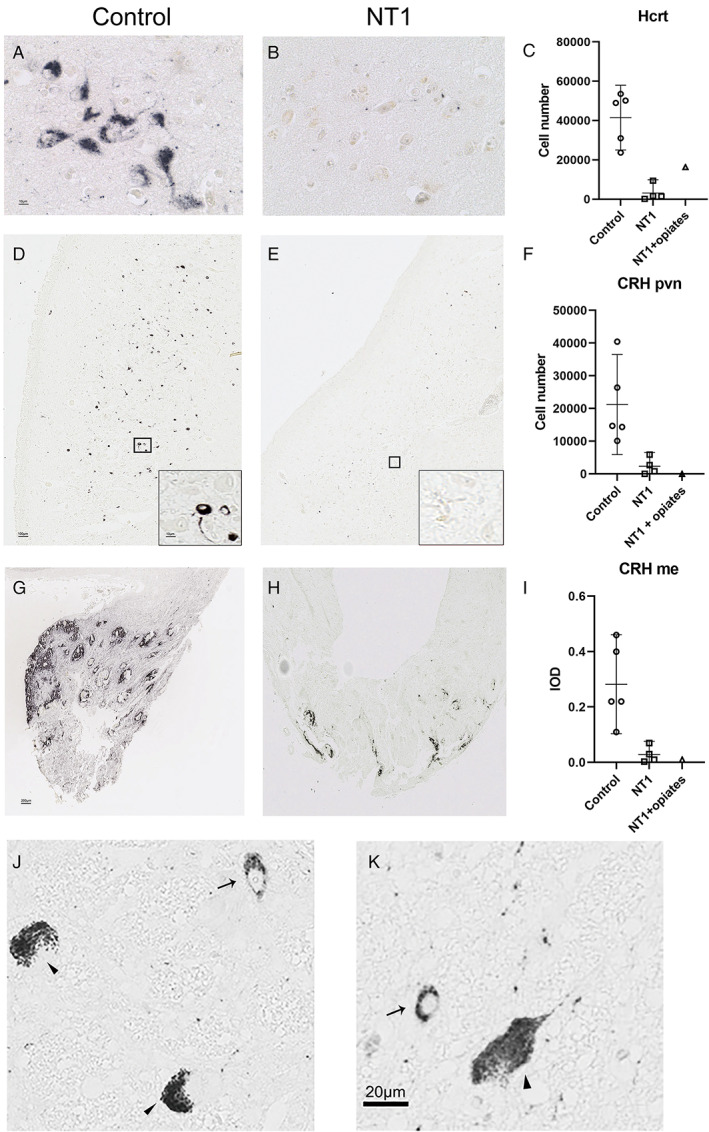
Autopsy of type 1 narcolepsy:

FIGURE 1.​

FIGURE 1


Patients with narcolepsy type 1 (NT1) have not only a loss of 97% of hypocretin/orexin (Hcrt) neurons but also an 88% reduction of corticotropin‐releasing hormone (CRH) expressing neurons in the paraventricular nucleus (pvn) and an 91% reduction of CRH‐positive fiber staining in the median eminence (me).

(A) Control and (B) NT1 Hcrt immunoreactive cells.

(C) The total number of Hcrt neurons is more than 97% reduced in patients with NT1 compared to controls.

(D) Control and (E) NT1 CRH immunoreactive cells in the pvn.

(F) The total number of CRH neurons in the PVN is 88% lower in patients with NT1 than in controls.

The subject with NT1 with chronic opiates (NT1 + opiates) also showed few CRH neurons.

(G) Control and (H) NT1 fiber immunoreactivity in the median eminence.

(I) The total optical density of CRH in the peak level of median eminence is 91% lower in NT1 than in controls.

(J, K) Photomicrographs showing pigmented locus coeruleus neurons (indicated with an arrow head) and (J) an example of the positive CRH staining (indicated with an arrow) in the locus coeruleus of control, (K) a positive CRH staining (indicated with an arrow) in the locus coeruleus of the subject with NT1.

The 6 μm sections of the locus coeruleus area contained up to 20 CRH neurons, in both, the controls and the patients with NT1.

Scale bar represents 10 μm for A; 100 μm for D and 10 μm for insert; 200 μm for G and H, and 20 μm for K. Bar plots show the mean and the lower Bound‐Upper Bound of the 95% confidence intervals in C, F, and I. [Color figure can be viewed at www.annalsofneurology.org]

 
Last edited:
the narcolepsy results looked similar.

Good point.
Maybe a caveat is that narcolepsy, particularly of the type with cataplexy, is such a unique presentation that one might expect the pathology to be 100% correlating - like myasthenia gravis or polio. If severe ME/CFS is as pathologically homogeneous it would make everything an awful lot easier but up until now we have not been in a position to be so confident that will be so.
 
I can see how circumstance could eliminate cortisol for example. But CRH neurons being wiped out at the same time would imply a longer lasting defect, no?
Yes, I think that is true when it comes to the slides of CRH cells. But, if people have been in pain and severe emotional distress for a long time, then it seems possible to me that some of the drugs (e.g. anti-psychotics, benzodiazepines) they have been taking could potentially have an impact on specific types of neurons. I think it is possible that drugs might cause that fragmentation of microglia that was reported.

I have to admit though, that idea does seem a bit of a stretch. Just as there is likely to be variation in the actual pathology that the people diagnosed with ME/CFS had in this study, there is probably variation in the type of long-term drugs they were taking. We need more detailed information about the brain donors.

I should have acknowledged the brain donors - both the ME/CFS donors and the control donors - and their families. I hope this discussion isn't causing distress. It's an enormously valuable gift that these people have given. I just hope that the researchers have the necessary equipoise to honour the gift.
 
Or that there is no neuroinflammation. Running out of inflammatory cells does not sound plausible to me.

The CRH cell finding stands out as interesting. Presumably if these cells are not working other signals are maintaining ACTH and cortisol levels.

A quick n=1 to note that I had hypocortisolism after adrenalectomy which resolved after a few weeks on steroids. Both the initial hypocortisolism and the resolution confused the endocrinologists. This might be consistent with pwME using some sort of backup or suboptimal system for regulating cortisol, which is less able to adapt to the loss of an adrenal gland, but catches up eventually.

Hope this is relevant. The rest of the discussion is way above my head, but I doubt there are massive numbers of pwME with adrenalectomy histories.
 
I picked through the Netherlands Brain Donation page to try and figure out some of our questions about the conditions of death etc. I've learned the following (auto-translating from dutch so hopefully correctly)
NHB maintains a maximum of 150 donations per year. [And this is split over many neurological diseases]
In the case of brain tumors, or if there is brain damage (e.g., a cerebral hemorrhage or stroke) that has caused lasting symptoms, brain donation cannot proceed.
Likewise, they do not accept brain donations if the donor is infected with covid, Hep B, Hep C or HIV. They do however accept post-euthanasia donations.

Also, not sure what the researchers controlled for in this case, but the brain bank says that in general:
The tissue can be matched for ante-mortem parameters (e.g. age, sex, time and season of death, agonal state, pH, APO-E genotype) and post-mortem parameters (post-mortem delay, freezing or fixation procedure, storage time).
(Source 1, and source 2)
 
Regarding the brain cortisol finding: we have had studies on cerebral spinal fluid and I'm pretty sure that abnormalities in cortisol levels in the brain have not been found. There may be some notes about that on the cortisol thread.
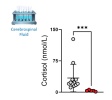
The plot for cortisol levels in cerebrospinal fluid looks similarly striking to the CRH finding. I would think that this would have already been tested in people who are alive, though I can't immediately find a study looking at CSF cortisol in ME/CFS. I don't see any mentions of CSF on the cortisol thread.

If it hasn't been tested before, it seems this should be a priority to replicate.

1770509622000.png
 
We should not assume that this is necessarily correct, or unfixable.
Seconded. I have been wondering if the cells are not gone though, just changed cell surface marker expression. That is another possibility, and might autocorrect if we ever have a treatment or cure. Or not. We need more info, and more research, and preferably a way to scan live brains with some kind of tagged marker.
 
This might be consistent with pwME using some sort of backup or suboptimal system for regulating cortisol, which is less able to adapt to the loss of an adrenal gland, but catches up eventually.
I have no link but came across mention of recent rat research. They traced a direct neural signal from the hypothalamus to the liver that can trigger glucose release even without cortisol. So backup systems are a possibility.
 
I don't see any mentions of CSF on the cortisol thread.

If it hasn't been tested before, it seems this should be a priority to replicate.
The NIH Walitt et al Deep phenotyping study looked at all sorts of things in the cerebrospinal fluid. I'd be very surprised if cortisol wasn't looked at. It wasn't mentioned as being different, whereas various much more obscure molecules were. Does someone have the CSF data from that study handy?
 
The NIH Walitt et al Deep phenotyping study looked at all sorts of things in the cerebrospinal fluid. I'd be very surprised if cortisol wasn't looked at. It wasn't mentioned as being different, whereas various much more obscure molecules were. Does someone have the CSF data from that study handy?

Cortisone is mentioned in supplementary data 14 for the CSF metabolites. Adrenocorticotropic hormone is mentioned in supplementary data 17.

CSF Cortisol is not mentioned anywhere as far as I can tell.
 
Last edited:
CSF Cortisol is not mentioned anywhere as far as I can tell.
Yes, I've been staring at the same file. I guess my question as a layman is, can I assume any reasonable metabolomics process would have picked up cortisol? Because it sounds like supplementary data 14 is just reporting the metabolites that were significantly different between cases and controls, so if they tested for it, and it's not there, I guess it was no different.

(It's a testament, maybe, to how under appreciated null results are that they don't seem to have explicitly reported the non-significant metabolites anywhere? They say 388 named and 57 unnamed metabolites were analyzed from the CSF, so most of those didn't make it into supplementary data 14.)
 
Cerebrospinal fluid immune phenotyping reveals distinct immunotypes of myalgic encephalomyelitis/chronic fatigue syndrome (2025)

They looked at cortisol, but it seems to be only in serum, not CSF. CSF was only taken from ME/CFS patients, not controls.

Quantification of hormones
The multiplexing analysis was performed using the Luminex 200 system. Six markers were simultaneously measured in the samples using Eve Technologies' Steroid/Thyroid Hormone 6-Plex Discovery Assay (MilliporeSigma) according to the manufacturer's protocol. The 6-plex consisted of cortisol, estradiol, progesterone, T3, T4, and testosterone.

Fig 2 shows a faint correlation between plasma fractalkine and cortisol levels in cases, and cortisol is not discussed in the paper beyond the above mention in methods. Presumably, again, plasma cortisol wasn't significantly different between cases and controls.
 
Last edited:
That sounds unlikely to me. Cells that secrete hormones tend to produce and store them ready for release in response to signals. If anything cells depleted of CRH might suggest they have released it all.

For comparison, there was 2006 study of CSF CRH in fibromyalgia Cerebrospinal Fluid Corticotropin-Releasing Factor Concentration is Associated with Pain but not Fatigue Symptoms in Patients with Fibromyalgia (2006), looking at men and women. (Women were further divided into those self-reporting previous sexual abuse or not, but they only had 7 and 9 respectively).

They found elevated CSF CRH levels in men and in women not reporting abuse, but not elevated (top of normal range) in women who did report abuse. None of the patient groups had low levels of CRH in CSF.

The purpose of this study was to compare FM patient symptoms and CSF CRF levels, no matched control group was employed. Previous studies utilizing control groups have reported mean CSF CRF levels of 22–25 pg/ml among controls (Bremner et al, 1997; Carpenter et al, 2004; Williams et al, 2004). In the present study, men and women with FM not reporting an abuse history had CSF CRF levels substantially higher than this (38.9 and 35.0 pg/ml, respectively), suggesting that FM in patients without a history of significant early life stress may be characterized by elevated CSF CRF levels.
 
Back
Top Bottom