Open International: Dr. Todd Davenport, PEM/PESE Activity Survey Study, Nov 2021

After taking this I wondered if it's a consistency or memory test.

I thought it shows how hopelessly inadequate these questionnaires are (but please don't let this discourage you from taking the survey).
 
I started doing it but the questions seem to be only applicable to people who are in this moment suffering with PEM. If I had PEM right now, I certainly wouldn't be doing a survey.

That doesn't mean I don't get PEM.
 
I started doing it but the questions seem to be only applicable to people who are in this moment suffering with PEM. If I had PEM right now, I certainly wouldn't be doing a survey.

That doesn't mean I don't get PEM.
I though it was about relative performance across three dimensions - before ill, ill but on a good day, and today - I didn't read anywhere that it asked if you were experiencing PEM today.
 
I did it. It was confusing (I wasn't sure if that was intentional; the metrics were hard to parse and interpret and didn't map on to the way I think about activities) and my answers were roughly the same but inconsistent. I thought it may be trying to demonstrate that these kinds of surveys are unreliable.
 
I have just done it. It made no sense which suggests to me that it's trying to find out something different from what is says it wants to find out. I'm sure I messed it up, but that's part of the process of showing them it's flawed I guess.
I think just go into it the best you can and they can see what results. You can email Todd to explain your questionns or difficulties if you want to.
 
This questionnaire isn't about gaining data, it's a test-retest[1]procedure for testing the statistical validity of the questions, which in this case are to be used in a formalised questionnaire to help (?) people suffering from PEM. That's why it is in three parts - the middle bit is to provide a cognitive break between the two answer sessions, this saves having to ask people to come back and do the second test at some later time.

In parts 1 and 3 it's not the answers they are interested in, it's how the two sets of answers hold up when subject to various statistical analysis designed to test reliability of the question construct.

[1] https://www.statology.org/test-retest-reliability/ -
 
Yeah, it does seem to be testing for consistency. It would be easy to cheat, by recording the answers, but that would defeat the presumed purpose of the survey.

I do wonder how useful the survey is though. I suppose if it shows that self-reporting isn't very reliable with even a small delay between doing it again, then follow-up self-reporting in a fluctuating condition some weeks after the first survey certainly won't be helpful (and can easily be biased by other factors).

But what if it showed that self-reporting with a break of a few minutes is reliable? Then it's not telling us anything about any sort of realistic situation where there are weeks in between. Nor does it tell us about surveys where the answers are on a Likert scale with only 5 or 7 options (it's a lot easier to consistently select those options than it is with a percentage sliding scale).
 
It also warns the participants that the will shortly be doing the same questionnaire again, so defeats the purpose as people will try harder to get the same answer including writing them down. I think to test consistency in a single sitting there should be no prewarning and the questions should be mixed in with other questions with sliding scales, and in a different order.
 
To test consistency the questions should make sense. Part of the reason for answering inconsistently would be having trouble parsing the question and assigning a value in the first place due to poor framing/lack of correspondence with experience and picking the best thing. Hard to remember what you've done. This seemed like it was testing consistency. Doing a test about bad research questions in the same exercise as one about consistency makes little sense.
 
It also warns the participants that the will shortly be doing the same questionnaire again, so defeats the purpose as people will try harder to get the same answer including writing them down. I think to test consistency in a single sitting there should be no prewarning and the questions should be mixed in with other questions with sliding scales, and in a different order.

Well it could also be used as a cognitive ability test because I totally missed that warning! Just got confused why I was answering the same questions again. I'm very grateful to you all for explaining what's going on.
 
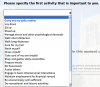
Did it warn that the first time through you would only get to choose 3 options to answer? I thought it was going to work through the whole list, so did the first 3, one of which made no sense to try to answer. How can you say how well you can manage to lie down compared with when you were well?
 
"Have you tested positive for EBV" etc... well no but there isnt an option for becuase i never been tested.

The way they ask you to select and activity that is 'important to you' is crazy ambiguous. I mean going to work is important to me, not been able to do it for 20 yrs but its still important to me. So is going to the toilet but i can usually manage that.

If they just want you to pick an activity they need to mae it clear whether they asking ypou to pick something you can do at your level of severity or just something you'd like to do because its important to you.
 
Also the how often does symptom change questions, by the hour,day,wk,mnth, errr what about the measurements inbetween... its not by the hour but its not by the day either what are you supposed to put?
 
Back
Top