Thanks for the blog!Second blog article on the DecodeME results, this time focusing on genes related to ME/CFS.
I think fine mapping refers to identifying the causal variant out of all the significant variants, not identifying the gene that the variant affects. I think that would be 'gene prioritization':We do not know which gene(s) the DNA signal points to, and the process of figuring this out is called ‘fine-mapping’.
- https://royalsocietypublishing.org/doi/10.1098/rsob.190221
3. Gene prioritization using GWAS traits
Traditional fine-mapping approaches focus on identifying the causal variants that affect a trait of interest. While very important, knowing which variants are causal does not identify the downstream effects of the variant on the trait. One way to gain such insights is by identifying the genes that are affected by each GWAS locus.
---
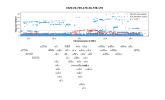
Although the region has multiple candidate genes, it’s quite likely that ARFGEF2, CSE1L, and STAU1 are involved in ME/CFS pathology because the signal around them is so strong. The gene-based test of MAGMA, a tool that helps you estimate which genes are relevant, highlighted all three of them.
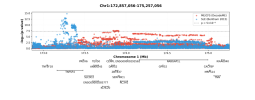
I don't think we can say things about loci likely being related to multiple genes with certainty. For chromosome 20, the locus being very significant doesn't indicate that multiple genes are involved. It may just be that ARFGEF2 or another gene just has a very strong effect.The one below on chromosome 1 is likely to have more than one signal.
MAGMA is basically just looking at the significance of variants only within the bounds of a gene. If a variant in one gene is very significant, and also is in LD with variants in another gene, both genes will be significant in MAGMA.
For some reason, LocusZoom doesn't show LD for the chr20 locus. But it does for the chr1 locus (last locus in the first image here), which shows that the second long RABGAP1L region is in moderate LD with the main variants above DARS2. So even if the only interesting causal variant was a variant above DARS2, we'd likely see the same pattern as we do.
---
Typo:
A bit caveat is that the genes highlighted above are involved in other functions
Change to "as similar as possible"?
They included only British participants with European ancestry so that they were as similar as the controls in the UK Biobank.
Add space.
Likely candidates are TAOK3, SUDS3, andPEBP1.
Last edited: