Preprint Evidence of Accumulating Neurophysiologic Dysfunction in Persistent Post-COVID Fatigue, 2025, Germann et al

forestglip

Moderator
Staff member
Evidence of Accumulating Neurophysiologic Dysfunction in Persistent Post-COVID Fatigue

Germann, Maria; Maffitt, Natalie J; Burton, Olivia A; Ashhad, Amn; Baker, Anne M.E.; Zaaimi, Boubker; Ng, Wan-Fai; Soteropoulos, Demetris S; Baker, Stuart N; Baker, Mark R

[Line breaks added]

Abstract
A major consequence of the COVID-19 pandemic has been the emergence of post-COVID syndrome (PCS), and more specifically, post-COVID fatigue (pCF), with an estimated prevalence of ~2%. We previously showed that, compared to healthy controls, people with pCF exhibit changes in muscle physiology, cortical circuitry, and autonomic function.

Here we present results from a cohort of people with pCF (N=145), between 12 weeks and 45 months post-infection. We report self-perception of fatigue; objective measures of cortical circuits via transcranial magnetic stimulation and reaction time tasks; peripheral muscle fatigue; and autonomic function such as heart rate variability.

Those with pCF persisting >200 days had significantly more fatigue and showed increased cortical excitability, slower reaction times and increased peripheral muscle fatigue compared to those with <200 days of pCF .

In pCF, if there is no spontaneous recovery, fatigue worsens, and patients continue to accumulate significant neurophysiologic abnormalities.

Web | PDF | DOI | medRxiv | Preprint
 
This looks pretty interesting because they tested a lot of different objective nervous system metrics. I don't know much about these measures, but there's measurements related to things like reaction time, cortical excitability, blood oxygen saturation, and peripheral fatigue. Some examples:
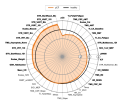
pCF participants had an increased level of peripheral fatigue (size of maximum twitch evoked by direct electrical stimulation of the muscle after a sustained contraction compared with baseline; TI_PeriphFatigue p<0.001)
Central activation, which assesses the ability of the CNS to activate muscle maximally voluntarily, was significantly reduced in pCF, either assessed at baseline (TI_CA_baseline p=0.002) or after a fatiguing contraction (TI_CA_fatigue p<0.001).
The StartReact effect, which measures the acceleration of a visual reaction time by a loud (startling) sound and has been proposed to assess reticulospinal pathways, was also significantly increased in both muscles (STR_StartReact_Bic p<0.001 and STR_StartReact_1DI p=0.009),
1767021970699.png

Bold measures were significant after multiple test correction.

The plot shows the effect size for each metric. They take the difference of the means from each group for a given metric and divide that difference by the standard deviation of the healthy group. It's similar to Cohen's D effect size, but Cohen's D divides by the standard deviation of everyone combined, while they used only the healthy group.
Because each measure has different units and scales, data were normalized as a Z-score to allow easy comparison of differences. Z-scores were calculated by taking the difference in means of a measure between datasets (pCF vs healthy controls or pCF less than vs greater than 200 days) and dividing it by the standard deviation of the normative dataset (healthy controls or pCF less than 200 days). This is a measure of effect size and similar to Hedge’s g measure.

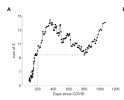
Also, they looked at how difference from controls changes with increasing time since infection (this is cross-sectional, not looking at individuals over time):
1767022780932.png

Each dot represents 20 individuals with post-COVID fatigue, and they use a sliding window. So if patient 1 has the shortest time since infection, patient 2 has the second shortest time, etc, then the first dot represents patients 1-20, the second dot represents patients 2-21, and so on.

For each group of 20 patients, they created a z-score for each metric for those patients, same as above, to see how much they differed from healthy controls, then added all the z-scores for all the metrics together and that's what the height of the points represents.

The plot shows that the difference from healthy controls is larger in patients who had been ill longer.
 
They combined data from two groups of people with post-COVID fatigue. A group of 37 that they analyzed previously, plus data for another group of 108 patients.
For this study, data from 145 participants (108 females) who were suffering from pCF by self-104 report were analysed. This included data from a pCF cohort of 37 participants (27 females) that were collected for our previous studies15,16 and baseline data (prior to any intervention) from individuals with pCF (108 participants, 81 females) that went on to participate in a vagus nerve stimulation trial (ISRCTN registry; ISRCTN18015802).

Here are the threads for the previous studies (refs 15, 16):
- Neural dysregulation in post-COVID fatigue 2023 Baker et al
- Recovery of neurophysiological measures in post-COVID fatigue: a 12-month longitudinal follow-up study, 2024, Maffitt et al.
 
Last edited:
How will these measurements be affected by regular deconditioning? Could the observed differences primarily be downstream effects of whatever is keeping them ill?
 
Back
Top Bottom