

You are using an out of date browser. It may not display this or other websites correctly.
You should upgrade or use an alternative browser.
You should upgrade or use an alternative browser.
Charting the circulating proteome in ME/CFS using cross-system profiling to uncover mechanistic insights, 2026, Hoel, Fluge, Mella+
- Thread starter SNT Gatchaman
- Start date

Tree
Senior Member (Voting Rights)
Hi Butter,Another group is showing that GDF15 is normal in ME/CFS, @Jonathan Edwards. The testing I was part of showed that the most severe patients had the lowest GDF15. Explaining how this could be would go a long way, in my opinion.
I still think it's plausible that, due to poor microvascular diffusion and reduced gradients, blood values might not reflect tissue values. Something similar is seen in mitochondrial diseases, where lactate levels in the blood can be normal.
There could be many other reasons, of course.
Interesting that you were tested for that. Was that as part of a study or something available to the public?
Tree
Senior Member (Voting Rights)
If you do not mind me asking, you seem to have a vast knowledge of all these studies. How do you keep track and organize these studies?Complement C3 has come up in a couple of studies before, for example this one:
Complement Component C1q as a Potential Diagnostic Tool for Myalgic Encephalomyelitis/Chronic Fatigue Syndrome Subtyping - PubMed
I struggle to keep track so was interested in how you do it.

ME/CFS Science Blog
Senior Member (Voting Rights)
I try to follow ME/CFS research as closely as I can and sometimes write blogs about them. For example, at the end of the year I write an overview of the most interesting studies of the year, which helps to keep track of the most important ones.If you do not mind me asking, you seem to have a vast knowledge of all these studies. How do you keep track and organize these studies?
https://mecfsskeptic.com/2024-looking-back-on-a-year-of-me-cfs-research/
I also notice that I tend to ignore the less quality studies more and more. Many papers just aren't worth the time and effort.

I find PXDN very interesting too.Peroxidasin is intersting to me, it might help explain POTS
Mammalian Peroxidasin (PXDN): From Physiology to Pathology
PXDN expresses in the endothelial cells and secretes into blood. PXDN exhibits with much higher concentration in plasma than MPO [20]. Therefore, it is reasonable to speculate that PXDN also plays an important role in vascular tone under physiological and pathological conditions.
According to that review it also seems to be involved in extracellular matrix and fibronectin. i don't know too much about extracellular matrix and fibronectin but I do know that these are bits of biology that keep coming up! Collagen-associated functions suggest a possible link to Ehlers Danlos or similar connective tissue issues.
Here's a link to a post I made about earlier findings:
Myopathy as a cause of fatigue in long-term post-COVID-19 symptoms: Evidence of skeletal muscle histopathology, 2022, Hejbøl et al

Was told once by a senior researcher in materials science that when he gets a paper to read he goes straight to the methodology section, and doesn't read the full paper until he knows it is worth reading. Said it saved him a lot of time.I also notice that I tend to ignore the less quality studies more and more. Many papers just aren't worth the time and effort.
HLA-C has the 39th highest fold change out of the 7326 aptamers they tested (logFC = 0.35). Not significant though (p=.19, q=.45).
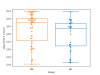
Here are all the ones they tested that mentioned HLA:
Edit: Mistyped the q-value.
Here are all the ones they tested that mentioned HLA:
Rank | EntrezGeneSymbol | logFC | adj.P.Val
39 | HLA-C | 0.35 | 0.45
1662 | CD74 | 0.05 | 0.11
2047 | HLA-G | 0.04 | 0.64
2255 | HLA-E | 0.03 | 0.78
3243 | CD74 | 0.01 | 0.83
4309 | HLA-DRB3 | -0.01 | 0.94
5759 | HLA-DQA2 | -0.06 | 0.06
Edit: Mistyped the q-value.
Last edited:

wastwater
Senior Member (Voting Rights)
Homozygous Mutations in PXDN
Cause Congenital Cataract, Corneal Opacity,
and Developmental Glaucoma
Cause Congenital Cataract, Corneal Opacity,
and Developmental Glaucoma
ME/CFS Science Blog
Senior Member (Voting Rights)
Noticed this thread on Twitter which may be useful to merge data with different names for the same gene ID.That said it's a ton of work, as you guys found there's a lot of ways to annotate the name of a protein, metabolite or other molecule, and a dozen different numbering systems.

Thread by @tangming2005 on Thread Reader App
@tangming2005: 1/ You’re merging gene data across tools. Suddenly nothing matches. ENSEMBL, ENTREZ, TP53, P53… Why so many gene IDs? 2/ Gene ID chaos is real. One gene, three names: ENSEMBL ID, ENTREZ ID, gene symbo...…
 threadreaderapp.com

Chandelier
Senior Member (Voting Rights)
https://doi.org/10.1016/j.xcrm.2026.102647
Now published as:
Charting the circulating proteome in ME/CFS using cross-system profiling to uncover mechanistic insights
• Tissue-linked shifts show reduced intracellular and increased secreted proteins
• Immune signatures show reprogramming with reduced neutrophil-derived proteins
• Regulatory networks link immune, vascular, and metabolic dysfunction
We apply aptamer-based serum proteomics to 50 ME/CFS patients and 29 healthy controls, analyzing 7,326 protein targets.
We identify 1,823 aptamers with significant differences between the groups (845 after false discovery rate [FDR] correction).
Distinct patterns of tissue- and process-specific changes are seen.
There is a broad increase in secreted proteins, while intracellular proteins, e.g., from skeletal muscle, particularly show reduction. Immune cell-associated signatures indicate immune reprogramming, including a distinct reduction in proteins secreted by activated neutrophils.
Focused secretome analysis supports intensified regulatory interactions related to immune activity, inflammation, vasculature, and metabolism.
Validation of measurements using antibody-based methods confirms findings for a selection of proteins.
The uncovered serum proteome patterns in ME/CFS patients may contribute to understanding the pathophysiology and inform future biomarker research and therapeutic development.
Now published as:
Charting the circulating proteome in ME/CFS using cross-system profiling to uncover mechanistic insights
August Hoel<a>1</a>,<a>2</a>,<a>7</a> ∙ Fredrik Hoel<a>1</a>,<a>7</a> ∙ Sissel Elisabeth Dyrstad<a>1</a> ∙ Henrique Chapola<a>1</a> ∙ Ingrid Gurvin Rekeland<a>3</a> ∙ Kristin Risa<a>3</a> ∙ Kine Alme<a>3</a> ∙ Kari Sørland<a>3</a> ∙ Karl Albert Brokstad<a>4</a> ∙ Hans-Peter Marti<a>2</a>,<a>5</a> ∙ Olav Mella<a>3</a>,<a>6</a> ∙ Øystein Fluge<a>3</a>,<a>6</a> ∙ Karl Johan Tronstad
Highlights
• Serum proteomics reveals widespread protein changes in ME/CFS patients• Tissue-linked shifts show reduced intracellular and increased secreted proteins
• Immune signatures show reprogramming with reduced neutrophil-derived proteins
• Regulatory networks link immune, vascular, and metabolic dysfunction
Summary
Myalgic encephalomyelitis/chronic fatigue syndrome (ME/CFS) is a debilitating condition often triggered by infections, with unclear mechanisms and no established biomarkers or treatments.We apply aptamer-based serum proteomics to 50 ME/CFS patients and 29 healthy controls, analyzing 7,326 protein targets.
We identify 1,823 aptamers with significant differences between the groups (845 after false discovery rate [FDR] correction).
Distinct patterns of tissue- and process-specific changes are seen.
There is a broad increase in secreted proteins, while intracellular proteins, e.g., from skeletal muscle, particularly show reduction. Immune cell-associated signatures indicate immune reprogramming, including a distinct reduction in proteins secreted by activated neutrophils.
Focused secretome analysis supports intensified regulatory interactions related to immune activity, inflammation, vasculature, and metabolism.
Validation of measurements using antibody-based methods confirms findings for a selection of proteins.
The uncovered serum proteome patterns in ME/CFS patients may contribute to understanding the pathophysiology and inform future biomarker research and therapeutic development.

DMissa
Senior Member (Voting Rights)
I just want to heap some praise onto the authors of this study.
Every time I see proteomics from biofluids I always wonder "okay but what tissue specific information can this tell us if any?"
They have made great efforts to address this in the paper. The intracellular stuff is noted to be limited in its interpretability by being so and later they do a bunch of things with different gene expression atluses. Extremely impressive
Every time I see proteomics from biofluids I always wonder "okay but what tissue specific information can this tell us if any?"
They have made great efforts to address this in the paper. The intracellular stuff is noted to be limited in its interpretability by being so and later they do a bunch of things with different gene expression atluses. Extremely impressive


mariovitali
Senior Member (Voting Rights)

hotblack
Senior Member (Voting Rights)
I was going to ask those more knowledgeable and experienced in this field (like @DMissa ) what the chances are of someone else looking at ME/CFS proteomics would be of reproducing this. It looks like the Rosetta Stone study is using the same kit at least, I wonder if they're aware of this paper?
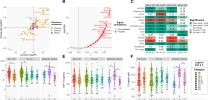
From this paper
From this paper
From the Rosetta Stone funding documentSerum protein concentrations for 50 ME/CFS patients and 29 HCs were measured using aptamer-based technology (SomaScan v.4.1 7 k).
The UCL study is using a different platform and more focussed on immune/neurological so perhaps isn’t such a good fit, from their funding documentThe study will also investigate several important biological questions, including whether:
• Proteins in the blood (measured using SomaScan proteomics) reveal shared disease patterns or underlying mechanisms in LC and ME/CFS.
The project will use ALAMAR Bioscience’s NULISA platform, a next generation technology with extremely high sensitivity. It can detect more than 300 proteins involved in immune function and central nervous system processes — including many that cannot be measured using standard immunoassays (a simple test that used antibodies to detect something present in a sample, such as a protein).
hotblack
Senior Member (Voting Rights)
I just noticed that revisiting this paper, my JAK-STAT pathway senses started tingling. So elevated MCTS1 leading to increased JAK2 protein so hypersensitive JAK-STAT? Maybe something here with the interleukins and complement to to keep a bit of an IFN loop going too?Sorry to be the same broken record: obligatory mention that JAK2 is not exclusive to interferon gamma

jnmaciuch
Senior Member (Voting Rights)
Maybe! I think in general when genes come up in an untargeted study like this, they tend to be upregulated somewhere downstream of an abnormal disease processI just noticed that revisiting this paper, my JAK-STAT pathway senses started tingling. So elevated MCTS1 leading to increased JAK2 protein so hypersensitive JAK-STAT? Maybe something here with the interleukins and complement to to keep a bit of an IFN loop going too?
jnmaciuch
Senior Member (Voting Rights)
Followed up on the link between MCTS1 and IFN-g, seems to come from this paper:
What they found was that an MCTS1 loss-of-function mutation caused a deficiency of the JAK2 protein (not mRNA) because JAK2 requires a specific MCTS1-dependent process to be fully translated. The initial hypothesis was that this would impair the cellular response to IFN-g (JAK2 is attached to the IFN-g receptor and is involved in the signaling cascade) but that actually didn’t seem to be the case. What was impaired was response to IL-23, which does influence production of IFN-g by T cells.
Either way, MCTS1 is a pretty ubiquitously expressed protein. More MCTS1 probably wouldn’t mean more JAK2, because it doesn’t seem like the limiting factor in that direction. So I think it supports the idea that if MCTS1 is related to interferons at all, it would be something farther downstream.
What they found was that an MCTS1 loss-of-function mutation caused a deficiency of the JAK2 protein (not mRNA) because JAK2 requires a specific MCTS1-dependent process to be fully translated. The initial hypothesis was that this would impair the cellular response to IFN-g (JAK2 is attached to the IFN-g receptor and is involved in the signaling cascade) but that actually didn’t seem to be the case. What was impaired was response to IL-23, which does influence production of IFN-g by T cells.
Either way, MCTS1 is a pretty ubiquitously expressed protein. More MCTS1 probably wouldn’t mean more JAK2, because it doesn’t seem like the limiting factor in that direction. So I think it supports the idea that if MCTS1 is related to interferons at all, it would be something farther downstream.
hotblack
Senior Member (Voting Rights)
Presumably we’ll find out more about any alleles once the X and Y results from DecodeME are released, does anyone know how things are looking on that front? @Andy perhaps?The paper linked above talks about an X-linked recessive MCTS1 deficiency in males - MCTS1 is on the X chromosome.
I'm not sure how the gene works, if just one version works or if both contribute to the functionality. But, if there is an allele that increases interferon gamma responsiveness to a signal, perhaps that could be a reason for the female predominance in ME/CFS? I did see some papers that suggested that females produce more interferon gamma than men.
hotblack
Senior Member (Voting Rights)
Thanks @jnmaciuch useful to have your expertise on my wild speculation.Either way, MCTS1 is a pretty ubiquitously expressed protein. More MCTS1 probably wouldn’t mean more JAK2, because it doesn’t seem like the limiting factor in that direction. So I think it supports the idea that if MCTS1 is related to interferons at all, it would be something farther downstream

Andy
Senior Member (Voting rights)
Almost certainly this year, hopefully within the next 6 months.Presumably we’ll find out more about any alleles once the X and Y results from DecodeME are released, does anyone know how things are looking on that front? @Andy perhaps?