Central noradrenergic deficiency in post-infectious chronic fatigue: neurobehavioral correlates, 2026, Aregawi et al

forestglip

Moderator
Staff member
Central noradrenergic deficiency in post-infectious chronic fatigue: neurobehavioral correlates

Aregawi, Lillian; Walitt, Brian; Sullivan, Patti; Norato, Gina; Benjamin, Rohit Ninan; Goldstein, David S

Abstract
Fatigue, brain fog, and post-exertional malaise are major features of post-infectious myalgic encephalomyelitis/chronic fatigue syndrome and post-acute sequelae of severe acute respiratory syndrome coronavirus 2. To date, no specific neurotransmitter abnormalities have been found in either condition.

We examined the possibility of central catecholaminergic involvement and clinical correlates in post-infectious myalgic encephalomyelitis/chronic fatigue syndrome and post-acute sequelae of severe acute respiratory syndrome coronavirus 2 groups compared to healthy volunteers and, as positive controls, Parkinson’s disease patients. In an observational, cross-sectional cohort study conducted at the National Institutes of Health Clinical Center we measured CSF levels of catecholamines and metabolites in the four groups and assessed correlations with neurobehavioral measures.

CSF indices of the central Norepinephrine Pathway (norepinephrine+3,4-dihydroxyphenylglycol+3-methoxy-4-hydroxyphenylglycol) and Dopamine Pathway (dopamine+3,4-dihydroxyphenylacetic acid+homovanillic acid) were measured and related to patient-recorded outcomes and physiological assessments.

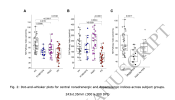
Mean values for Norepinephrine Pathway activity (in pmol/mL) were lower in the post-infectious myalgic encephalomyelitis/chronic fatigue syndrome, post-acute sequelae of severe acute respiratory syndrome coronavirus 2, and Parkinson’s disease groups compared to the healthy volunteer cohort (post-infectious myalgic encephalomyelitis/chronic fatigue syndrome (-15.9, 95% confidence interval [-26.1, -5.7], P=0.0006); post-acute sequelae of severe acute respiratory syndrome coronavirus 2 (-9.62, [-17.9, -1.4], P=0.015); Parkinson’s disease (-19.4, [-27.5, -11.3], P<0.0001)). Post-acute sequelae of severe acute respiratory syndrome coronavirus 2 participants with post-exertional malaise had evidence of central noradrenergic deficiency compared to healthy volunteers (-18.3 [-31.3, -5.3], P=0.0018).

The post-infectious myalgic encephalomyelitis/chronic fatigue syndrome and post-acute sequelae of severe acute respiratory syndrome coronavirus 2 groups did not differ from the healthy group in values for the Dopamine Pathway index. Across all participants, Norepinephrine Pathway activity correlated positively with handgrip duration and general health and negatively with fatigue.

We conclude that post-infectious myalgic encephalomyelitis/chronic fatigue syndrome and post-acute sequelae of severe acute respiratory syndrome coronavirus 2 feature a specific central neurotransmitter pattern involving noradrenergic but not dopaminergic deficiency. The noradrenergic abnormality is associated with major symptoms such as post-exertional malaise.

Web | DOI | PDF | Brain Communications | Open Access
 
Presumably the n=16 PI-ME/CFS are from the Intramural cohort under second author Brian Walitt. (The given reference there is off-target it seems.)

On first reading, this seems like an interesting study and findings that does not attempt to presume causation with reasonable hypotheses (around ATP). Limitations in terms of numbers, sex imbalance, drugs etc are noted.

As with the Intramural study they were unable to usefully evaluate OI: at least in terms of orthostatic hypotension and POTS. This applied to the PASC group also. Presumably cerebral blood flow as a potential index was unavailable in both protocols.

https://clinicaltrials.gov/study/NCT04573062 and https://clinicaltrials.gov/study/NCT04564287

Within the PI-ME/CFS and PASC groups, there were too few instances of orthostatic hypotension or excessive orthostatic tachycardia to conduct meaningful calculations of correlation coefficients.
 
Within the PI-ME/CFS and PASC groups, there were too few instances of orthostatic hypotension or excessive orthostatic tachycardia to conduct meaningful calculations of correlation coefficients.
People with excessive orthostatic tachycardia are extremely unlikely to find themselves into such research programs, they'd have to be sought out, and orthostatic hypotension is such a rare issue in ME/CFS that I don't think I've ever seen more than a handful of comments about it.
 
Screenshot 2026-05-18 at 10.13.22 PM.png
Interesting to see the ME/CFS patients in comparison to people with parkinsons (PD). Also interesting that, despite a known loss of dopamine-producing neurons, there's still a fair bit of overlap between PD and controls on the dopamine measure.

Making random connections: as this paper mentions, apparently cells make norepinephrine by packaging dopamine and the enzyme that converts dopamine into norepinephrine together into 'Large Dense-Core Vesicles' (which have a slightly different membrane than other vesicles and carry higher molecular weight cargo out from the golgi apparatus). As has been mentioned before, a couple of the DecodeME results have to do with vesicle trafficking from the golgi apparatus:
KLHL20, much like RABGAP1L and ARFGEF2 regulates vesicle trafficking between in the region between golgi and membrane
 
I was wondering when we’d see more about norepinephrine from this team. Interesting that they list the EEfRT as having been assessed, but did not report on it.

While working on our response to the interpretation of the EEfRT task in the NIH intramural study, I got excited about norepinephrine. Thought it would be worth sharing here.

First, here’s what Dr Madian (NIH team, was in charge of the EEfRT in the intramural study) said in the symposium (from about 2:24:35):“A lot of” the process of effort-based decision-making happens in the valuation network, and another region called the locus coeruleus is also involved - it produces norepinephrine for the rest of the brain. He points out

Importantly, the functioning of these brain regions does not appear to be under conscious control.
Importantly, we also found a strong positive correlation between levels of the neurotransmitter norepinephrine and the proportion of hard trials chosen in people with ME/CFS. This suggests a neurobiological underpinning, potentially involving the locus coeruleus and valuation network, for disrupted effort discounting in ME/CFS.
That correlation is shown in the slide as R=0.65, p=0.01, n=14.


Here’s what I wrote 19th August 2024 to @andrewkq and the rest of the team:

"This morning I’ve been thinking about norepinephrine. I feel like I’m onto something here, but it’s entirely possible that I’m barking up a particularly incorrect tree. Interested to see what you think.

They report that norepinephrine levels did not differ between groups. I note that the means are HVs: 146.2pg/ml, ME/CFS: 115.6pg/ml, with a lot of variance, and samples of n=18 and n=16 respectively.

In figs 6d and 6e, they illustrate that the higher the norepinephrine level in patients’ cerebrospinal fluid, the longer they can sustain 50% grip force (R=0.61) and the more hard tasks they chose (PHTC/effort preference) in the EEfRT (R=0.65).

I wondered about the relationship between norepinephrine and how successful people were at completing the hard tasks they chose. [Edit for S4ME: So not just whether they chose a hard task over an easy one, but whether they could actually do the hard task, which was 98 button presses in 21 seconds with the non-dominant little finger.]

I had a look at norepinephrine levels in cerebrospinal fluid of participants who did both lumbar puncture and EEfRT, again dividing the patients into those who patterned with the healthy volunteers on the EEfRT hard task (good completers) and those who successfully completed a lower proportion of hard tasks than every healthy volunteer (poor completers): [Edit: emphasis added for S4ME]

  • Healthy volunteers (n=13) NE=157 pg/ml
  • Good completers (n=8) NE=134 pg/ml
  • Poor completers (n=6) NE=91 pg/ml

… the patients who were poor completers on the EEfRT weren’t choosing anything during the LP. But it looks like their resting norepinephrine levels separate them from people who could do the hard task.

The 8 patients who did the CPET had mean NE=128.6pg/ml, ie closer to the average of the good completers than the poor completers. Only 2 poor completers did the CPET. So while Walitt et al. suggest that CPET didn’t correlate with effort preference because strong verbal encouragement overcame it, maybe it was just that the 8 patients who did the CPET had higher norepinephrine than the average patient…”

I’m cutting it off there as I would want to hear back from @andrewkq about whether he’s comfortable with me posting the next bit.

Hope this is interesting to some.

Thread for use of EEfRT in NIH study
Thread for our response
 
Last edited:
The sequel.

I asked Andrew whether there was a correlation between

· norepinephrine x proportion of hard tasks successfully completed
· norepinephrine x grip failure (non-dominant) and norepinephrine x grip failure (dominant)

Andrew ran those analyses and confirmed the next day (20th April 2024) that:

"CSF NE does have a strong correlation with hard task completion rates for the ME subset, rs = 0.72, p = .004, so that could be used as evidence that their proposed neuropharmacological basis for effort preference is actually a basis for the motor dysfunction measured by hard task completion rates...CSF NE is correlated with both dominant and nondominant grip time to failure, stats for nondominant are r = .53, p = .04."
[posted with permission from @andrewkq]

So lower norepinephrine in the cerebrospinal fluid - rather than "effort preference" - could be the "neurobiological underpinning" of patients' difficulty with the hard task in the EEfRT and the grip test.

And differences in CSF norepinephrine levels between the subgroup of patients who did the CPET and the larger groups that did the EEfRT - rather than verbal encouragement - could explain the CPET's lack of correlation with "effort preference".

What do people who know more about neurobiology think? @SNT Gatchaman
 
Last edited:
I find it hard to square low noradrenaline with the claimed link to POTS, which, together with ME/CFS in general has in the past been claimed to indicate upping of sympathetic and downing of parasympathetic I think. But that was likely nonsense anyway.
I wonder if there's a difference between plasma and CSF levels of norepinephrine. I think hyperadrenergic POTS is associated with higher plasma NE levels, but I don't know about CSF.

This seems to be heading towards studies of SNRIs and other norepinephrine modulators:
Our findings have implications for potential treatments of these forms of infection-associated chronic illness, depending on whether future research confirms that central noradrenergic deficiency in these conditions is pathophysiologically significant.
Evaluating causation could be done by examining effects of manipulations of central
norepinephrine release, reuptake, or metabolism on neurobehavioral measures.

That line of inquiry doesn't fill me with enthusiasm, but we'll see.

In psychiatric diseases, this whole area sounds complicated, and treatment messy. These quotes are from https://www.psychiatrist.com/jcp/dysregulation-of-noradrenergic-activity/
today’s clinician is called to think astutely and thoughtfully about the optimum modulation of norepinephrine functioning through a wise combination of pre- and post-synaptic receptor actions
Treatments focusing on maintaining a balance of norepinephrine activity are crucial since symptoms can develop at both high and low levels of activity because of the varying receptor affinity and activation at different levels of norepinephrine activity.
Targeted treatments for conditions with underlying dysregulation of noradrenergic signaling would be able to affect both the “accelerating” and “braking” mechanisms in the neuronal system pharmacologically better to mimic the body’s homeostatic regulation of norepinephrine firing. The most commonly used agents, including norepinephrine reuptake inhibitors, are too nonspecific, preventing norepinephrine reuptake everywhere and flooding the brain with norepinephrine. Conversely, some direct norepinephrine receptor modulators like prazosin, clonidine, and guanfacine, which target only the braking or the accelerating mechanisms, may be too narrow. As such, treatment goals should focus on the ability to modulate the symptoms created both by hypernoradrenergia and hyponoradrenergia safely and appropriately.
 
Last edited:
Back
Top Bottom