Preprint Biological Insights from Genome-Wide Association Studies and Whole Genome Sequencing of [ME/CFS], 2026, Maccallini et al

I remember in my sickest years lying in bed trying to get through every day, year after year, no internet. I felt so alone and so scary ill. I longed for research. S4ME would have been a great help knowing things were being done and members here were constantly looking into it. Thank you everyone, means so much to me.
 
Last edited:
Only this week we have woken up to the fact that ME/CFS gives an unusual response to buspirone. I have already asked some colleagues if they would like to look at that again. The genetic stuff is falling in to place in a way that I suspect can only snowball. [...] the rest of us think we might just have turned the biggest corner for twenty years.
With the buspirone reaction? Or lots of things together?
 
You only need one lot of people and there is a big lot here.
I've been thinking about this, in light of all the exciting new ideas people shared this week. It's amazing how much progress you can make with a group of clever, motivated people working together.

E.g. contrary to the popular image, mathematicians are extremely sociable (well, about math at least) and constantly get together at conferences and online because it accelerates problem-solving so much (and it's more fun).

Somehow during undergrad I never realized how similar problem solving in biology can be to problem solving in math. E.g. in both cases it's key to have a grab-bag of common counterexamples to test new ideas against. In math these are things like weird functions (also, funnily enough, the number '2'). In biology, better-understood illnesses seem to play the same role?

Recently, AI solved a non-trivial open math problem, and a bunch of famous mathematicians got together to write a mildly fascinating paper on the state of things and their feelings about it.

A lot of it feels relevant to us. E.g. here's Daniel Litt explaining how this math problem (which, it turned out, we had the tools to solve) remained unsolved for so long:
Daniel Litt (in the math paper) said:
One possible explanation for such low-hanging fruit: those working on the problem have anchored onto a non-optimal approach or belief about the truth. Another: the solution requires ideas from areas with which most of those working on the problem are unfamiliar.

In my own area—algebraic and arithmetic geometry—there are simply very few practitioners, and so arguably all problems are attention-bottlenecked.
I love the term "attention-bottlenecked" and I feel like this forum fights against exactly the three issues he outlined.
 
Last edited:
I've been thinking about this, in light of all the exciting new ideas people shared this week. It's amazing how much progress you can make with a group of clever, motivated people working together.

E.g. contrary to the popular image, mathematicians are extremely sociable (well, about math at least) and constantly get together at conferences and online because it accelerates problem-solving so much (and it's more fun).

Somehow during undergrad I never realized how similar problem solving in biology can be to problem solving in math. E.g. in both cases it's key to have a grab-bag of common counterexamples to test new ideas against. In math these are things like weird functions (also, funnily enough, the number '2'). In biology, better-understood illnesses seem to play the same role?

Recently, AI solved a non-trivial open math problem, and a bunch of famous mathematicians got together to write a mildly fascinating paper on the state of things and their feelings about it.

A lot of it feels relevant to us. E.g. here's Daniel Litt explaining how this math problem (which, it turned out, we had the tools to solve) remained unsolved for so long:

I love the term "attention-bottlenecked" and I feel like this forum fights against exactly the three issues he outlined.
I was about to post something about that paper. I agree with your analysis of the situation here.

We just have to try our best to not quash the new ideas too quickly if they are packaged in a way or with other things that are easy to pick apart (note to self). It might still be that the principles or angles take us further.

In a way, we have to manage to be very stubborn about following a particular argument to the very end, but also very open to new ideas. It gets disorienting fast.
 
We just have to try our best to not quash the new ideas too quickly if they are packaged in a way or with other things that are easy to pick apart (note to self). It might still be that the principles or angles take us further.
I do wonder if there are any long covid (or MECFS) papers that we have dismissed on the basis of describing unusual cytokine activity as 'inflammation' or talking about 'T cell exhaustion' or whatever that might be telling us something important underneath the usual memes.
 
I do wonder if there are any long covid (or MECFS) papers that we have dismissed on the basis of describing unusual cytokine activity as 'inflammation' or talking about 'T cell exhaustion' or whatever that might be telling us something important underneath the usual memes.
If so they did a good job at hiding it.. Hopefully it will show up in literature searches if the same things are talked about elsewhere.
 
Thank you for reading and commenting the preprint. I have been going through all the posts of this thread and of the related ones.

I would like to emphasize that this is only a preprint. This was originally meant to be a larger analysis, that included unsupervised clustering of ME/CFS among 27 common diseases. Then I realised I had to cut the whole pipeline in pieces in order to polish and refine at least part of it.

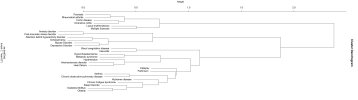
Nevertheless, since this forum is a place where even unfinished drafts can be discussed, I want to share my preliminary classification of ME/CFS based on a weighted average of three clustering methods: ME/CFS is outside the cluster of psychiatric diseases and of autoimmune diseases; It belongs to a somehow heterogenous cluster, between Alzheimer and sleep disorders (see the dendrogram below).

1779627201291.jpeg
It is important to note that this classification can be wrong and I may change the pipeline in the next future.

The complete detail of the analysis is available in my GitHub repository CompareME, with a paper-like README with standard sections: abstract, methods, results.

At present, I have the idea that ME/CFS is a neurologic disease with a mechanism that has never been described before. I also have the impression that ME/CFS patients start having symptoms years before what they indicate as the onset of the disease. But my ideas and impressions have always been wrong in the past. The truth is in the data.


Mod note: we have copied this post to start a new thread Genetic similarities between ME/CFS and other diseases
 

Attachments

Last edited by a moderator:
Great to have you here you react on your own paper!!.
Way over my head, but I really enyoy the discussion about your excellent paper.
Because of my brainfog it feels a bit like listening in on adult's conversations as a child.
Doing it all on your own where whole teams struggle, I take my hat off for you @paolo.
 
Last edited:
@paolo Thank you for your work, I believe that this kind of work will help move things forward significantly

In a previous post you characterize MECFS as a neurological disease. Do you believe that all non neurological manifestations are caused by brain synapses ? Do you believe that trplicated findings of lipid disruption are due to bad study design ?

Also how does your hypothesis explain patients getting significantly better, including having no PEM?
 
@paolo Thank you for your work, I believe that this kind of work will help move things forward significantly

In a previous post you characterize MECFS as a neurological disease. Do you believe that all non neurological manifestations are caused by brain synapses ? Do you believe that trplicated findings of lipid disruption are due to bad study design ?

Also how does your hypothesis explain patients getting significantly better, including having no PEM?

I think that genetic studies on 20,000 patients have several advantages over metabolomic/transcriptomic studies based on peripheral blood of a few patients. Not only the number of patients is bigger, but genetics is not influenced by deconditioning or downstream effects. Also, the genetic analysis is truly unbiased.

Finding suitable healthy controls for individuals that have been housebound for decades does not seem easy to me.
 
Last edited:
Also how does your hypothesis explain patients getting significantly better, including having no PEM?

Recovery is rare. It seems to me that it happens mostly within the first years from onset. We may have insufficient data on those who recover, though.

I recovered once, many years ago at the beginning of my disease, for 12 months. Then, about 15 days after an episode of high fever, I was trapped again; and this time for good.

Did I truly recover that time? And what happened when I got sick again? I don't know. Still trying to find an answer. But I feel I am closer now. I will continue the analyses, knowing that only gathering more data and running proper statistics can give an answer.
 
What would be degenerating? We haven’t found it yet at least.
Yes, there is no proof of degeneration, so far.

But what if it involved a very specific and small cluster of neurons? They could be cells you do not need to survive but without whom these weird symptoms start appearing. Would we find them without extensive post-mortem studies?

Of course, I don't know, but I think this could be one of the hypotheses, once we start thinking ME/CFS as a neurologic disease.
 
"Gene-set analysis identified multiple neuronal and synaptic gene sets, several of which were independently replicated, with glutamatergic synapses as the most specific replicated signal. Cell-type analysis identified independent replicated signals in distinct neuronal populations of subcortical and cerebellar regions."

How many different ways are there to make this happen in the brain.

Kinurenine pathway

Hypoinsulinemia

Hypoglycemia

Phospholipids

TBI

Good night

PS: I don't know if all of the above validly answer my question, or if my question is even valid.
 
Last edited:
I made a separate thread to discuss the eccentric medium spiny neurons (eMSN). These look like a more specific and informative result than synapses, glutamergic neurons, etc.

A comment about my preprint appeared on the Research Square website (link) and while it addresses some limitations that are real and important (I explicitly mentioned them in my manuscript) it appears to be in part an attempt at discrediting this work. The name of the author does not seem to be a real name.
 
Last edited:
A comment about my preprint appeared on the Research Square website (link) and while it addresses some limitations that are real and important (I explicitly mentioned them in my manuscript) it appears to be in part an attempt at discrediting this work. The name of the author does not seem to be a real name.
Put your work on www.biorxiv.org too if you can
 
A comment about my preprint appeared on the Research Square website (link) and while it addresses some limitations that are real and important (I explicitly mentioned them in my paper) it appears to be in part an attempt at discrediting this work.

I would not be too concerned about that comment. It is critical but not dismissive. I think the urging of caution on interpretation is not unreasonable. As you have said yourself @paolo , what matter are the data and these data are of great interest. The interpretation can be very cautious but still make its mark. As in the famous comment in 1953 "It has not escaped our notice..." W&C.
 
A comment about my preprint appeared on the Research Square website (link) and while it addresses some limitations that are real and important (I explicitly mentioned them in my manuscript) it appears to be in part an attempt at discrediting this work. The name of the author does not seem to be a real name.
It mentions limitations, but none that you already acknowledge in your paper and none that make the results unreliable.

The comment itself looks AI-generated to me. As if someone who doesn't understand the methodology asked to find criticism or limitations of the study. Why would anyone write this:
The writing style contains several characteristics often associated with AI-assisted drafting, including repetitive sentence structures, formulaic transitions, exhaustive methodological descriptions, and highly standardized phrasing. However, these features alone do not demonstrate AI generation. Likewise, no clear evidence of plagiarism can be established from manuscript inspection alone; dedicated similarity-checking software and comparison against source literature would be required.
 
Back
Top Bottom