Autism and ME/CFS

I find the idea of autism being an autoimmune disease profoundly unsettling.

I don't know, obviously I have what we now call level 1 autism, and there are people who are far far more disabled by it than me whose lives would be transformed by a hypothetical cure, and that's very important to acknowledge, but just from my personal perspective - the idea that so much of what I think of as my personality could actually be an autoimmune disease state is really weird to contemplate.

If you could 'cure' it, who would I be? How much of what I think of as me would be left after treatment? Would the autistic traits I find beneficial in life or just pleasant/enjoyable be gone too? Would I still be the person my partner loves? I've definitely experienced a lot of challenges and adverse life events due to my autism and people's attitudes to it. But I don't know if I'd want to get rid of it and be 'normal'. I spent years coming to terms with the fact I'd never be 'normal' and learning to like myself. I would have taken a cure in a heartbeat as a teenager but now I probably wouldn't.

Plus like the whole thing about autism awareness now is that it's supposed to be a difference, a variation in cognition. If it's a disease that sort of undoes all of the progress that's been made by advocacy, and validates in some awful way all the parents and doctors and teachers who traumatise their kids by trying to make them 'normal' and fantasise about a cure.

I have always struggled to understand disabled people who talk about not wanting to be cured when I look at it through the lens of MECFS. But when I look at it through the lens of level 1 autism I can see their point.
 
Having spent my life working on autoimmunity I do not see any very good reason to think autism is autoimmune. There is a longstanding belief that autoimmunity is triggered by infection or vaccines but my understanding is that there is little or no convincing evidence to support that. I would have to think more about it but most of the folklore in this area is unsubstantiated.

The wider issue of how to view a "cure" for something that has become part of one's identity is something I thought about a lot even for people with arthritis. The situation is very different from autism but quite a few people say no thanks to treatments and I respected that, having made sure they knew as much as possible about the options and implications.

My gut feeling is that if there is any connection between ME/CFS and autism it is just that they pass through some similar signaling staging post somewhere.
 
For sure - women with lupus, immuno-neuro conditions like ME/CFS are more likely to have kids with different traits like this.

Maybe ME/CFS 'isn't adult autism' but is 'a severe case of a certain type of autoantibody' which is always present in moms that give birth to kids with a certain type of autism?

One such mechanism candidate is pointed to in your cited Frontiers review - "BDNF" (Brain-derived neurotrophic factor - I also see autoabs to BDNF in studies sometimes)! What if 'autism' is 'too much anti-BDNF autoab from mom in brain of fetus.'? What if that was also critical to ME/CFS? Not saying that is the literal link but it's the type of thing we need to find. A literal mechanistic link you could test for in assays.
 
"Having spent my life working on autoimmunity I do not see any very good reason to think autism is autoimmune. I would have to think more about it but most of the folklore in this area is unsubstantiated.

My gut feeling is that if there is any connection between ME/CFS and autism it is just that they pass through some similar signaling staging post somewhere."
Autism (presenting in infancy) may very well have nothing to do with autoimmunity in the infant themselves. This hypothesis would be 'moms have dysregulated immunity due to some 'similar signaling staging post' (perhaps one that also leads to ME/CFS) that leads them to have some specific anti-brain growth autoantibody (ie anti-BDNF). During fetal development, the amount of this autoab (and others) wires the developing brain in a varied neurodivergent ways. The baby then develops as a healthy neurodivergent kid without 'autoimmunity' to the brain from their own native immune system. Another would be that it's acquired early and skews early childhood growth (via their own bad autoab such as from infection or vaccine).

On another of your points - there are mountains of literature on virus-induced autoimmunity.... vaccines much less clear (and very intentionally under-studied in humans). Though... ironically - many of the mouse models used to prove said viral linkages involve not live virus but viral antigen + adjuvant (ie a vaccine...!)

Bill Robinson lab at Stanford has shown EBV is a prerequisite for lupus. In his own words "This is the single most impactful finding to emerge from my lab in my entire career,” said William Robinson, MD, PhD, a professor of immunology and rheumatology and the study’s senior author. “We think it applies to 100% of lupus cases.”


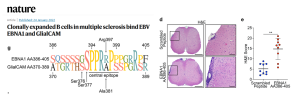
Our arrays were used as part of another big finding out of his group that ~25% of MS cases have immunity to a phosphorylated subunit of GlialCAM (HEPACAM) - hypothesized induced by molecular mimicry to EBV EBNA1.

 
Can you explain how «viral mimic» would work?

There’s a discussion about the concept here, with e.g. @Jonathan Edwards arguing that it doesn’t make sense as a disease mechanism by itself.
This is a really nice thread and I actually agree with a lot of what Jonathan Edwards is saying.

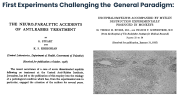
I actually doubt "Guillain Barré syndrome" has anything to do with molecular mimicry as a start. Starting here as he's saying it's likely the one case where mimicry maybe happens. Guillian Barre is deeply tied to our discussions on this topic. It was originally observed as 'neuro-paralytic accidents' following rabies treatment. At the time - many assumed it was surviving live rabies causing the disease. Autoimmunity was assumed to be impossible (based on Paul Erlich's concepts of 'horror autotoxicus' - the body's innate fear of making immunity vs itself).

That was until 1935 - when the paper on the right came out. Rabies vaccine was always grown in rabbit brain. This group showed that injecting the adjuvant and rabbit brain alone - WITHOUT rabies virus - could create this encephalomyelitis (Guillian Barre) in monkeys. Some actually cite this work as the first proof that that Erlich was partially wrong, horror autotoxicus is imperfect, and true autoimmunity is possible.

1779287191411.png

And so downstream of this to our discussion. TLR ligand / adjuvant + damaged tissue/foreign mimic antigen = autoimmunity. The rabbit brain would be a close molecular mimic to monkey brain protein in the above experiment - but non-viral. If it is ever proven that vaccines induce autoimmunity I actually expect it by the above old mechanism. Just like then, vaccines today are often grown in cells (including human cells) and there is an entire literature on 'trace' host-cell protein contamination in vaccine lots. There are leftovers of mammal/yeast/egg/etc cells injected with vaccines globally today.

As to how certain 'mimicry occurs' in the EBV case above... why the veto of tolerance can be overridden. Viruses like EBV have very strange ways of hacking immunity - they bear a copy of the tolerogenic cytokine IL10 which I'm sure causes all sorts of things to go haywire.

I also agree it is hard to prove 'its actually mimicry' - maybe it's just 'TLR ligand from virus + damaged self tissue = autoimmunity' (like the Gullian Barre example above). And maybe EBV causing lupus/MS is more the virus doing 'that' vs literally being a mimic. The Lanz/Robinson case on GlialCAM is very good! The EBV link is very good! But the EBNA1 mimicry link.... well they show autoantibodies and T cells to the EBNA1 fragment in question recreate MS in mice (via vaccination haha). So they can literally 'recreate' the mimic and induce MS-like symptoms in mice. It's a good experiment!

1779288135849.png


But does this 'prove' chronic EBNA1 antigen induces the anti-glialCAM autoab to that sequence? Not necessarily. It could simply be that EBV kills cells in ways that induce autoimmunity that cross-reacts with EBNA1 by accident (ie maybe like the rabies encephalomyelitis above not needing rabies virus present - maybe the 'immune environment' EBV creates for itself would cause MS sometimes even without that sequence existing within EBNA1). The above hypothesized mimic sequence SPPRxPxxxxR is an amount of mimicry that happens ALL THE TIME. Nearly any viral protein will have a 6/11 mimic match to half the human proteome.

I'm actually working on an app to 'automate' discoveries like the above... Below is GlialCAM / HEPACAM (human - the MS antigen bearing the sequence above) it is painted for literal molecular mimicry to canonical EBV proteins at 6/9 amino acid identity. There are a ton! All of these are a STRONGER 'mimic' in literal sequence than the 5/9 match in the famous Lanz and Robinson paper. That famous one at sequence level is not even that good or unique of a sequence-level molecular mimic! Everything painted on here are EBV mimics from other proteins and sites that are ABOVE the threshold of the one that paper is centered on.

Does this mean I don't think mimicry-induced-autoimmunity happens? No actually I do. Lanz and Robinson still have a very solid case. There is truly mimicry-level sequence identity everywhere you look across human and virus sequences - so much of it that I expect it becomes pathogenic in rare cases. But I will agree that it's terribly hard to prove 'why' this happens in one case and not another and is likely a lot more complicated than just matching sequence identities as I've found out for myself below...

1779288420063.png
 
Last edited:
This hypothesis would be 'moms have dysregulated immunity due to some 'similar signaling staging post' (perhaps one that also leads to ME/CFS) that leads them to have some specific anti-brain growth autoantibody (ie anti-BDNF).

That seems reasonably wild speculation to me.
On another of your points - there are mountains of literature on virus-induced autoimmunity....

That was my point. But almost all of it empty speculation. Give me a well established example. The role of EBV in MS seems solid but there is no good evidence for mimicry being involved. I have lived with this myth for fifty years now. It all started with trying to explain rheumatic fever and was never proven even there.

You can induce autoantibodies with adjuvant in animals but there is not a shred of evidence for that being relevant to human disease. Believe me, I have worked with these animal models.
Bill Robinson lab at Stanford has shown EBV is a prerequisite for lupus.

I am not convinced. We knew of EBV negative cases of lupus in the 1980s (my mother then ran the EBV service at the Central Public Health Laboratory in the UK and collaborated with the my lupus friends). This is a story that has been going for ever. And again, no decent evidence for mimicry.
 
immunity to a phosphorylated subunit of GlialCAM (HEPACAM) - hypothesized induced by molecular mimicry to EBV EBNA1.

Hare Krishna. Molecular mimicry is the stuckest vinyl LP of all time. And as someone has already pointed out we have discussed it previously and it provides no explanation for the autoimmune response, since the self antigen is already there. You need some other factor to explain the autoreactivity and there are much more elegant ways of doing that than MM.
 
Hare Krishna. Molecular mimicry is the stuckest vinyl LP of all time. And as someone has already pointed out we have discussed it previously and it provides no explanation for the autoimmune response, since the self antigen is already there. You need some other factor to explain the autoreactivity and there are much more elegant ways of doing that than MM.
Yes! Adjuvant + self antigen can induce autoimmunity without virus present. But that does NOT mean molecular mimicry is not also an elegant layer that can stack on top of this, and perhaps does so pervasively and chronically in all of us.

It just means it's much much harder and more complex to prove (or dismiss) :)
 
That seems reasonably wild speculation to me.


That was my point. But almost all of it empty speculation. Give me a well established example. The role of EBV in MS seems solid but there is no good evidence for mimicry being involved. I have lived with this myth for fifty years now. It all started with trying to explain rheumatic fever and was never proven even there.

You can induce autoantibodies with adjuvant in animals but there is not a shred of evidence for that being relevant to human disease. Believe me, I have worked with these animal models.


I am not convinced. We knew of EBV negative cases of lupus in the 1980s (my mother then ran the EBV service at the Central Public Health Laboratory in the UK and collaborated with the my lupus friends). This is a story that has been going for ever. And again, no decent evidence for mimicry.
Ha! Unreasonably wild speculation is the only way to find the causes of cause-unknown conditions.

'Function modifying autoantibodies' are very very much a thing. 5% of people over 70 have type I IFN blocking autoabs. There are dozens upon dozens of these cases demonstrated now. To 'speculate' that (known) anti BDNF autoabs in mothers (known) to bear autistic children might have functional relevance is not exactly wild speculation. It is wildly far from proof of course - but a valid hypothesis nonetheless.

Functional assays are much much harder than showing autoabs stick. But Paul Bastard / JL Casanova doing great work that even 'weak' autoabs can directly skew and impact immune function.
 
Bill Robinson lab at Stanford has shown EBV is a prerequisite for lupus. In his own words "This is the single most impactful finding to emerge from my lab in my entire career,” said William Robinson, MD, PhD, a professor of immunology and rheumatology and the study’s senior author. “We think it applies to 100% of lupus cases.”
Thread here:
 
You are entitled to go on believing what everyone else has believed for fifty year without a scrap of evidence or any sound rationale but I moved on a while back!!
I presented clear evidence and admitted it has caveats - there are more than scraps there. And of course there are caveats and alternative pathways to everything. You can also inject a mouse with pristane and induce lupus! I also assume '100%' is an absurd claim. But there being EBV-negative outliers' does not prove you can entirely dismiss a strong causal link between EBV and lupus (or mimicry). Sigh... I'll go read the thread. Believe it or not it is actually refreshing for me to encounter so many people with opinions on these things.
 
Ha! Unreasonably wild speculation is the only way to find the causes of cause-unknown conditions.

Yes, I know a bit about speculation -good and bad. You might take note that it was my understanding of the futility of the molecular mimicry path that led me to introduce the concept and practice of B cell depletion therapy in autoimmune disease in 1998. That approach has proven its worth in tens of billions of dollars. I feel a teeny bit entitled to wait for the proof of your pudding.
 
The above hypothesized mimic sequence SPPRxPxxxxR is an amount of mimicry that happens ALL THE TIME. Nearly any viral protein will have a 6/11 mimic match to half the human proteome.
But this is the problem with the hypothesis. If it happens all the time, why does it create disease in one person and not the other?

If something is normal, it will result in something normal. There has to be something abnormal for disease to happen.
 
The discussions in this thread rightly question the 'mechanism' proposed in the paper. I do not think this paper necessarily 'solves' lupus. Nor perhaps did the EBNA1/GlialCAM mimicry paper 'prove' that is literally the cause of MS. But the experiments seem good - the mechanism remains elegant and plausible - and there are undeniable population-level links between EBV and these diseases.
 
But there being EBV-negative outliers' does not prove you can entirely dismiss a strong causal link between EBV and lupus (or mimicry).
Why not? The only way around it would be to construct a completely different explanation for lupus that doesn’t involve EBV, and show that both that and the EBV model can apply.
The discussions in this thread rightly question the 'mechanism' proposed in the paper. I do not think this paper necessarily 'solves' lupus. Nor perhaps did the EBNA1/GlialCAM mimicry paper 'prove' that is literally the cause of MS. But the experiments seem good - the mechanism remains elegant and plausible - and there are undeniable population-level links between EBV and these diseases.
If you ignore those with no links, sure.

I don’t understand why the outliers are essentially ignored. Wouldn’t they provide very valuable clues about what the mechanisms might be?
 
But this is the problem with the hypothesis. If it happens all the time, why does it create disease in one person and not the other?

If something is normal, it will result in something normal. There has to be something abnormal for disease to happen.
Everyone has hundreds of private autoantibodies that are stable for decades and private to themselves. Most are assumed to be harmless; but that does not mean all are 'normal.' I do yes tend to assume that they are sustained via chronic antigen exposures and cross-reactivity molecular to chronic viral/food/microbial antigens. This does not seem so absurd to claim?

I think these autoantibody mistakes tend to be random, mostly harmless - but where they are harmful then they cause disease. IE multiple sclerosis will be RARE even though EBV will be COMMON. That ME/CFS will be RARE even if whatever its trigger happens to be is COMMON. The 'bad place to make the mimic mistake' will be an accident of that person's immune system tied to genetic features like the HLA-type, predisposition to present that mimic antigen and activate a bad response, plus random chance itself.

IE I tend to assume everyone that gets an EBV infection will in their response create molecular mimic autoabs - likely dozens or hundreds of mimic clones and yes caused by all that pervasive mimicry I pointed out. Most of these will be benign and hit various random places in intracellular proteins or be very weak antibodies to non-critical regions of surface/circulating molecules. But sometimes, in rare cases, they will hit just the right thing in just the right way - and that becomes the 'disease' we are talking about. IE most molecular mimicry events induced by EBV are very different from the EBNA1/GlialCAM case - but only in that case do you get the disease.
 
IE I tend to assume everyone that gets an EBV infection will in their response create molecular mimic autoabs - likely dozens or hundreds of mimic clones and yes caused by all that pervasive mimicry I pointed out. Most of these will be benign and hit various random places in intracellular proteins or be very weak antibodies to non-critical regions of surface/circulating molecules. But sometimes, in rare cases, they will hit just the right thing in just the right way - and that becomes the 'disease' we are talking about. IE most molecular mimicry events induced by EBV are very different from the EBNA1/GlialCAM case - but only in that case do you get the disease.
The question is still why some people end up with the bad autoantibodies and others don’t.

If I’ve understood it correctly, which is by no means a guarantee, the binding parts of the antibodies are generated randomly, so everyone will generate autoantibodies for everything.

Which events have allowed for the survival of pathogenic autoantibodies? How did they get past all of the checkpoints that are supposed to weed out autoantibodies with a strong enough affinity to self before they get out and about doing damage?
 
Back
Top Bottom