You can learn more about PEM and pacing in our short, ten minute talk "Top ten tips for PEM".
I thought this wasn't too bad, it's probably not going to be harmful. However, it isn't really focussed on PEM, there's more content on pacing. If I didn't know what PEM is, I don't think this presentation would help me understand, so I can't recommend it as a resource on PEM.
In the first slide, it is said that 'in a 7 month long study, 90% of those who had had Covid-19 reported experiencing PEM'. I really doubt that all of those people had PEM.
There is a feeling of 'medical professionals know best'. For example, when talking about pacing, the presenter says 'usually patients need to be taught it'. I don't think that is true, I think most people with ME/CFS will find their way to some sort of pacing quite quickly. Life is just too brutal and unworkable otherwise. Yes, possibly a medical professional can help finesse things and can validate people's approaches, and certainly they can be very useful when the patient does not have much power to manage the expectations of those around them, for example, when the patient is a child or is very ill. But, it would have been good for this nurse, who sounds very pleasant and caring, to have acknowledged the knowledge that people will bring to the adaptation that has to occur. I think most successful pacing really has to be worked out by the person themselves.
There is a mention of sticking to a pacing plan, even when someone feels good. I think most people who have had ME/CFS for a while don't have a pacing plan.
There's a focus on 'the safe activity level' and establishing a baseline. 'We encourage people to rest at that 60% charge, rather than than when they have very little or no charge left'. I know it's just a metaphor, but the result is that it all comes across as 'knowable' and 'controllable'.
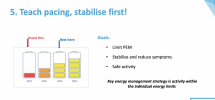
'Pacing, like any skill, must be practised and it becomes easier over time'. There's talk about helping the patient to think about things like whether they could get a carpark closer to the office. But, there is no mention of the big decisions that people need to make - do they need to work part-time? do they need to not work at all? do they need to move in with family? can they get some paid assistance? There also is no mention of the support that people need to be able to make the decisions they need to, to avoid PEM.
There is a slight hint of 'pacing up'. For example, there's talk of finding out how long a person can read for their job before they need to take a break. 'Don't increase that time, until it doesn't cause PEM.'


