A Digital Platform with Activity Tracking for Energy Management Support in Long COVID: A Randomised Controlled Trial, 2025, Hayes et al

forestglip

Moderator
Staff member
Now published - see post #17


Preprint
A Digital Platform with Activity Tracking for Energy Management Support in Long COVID: A Randomised Controlled Trial

Lawrence Hayes, Nilihan Sanal-Hayes, Jacqueline Mair, Antonio Dello Iacono, Joanne Ingram, Jane Ormerod, David Carless, Natlie Hilliard, Marie Mclaughlin, Rachel Meach, Nicholas Sculthorpe

Abstract
People with long COVID (LC) report worsening symptoms after activity, like post-exertional malaise (PEM) in chronic fatigue syndrome (CFS). The National Institute for Health and Care Excellence (NICE) recommends ‘energy management’ for CFS, but at the time of writing, how people with LC would respond to energy management was unknown.

In a 6-month pragmatic decentralised randomised controlled trial (RCT), we compared a just-in-time intervention to support energy management in adults with LC to standard care. Participants were randomised to receive either the ‘Pace Me’ app and a wearable activity tracker (intervention) or an app only with data entry screens (control). The intervention group received just-in-time messages on PEM management when they reached 50%, 75%, and 100% of their daily ‘activity allowance’. The primary outcome was PEM measured by the DePaul Symptom Questionnaire-Post-Exertional Malaise (DSQ-PEM).

Of 368 participants assessed for eligibility, 250 participants were randomised 1:1, but 36 control and eight intervention participants were lost to follow-up. 12 control and 24 intervention participants were excluded from analysis due to missing data. 84 intervention participants and 77 control participants were analysed. There was no time by group interaction for the DSQ-PEM. The intervention group value was 48 (95% CI 44–53) pre-intervention and 46 (95% CI 41–51) post-intervention (arbitrary units). The control group value was 47 (95% CI 42–52) pre-intervention and 44 (95% CI 39–49) post-intervention (interaction effect p = 0.614, η²p = 0.002; trivial). No individual question exhibited an interaction effect (P > 0.05).

Digitally supported energy management in people with LC had no effect on PEM compared to standard care. Although the intervention had no additional effect compared to control, the substantial recovery rate in LC may have masked intervention effects. Therefore, future studies should consider this energy management framework in conditions without such recovery rates, such as CFS.

Link | PDF (Preprint: Research Square) [Open Access]
 
Last edited by a moderator:
The intervention used a personalised activity allowance, initially set to no more than 30 minutes of activity above 60% of their age-predicted heart rate maximum. This allowance was iteratively adjusted in response to participants’ activity and PEM reports. If participants reported PEM and had exceeded the allowance, the allowance remained unchanged (i.e. the PEM may be due to poor pacing). If participants reported PEM but had remained within their allowance for the preceding 3 days, the allowance was reduced in a stepwise fashion (i.e. activity allowance may be too large to prevent PEM). Conversely, the allowance was increased if participants did not report PEM for three consecutive weeks. For participants with unstable heart rates (e.g. autonomic issues), step counts were used to set activity allowance. These limits were not intended as targets but as a guide for energy management.
The bolded section is literally pacing up.

If their aim was to reduce PEM - why did they encourage the participants to do more once they’ve managed to avoid PEM for a short while?
 
This is the first study of its kind to examine digital technology to support energy management in conditions with PEM. We rigorously tested guided energy management in this randomised controlled trial (RCT), the first since the landmark PACE Trial, published over a decade ago 22.
This statement is a bit worrying..
 
A consequence of these findings is that, for most individuals (excluding a small proportion who may develop a more persistent post-viral condition), LC differs from conditions like ME/CFS, where recovery can take years or may not occur at all. Consequently, the effectiveness of this type of activity-tracking just-in-time intervention is less certain for individuals with ME/CFS, who are unlikely to experience significant recovery or symptom reduction within the timeframe of such trials.
I don’t understand the last sentence. Would it not be beneficial if an intervention prevented worsening - which is a plausible result for some pwME/CFS if pacing properly?
 
Couple of things from a quick skim of the PDF:

Exclusion Criteria
Participants were excluded if they (1) had insufficient English language to understand messages, (2) had no smartphone access, (3) were participating in another LC intervention, (4) had impaired cognitive function which compromises comprehension of study information or messaging, (5) were receiving therapies known to cause symptom exacerbations (e.g. chemotherapy) or aimed at treating LC, (6) or (6) were receiving ongoing care for LC via primary or secondary care services.

That suggests their participants were on the milder end of LC, because those with more severe symptoms would have been more likely to already be on a GP or specialist care pathway and so ineligible for the study?


(from Discussion)
it is possible that some control participants used their own activity tracker or app to modify and manage their activity. For example, part way through the trial a commercial app aimed at energy management was launched and some control participants may have decided to use that app
 
A second limitation, although necessary, was that we provided activity trackers to the intervention group but not the control group. The reason we believed this necessary was provision of a wearable would be in itself a form of intervention. As such, it is possible that similar frequency and severity of PEM existed between the two groups despite differences in physical activity, but due to our design we cannot examine this.
This is a flawed argument. A controlled placebo does not mean ‘no intervention’, it means to try to replicated every aspect of the intervention except for the part you want to measure the relative effect of. If the app was the thing they believed would create an effect - they could have given everyone a fitbit.
 
Last edited:
The intervention integrated heart rate and step count feedback using Fitbit Charge 5, logging of PEM, logging of symptoms, and support messaging when patients exceeded their energy allowance (see supplementary information 1 for full details of the intervention).
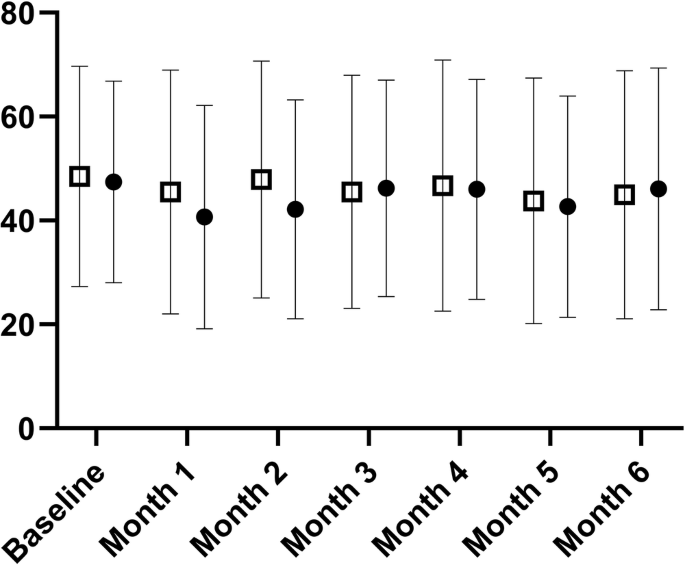
I can’t find this. There are only two images in the supplementary files. Including this weirdly labeled graph (image file is named days without PEM):
fcb4756781c616239040cc4c.tif

I would have put the months on the left axis and plotted the intervention with solid colours and the control with just the outline.

Edit: I would also have flipped the axes - time is usually on the x-axis.
 
Last edited:
Yeah it’s weird. If the point is to avoid PEM. Try pacing strict.

If the point is to test that some softened “PEM aware” version of Graded Activity Management would work for pwLC, why did they have PEM as a primary outcome, and not something like FUNCAP. I mean you'd want something that can show improvement in the functioning. I guess they kind of removed the step data from the abstract since it didn't show any difference.

Also noting that the DePaul Symptom questionnaire they use measures something more like long lasting fatigue after exertion, than PEM.
 
Last edited:
That is deliberate. The paper is a pre-print so this will be how the journal expects the manuscript; usually they ask for figures as separate files or collated at the end of the document.
I’m confused. Is this normal for pre-prints? It’s the first time I’ve come across it.

I can understand that they would send it to the publisher like that, but not that the published preprint wouldn’t include the figures in the correct place.

Is it just how the platform works - you can’t insert figures?
 
I’m confused. Is this normal for pre-prints? It’s the first time I’ve come across it.

I can understand that they would send it to the publisher like that, but not that the published preprint wouldn’t include the figures in the correct place.

Is it just how the platform works - you can’t insert figures?

I don't know exactly how it works, but pre-prints are not yet typeset in the journal style, so it is common to upload the submission file and separate files for figures, but I'm sure you'd find pre-prints where the figures are inline.
 

News Release 2-Feb-2026

Tracker to help manage Long COVID energy levels created by researchers​

Peer-Reviewed Publication
Lancaster University


FacebookXLinkedInWeChatBlueskyMessageWhatsAppEmail

DrLawrenceHayes
image:

Dr Lawrence Hayes of Lancaster Medical School


view more


Credit: Lancaster University

The first study to test a digital tool designed to help people with Long COVID manage their energy levels has been developed by a team of researchers.

The paper published in Nature Communications is entitled “A Digital Platform with Activity Tracking for Energy Management Support in Long COVID: A Randomised Controlled Trial”.

In this study, funded by the National Institute for Health and Care Research (NIHR), people with Long COVID tried out a new app called “Pace Me” to help manage their energy levels. The tool combines a wearable activity tracker (Fitbit watch) with an app that sends helpful messages throughout the day, reminding users when they may be doing too much.

The research was carried out by a team jointly led by Dr Lawrence Hayes of Lancaster University with Dr Nilihan Sanal-Hayes from the University of Salford and Professor Nicholas Sculthorpe from the University of the West of Scotland among others.

Dr Hayes of Lancaster University said: “This trial marks a significant step in understanding how digital tools can support people living with Long COVID. While the intervention didn’t outperform standard care, it was safe, well-received, and offers a promising framework for future research in chronic conditions where recovery is less likely.”

The study split a total of 250 participants equally and at random between two groups. One group used the app with a wearable tracker that gave real-time feedback and alerts when they were close to doing too much. The control group used a “dummy” version of the app with only data entry screens (no tracking or alerts). The final analysis at the end of six months included 84 users of the app and 77 control participants using the “dummy” version.

The main symptom measured was post-exertional malaise (PEM), which is when symptoms get worse after physical or mental effort.

Over six months, both groups felt better overall. Participants exceeded their energy allowance on average for around 50 or so days over six months. Thirteen participants in the intervention group improved from PEM-positive to PEM-negative status while the numbers of intervention participants reporting PEM at baseline fell by 10%.

Dr Hayes said: “This study demonstrates the feasibility of using digital platforms for energy management in Long COVID. Although the intervention did not reduce PEM more than standard care, these results give us important clues for designing future digital health tools, especially for people with long-term conditions that involve fatigue and symptom flare-ups after activity. It lays the groundwork for future trials in conditions with more persistent symptoms, such as ME/CFS, lupus, MS, or other fatiguing conditions.

“In line with the Darzi report and NHS long-term plan, the platform could be adapted for other chronic illnesses with PEM-like symptoms, offering scalable, remote support for symptom management. The study also highlights the importance of tailoring digital interventions to the recovery trajectory of specific conditions.”


Journal​

Nature Communications

DOI​

10.1038/s41467-025-64831-y

Method of Research​

Randomized controlled/clinical trial

Subject of Research​

People

Article Title​

A Digital Platform with Activity Tracking for Energy Management Support in Long COVID: A Randomised Controlled Trial

Article Publication Date​

2-Feb-2026
 
and offers a promising framework for future research in chronic conditions where recovery is less likely.”

If it didn't deliver a benefit, then what is it purpose?
 
Quite a drop out rate too including nearly 50% in control which shows what an obligation writing the equivalent of diary entries is.

I agree with @Sean that whilst I guess it’s the pr culture at the moment it’s all very only inside their own bubble and shows their industry up as pointless when there are no results but it’s still pushed as the way forward without even a ‘lessons learned’ note that squares the circle why the results don’t just mean bin it.

I thought it was a laugh too that they haven’t picked up on the ave of 50dsys overdoing it energy-wise in 6months being the bit that shows PEM and also the world we are stuck living in - and it’s not us forgetting to say no that’s the issue

THATS the best representation of me/cfs I’ve seen. A body of invidious choices that can’t make ends meet in a world where you will have to do certain things and then take the hit. 50 days in 182 to me sounds like one day on then 2.6 days iller/doing less.

Of course a bleep didn’t make half-showers possible or get that visitor out the door or the neighbour to not be noisy or mean you could get your workload sorted by your boss so it was less (not managed out in chunks but still the same impossible to complete even when done more intensely in time given etc). It didn’t make the groceries jump in the fridge by themselves.

That needed something those who get involved with these things for the wrong reasons don’t want to do: analyses and listen open-minded and properly to then be an advocate in the true sense of the word. THAT worded as ‘look at what these people go thru, we can see it’ and example h how much of it was unavoidable OR required others to help (which requires them to believe ‘that extra’ they thought would build them up or stop them getting deconditioned sent them into bed and pain for days). And no one other than politics/hidden culture etc is stopping them from adding that part into their job.

Without it such things are useless. It’s like training up the person who gets regular heart attacks in cpr and choosing not to tell anyone around them that they’ll need it but saying ‘it’s ok they know how to do cpr now you can stop worrying about them’ at its best.

I’m still cynical that many people (particularly bad seem to be those calling themselves the experts) don’t get that talking about folding tea towels in a staggered way so it’s only some each day not a whole pile isn’t the fix for me/cfs and it’s a horrible belittling and misrepresentation and understanding of the world and body we live in that makes the illness and how we are treated daily worse by undermining us

Of course they don’t talk about the things we really have to do like a shower someone with accuse us of letting ourselves go fur not having. Because THEY can’t come up with a way of having half a shower one day and the other half the next and not double the energy for the whole thing anyway and just run the risk your body wasn’t up to it on two days that week to even do half a shower.

So I get annoyed by this. Because I know whose hands it’ll fall into and paternalism is the blight we need to eradicate from me/cfs not have more of and more of justifying or sliding in under false pretences.

Why aren’t they using tracking to be curious and discuss with the patients what these patterns represent from their own insight rather than assuming. And then using that to educate the non-experts who keep insisting using that self-appointed title?
 
Back
Top Bottom