The role of genetic liability for psychiatric disorders and personality traits in [LC]: data from three Nordic population cohorts, 2026, Quinn+

SNT Gatchaman

Senior Member (Voting Rights)
Staff member
The role of genetic liability for psychiatric disorders and personality traits in post covid syndrome: data from three Nordic population cohorts
Liam Quinn; Ida Henriette Caspersen; Ingibjörg Magnúsdóttir; Yue Wang; Mischa Lundberg; Jesper Gådin; Kadri Kõiv; Anna Bára Unnarsdóttir; Arna Hauksdóttir; Bitten Aagaard; Bjarke Feenstra; Christian Erikstrup; Christina Mikkelsen; Jakob Hjorth von Stemann; Nanna Brøns; Josephine Gladov; Lotte Hindhede; Maiken Astrup Madsen; Lea Arregui Nordahl Christoffersen; Jacob Træholt; Bertram Kjerulff; Jens Kjærgaard Boldsen; Johan Skov Bundgaard; Line Hjorth Stjernholm Nielsen; Mette Skou Bentsen; Khoa Manh Dinh; Joseph Dowsett; Maria Didriksen; Michael Schwinn; Lisette kogelman; Anne Grosen; Tanya Techlo; Christina MIkkelsen; Thomas F Hansen; Susan Mikkelsen; Kathrine A Kaspersen; Laura Barrett Ryø; Rasmus Tanderup Jensen; Casia Nursyifa; Caroline Thue Hvilsom; Emil Jørsboe; Dorte Helenius; Edda Bjork Thordardottir; Elzabeth C Corfield; Erik Sørensen; Frank Geller; Jakob Thaning Bay; Jóhanna Jakobsdóttir; Johanne Hagen Pettersen; Kelli Lehto; Khoa Manh Dinh; Kristjana H Ásbjörnsdóttir; Lill Trogstad; Maria Didriksen; Mie Topholm Bruun; Ole Andreassen; Per Magnus; Ragnhild Eek Brandlistuen; Sisse Rye Ostrowski; Søren Brunak; Thomas Werge; Thor Aspelund; Helga Ask; Unnur Anna Valdimarsdóttir; Ole Birger Vesterager Pedersen; Lea Arregui Nordahl Christoffersen

BACKGROUND
Post-COVID syndrome (PCS) remains a substantial public health concern, yet its genetic determinants are poorly understood. Psychiatric disorders and related traits influence infection risk and acute COVID-19 outcomes, raising the possibility that shared genetic liability may also shape long-term symptom persistence. We examined whether polygenic scores (PGS) for schizophrenia (SCZ), bipolar disorder (BPD), major depressive disorder (MDD), attention-deficit/hyperactivity disorder (ADHD), and neuroticism are associated with PCS, and explored potential pathways underlying these associations.

METHODS
We analysed three population-based cohorts from Denmark, Norway and Iceland (total n=80,726; PCS cases=6103) between March 2020 and June 2022. PCS was defined as COVID-19–related symptoms lasting ≥3 months. Logistic regression models estimated associations between standardised PGS and PCS among COVID-19 positive individuals, adjusting for ancestry principal components. Additional analyses assessed associations with COVID-19 infection. In a subset with available personality data, models were additionally adjusted for measured Neuroticism (NEO-FFI). Supplementary analyses examined associations between PGS and COVID-19 infection risk, and we conducted LD score regression (LDSC) and proteomic analyses as contextual genetic and biological characterisations of the PGS traits.

FINDINGS
Higher PGS for neuroticism, MDD and ADHD were consistently associated with increased odds of PCS across all cohorts (ORs per SD: ∼1.07–1.16). Quintile analyses showed a graded pattern, with the highest PGS quintile displaying 30–45% higher odds of PCS than the lowest. PGS for SCZ and BPD showed no evidence of association with PCS. PGS associations with COVID-19 infection were weaker and inconsistent. In the subset with available personality data, these associations remained essentially unchanged after adjusting for measured Neuroticism, indicating that they are not solely attributable to observed personality differences. LDSC and proteomic analyses did not alter the primary interpretation of the PGS–PCS associations.

INTERPRETATION
Polygenic liability for neuroticism, MDD, and ADHD is associated with increased risk of PCS across three national cohorts. This pattern is consistent with shared symptom-related liability contributing to these associations, although the data do not allow differentiation between post-viral sequelae and pre-existing symptom liability. While PGS explain only a modest proportion of PCS variance, they provide useful insight into underlying psychiatric and personality-related factors associated with persistent symptom reporting following COVID-19 infection.

FUNDING
The study was funded by EU Horizon REACT study (101057129), environMENTAL study (101057429), Nordforsk (project numbers 105668 and 138929), and the Independent Research Fund Denmark (0214-00127B).

Web | DOI | PDF | Lancet: eClinicalMedicine | Open Access
 
The Lancet, of course.

From the abstract:
PCS was defined as COVID-19–related symptoms lasting ≥3 months.
This is pretty hopeless. Those 'COVID-19-related symptoms' could be all sorts of things. Self-reported.

This pattern is consistent with shared symptom-related liability contributing to these associations, although the data do not allow differentiation between post-viral sequelae and pre-existing symptom liability.
That seems like an enormous admission of uncertainty - not being able to differentiate between the health conditions they set out to examine from 'pre-existing symptom liability'. I'd like to know if things were as bad as they sound. Potentially, someone could have a diagnosis of MDD with problems concentrating before Covid-19, and then have 'brain fog' after Covid-19.

While PGS explain only a modest proportion of PCS variance, they provide useful insight into underlying psychiatric and personality-related factors associated with persistent symptom reporting following COVID-19 infection.
So, they seem to be saying that genetic risk for these psychiatric disorders and negative personality traits explained whether people get Post-Covid Syndrome to 'only a modest' extent. That sounds pretty weak. They also seem to be saying that regardless of the modesty of explanatory power, the findings are useful. I have no doubt that is true, and that they will be used to suggest that people with persisting symptoms after Covid-19 have psychiatric and personality-related factors amenable to BPS treatments.


There could potentially be useful information in these genetic data databases from which the polygenic risk scores for psychiatric diseases and neuroticism were calculated for individuals. GWAS data on the health conditions was used to create the polygenic risk scales.
Denmark sample
The Danish study sample was based on participants in the Danish Blood Donor Study (DBDS).
In DBDS, DNA from whole blood was genotyped at deCODE Genetics, using the Illumina Global Screening Array chips and long range phased using Eagle2
The reference panel at deCODE Genetics, Iceland included a total of approximately 25,000 individuals of North-Western European ancestry, with around 8500 Danish individuals sequenced as part of other studies.

Norway sample
The Norwegian Mother, Father and Child Cohort Study (MoBa) is a population-based pregnancy cohort study conducted by the Norwegian Institute of Public Health.29 Participants were recruited from all over Norway during 1999–2008. The women consented to participation in 41% of the pregnancies. The cohort includes around 95,000 mothers, 75,000 fathers and 114,000 children. Genotype data was procured from blood samples taken during pregnancy.30 Genotype calling, quality control, phasing, and imputation were carried out using the MoBaPsychGen pipeline, developed by Corfield et al.31 Between March 2020 and June 2022, active adult participants (mothers and fathers) were invited to answer electronic questionnaires on the COVID-19 pandemic every 14–30 days. In June 2022, 60,780 participants answered a questionnaire which included self-reported symptoms related to PCS (response rate 44%). For this study, we used a subset of MoBa mothers and fathers with available genotype and questionnaire data on PCS symptoms (n = 45,125)

Iceland sample
The Icelandic study sample was from the Icelandic COVID-19 national resilience cohort (C-19 Resilience), which was established in April 2020 and eligible for all Icelandic speaking individuals aged 18 years or older in Iceland.32 A total of 23,960 individuals were recruited at baseline (April 2020–May 2021), and three waves of follow-ups were completed by February 2022. Participants were invited to complete a series of web-based questionnaires and provide information on demographics, lifestyle and general health, as well as COVID-19 status at each assessment. Genetic data was obtained through linkage with the deCODE genetics database, which has collected blood samples for more than 160,000 Icelanders by August 2017.33


They also investigated 36 blood proteins.
Plasma protein concentrations were obtained using the MESO Scale Discovery (MSD) electrochemiluminescence platform as described in the Danish blood donor proteomics study.39 In brief, multiplex electrochemiluminescence immunoassays were used to quantify 36 inflammatory and immune-related proteins across multiple panels, including cytokines, chemokines, and endothelial activation markers.

Across all three cohorts, individuals with PCS were more often female and younger than both COVID-19 cases without PCS and non-COVID-19 individuals. For example, females comprised 75.3% of PCS cases in Norway (vs. 66.2% of COVID-19 cases without PCS), 59.5% in Denmark (vs. 53.6%), and 75.9% in Iceland (vs. 68.9%).
Not an enormous female skew for PCS, considering the higher representation of females in the total samples.
 
Across all three cohorts, individuals with PCS were more often female and younger than both COVID-19 cases without PCS and non-COVID-19 individuals.
PCS cases also tended to come from younger birth cohorts; in Norway, 68.6% of PCS individuals were born in the 1970s, with older groups under-represented, a pattern mirrored in Denmark and Iceland.
They say the PCS individuals are more female and younger. I think there is some bias showing in how they have presented things The issue is particularly bad for the suggestion that the PCS cases tended to come from younger birth cohorts, that just is not supported by the data

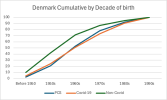
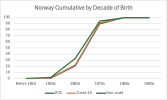
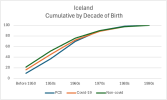
Here are some cumulative charts of the percentages by decade of birth. The data is from Table 1.

1779425318245.png

1779425341165.png

1779425388331.png

In each case, the 'non-covid' group (green) tends to be a bit older than the other two groups, which is not surprising. they had the most to lose by catching SARS-CoV-2. But the PCS and Covid-19 cohorts are very similar in the percentages in each decade in each national sample. In Iceland, and Norway too, almost everyone in all of the samples is older. There is no good basis here to say that the PCS group is younger.

(I am worried that I have misunderstood something, because the age group data seems so far from what the authors have claimed. I have checked. But still.)
 
Last edited:
This pattern is consistent with shared symptom-related liability contributing to these associations, although the data do not allow differentiation between post-viral sequelae and pre-existing symptom liability.
That seems like an enormous admission of uncertainty - not being able to differentiate between the health conditions they set out to examine from 'pre-existing symptom liability'.
That, plus the modest association with even this loosely defined sample, does not justify the conclusion.

But it rarely does with BPS claims.
 
Yeah, I'm still on Table 1, there are the numbers of people with the various pre-existing diagnoses.

The representation of the psychiatric diagnoses in the PCS cohorts, and in fact, in all of the cohorts is just ridiculously low.

Take Schizophrenia: the largest number of people reporting that illness in a national cohort subset is 12, accounting for 0.2% of the Iceland No Covid cohort. In 5 of the 9 subsets, the number is so small, we are only told that it is less than 5.

1779427853680.png

The entire Denmark sample, the blood bank donors, is remarkably free of the four conditions. I suspect that may be a reason why the researchers decided to attribute, for example, 'Schizophrenia-risk' to the (mostly schizophrenia-free) people based on supposed risk factors for it reported from existing GWAS.

If the GWAS for the 4 psychiatric conditions are anything like DecodeME, and I suspect they are mostly not substantially better, then it seems a bit premature to start attributing 'genetic risk scores' for the conditions to people based on whether or not they have identified variants. That seems particularly true for people who have got to their 50s and 60s without the psychiatric conditions.

I mean, with DecodeME, probably most of participants didn't have any of the identified significant variants, and we don't really know how relevant most of the variants identified are, especially those that aren't significant. We can't be super confident that all of the participants in the GWAS have the same condition. I don't think the DecodeME authors were suggesting it was a good idea to rate people's risk for ME/CFS based on the DecodeME GWAS? Conditions like MDD aren't any easier to characterise, selection of participants and the relevance of identified variants will also be uncertain.

I'm left wondering whether it would have been more honest and perhaps more useful for the researchers to just do a Post-Covid Syndrome GWAS on the combined PCS cohort. And then compare and contrast their results with the results from the GWAS's for the psychiatric conditions (and DecodeME, for that matter). I guess they only had about 6000 people that they gave a PCS label to, perhaps not enough, certainly given the heterogeneity of the people meeting the criteria of 'symptoms persisting for 3 months or more after Covid-19'.
 
No. It was just a rhetorical question. The DecodeME people wouldn't do that.

But these authors seem to be happy to essentially apply risk ratings for a range of psychiatric conditions and situation contingent personality traits to the people in their samples. They are doing that on the basis of the similarity of the individual's gene variants to the findings of various GWAS.
 
That, plus the modest association with even this loosely defined sample, does not justify the conclusion.

But it rarely does with BPS claims.
In biopsychosocial reasoning, if it looks like a bird, or if it looks like a plane, it's clearly Superman. No other possible explanation.

The differences in standards are stunning. Going back to a recent paper asking participants in a conference on functional symptoms, and asking them how often they endorse having such symptoms, merely because it could be, is something that no physician would think of doing in an oncology conference, where the most common symptoms are very similar. It merely has to be a possibility, and only in the sense that it hasn't been ruled out, which is not even a thing anyway, and common practices artificially amplify and overestimate them by simply equating having symptoms with mental illness.

In mental health care, evidence is needed to prove that it isn't mental illness, in the form of a "biomedical" diagnosis. It works exactly backwards to not just how the rest of medicine works, but how every other profession does everything. It's no wonder that mental health might be the most ineptly mismanaged major issue in all the professions, with barely a hint of a single genuine achievement, and it's all because it's worked out backwards most of the time.

Also there is something odd in how they frame "personality traits". From the title, it's plural, but in the paper, they only mention comparing to "neuroticism", which is a flimsy construct that has no objective measurement.
In a subset with available personality data, models were additionally adjusted for measured Neuroticism (NEO-FFI)
I don't know what that means.
In the subset with available personality data, these associations remained essentially unchanged after adjusting for measured Neuroticism, indicating that they are not solely attributable to observed personality differences
Or that. Notable is the idea of "solely attributable", which is an absurd premise that has no basis in reality. Clearly they were trying to fit the data to their model, but couldn't match it, and conclude that, heh, whatever, the shoe doesn't fit, but it might have!
While PGS explain only a modest proportion of PCS variance, they provide useful insight into underlying psychiatric and personality-related factors associated with persistent symptom reporting following COVID-19 infection.
It looks like they went fishing, found only a few sardines that may have been thrown overboard, and decided "whatever, it still must be right".
 
Back
Top Bottom