Symptom-based rehabilitation in people with post-COVID-19 condition (RELOAD study): a randomised controlled trial, 2026, Schneeberger

Dolphin

Senior Member (Voting Rights)

Respiratory research•20 May 2026
Open access

Symptom-based rehabilitation in people with post-COVID-19 condition (RELOAD study): a randomised controlled trial​


Tessa Schneeberger1 2, Inga Jarosch1 2, Daniela Kroll1 2, Rainer Gloeckl1 2, Carla Schneider1 2, Bernhard Ulm3, Martin Schwaiblmair4, Sabine Lampert5, Timm Greulich6 7, Ida Schoenherr6 7, Thomas Schultz 8, Till Schrag 9, Clancy John Dennis10, Andreas Rembert Koczulla1 2


Abstract​

Rationale

Post-COVID condition (PCC) is characterised by persistent symptoms that impair health-related quality of life (HRQoL); rehabilitation (REHAB) strategies remain scarce.

Objective

To investigate the effect of a symptom-based REHAB programme versus usual care on HRQoL in people with PCC.

Methods

In this single-blind randomised controlled trial, a total of 132 people with PCC were randomised to either a REHAB group or a control group, with 104 completing the trial. The REHAB group received a multimodal 3-week REHAB programme tailored to the participant’s primary symptom-based group (fatigue, cognitive problems or somatic symptoms); the control group received usual care. The primary endpoint was the between-group difference in change in HRQoL, measured by the 12-item Short Form Health Survey (SF-12) physical component summary (PCS) score at 3 weeks post baseline (intervention period). Changes from baseline to a 3-month follow-up after the intervention period were also analysed as a secondary measure. Additional outcomes included mental HRQoL (SF-12 mental component summary (MCS)), depression symptoms (Patient Health Questionnaire 9 (PHQ-9)) and anxiety symptoms (Generalized Anxiety Disorder 7 (GAD-7)).

Results

Participants (mean age 47±12.3 years, 90.4% not hospitalised during acute SARS-CoV-2 infection, 69.2% female) in the REHAB group (n=47) showed a significantly greater improvement in PCS compared with the control group (n=57) (mean difference (Δ) 2.9 points, 95% CI 0.2 to 5.7, p=0.038) at 3 weeks post baseline. This difference remained significant at the 3-month follow-up (Δ 4.2 points, 95% CI 1.5 to 6.9, p=0.003). The REHAB group also showed significant improvements in mental HRQoL (MCS: Δ 5.7 points, 95% CI 2.0 to 9.4, p=0.003), as well as in depression symptoms (PHQ-9: Δ −2.7 points, 95% CI −4.2 to −1.2, p<0.001) and anxiety symptoms (GAD-7: Δ −2.4 points, 95% CI −3.7 to −1.1, p<0.001) at 3 weeks post baseline compared with the control group. At the 3-month follow-up, the reduction in depression symptoms remained significant, while no significant differences were observed for mental HRQoL or anxiety symptoms.

Conclusion

A symptom-based rehabilitation programme significantly improved HRQoL in individuals with PCC after 3 weeks, with some benefits persisting at 3 months.
Trial registration number NCT05172206.
Back to top

What is already known on this topic​

  • Post-COVID condition (PCC) is common, including among non-hospitalised individuals with mild acute disease, and is associated with impaired health-related quality of life; however, evidence from randomised controlled trials of rehabilitation programmes remains limited and has largely focused on people who were hospitalised during acute SARS-CoV-2 infection.

What this study adds​

  • A 3-week multimodal, symptom-based rehabilitation programme significantly improves physical and mental quality of life, as well as depression and anxiety symptoms, in individuals with PCC compared with usual care. The findings were observed in a cohort predominantly composed (90.4%) of non-hospitalised individuals with mild acute COVID-19.

How this study might affect research, practice or policy​

  • These findings support the use of symptom-based rehabilitation approaches in PCC and highlight the need for further research on long-term effectiveness.
 
Last edited by a moderator:
We had a thread for the announcement of this trial - here
Clinical Trials entry

All study participants will be provided with a continuous telemonitoring system (SaniQ app) throughout the study period. After the interventional phase, there will be a 3 months follow-up assessment to evaluate the maintenance effects of COVID rehabilitation.
Not a word of the continuous telemonitoring system in the abstract. Perhaps there was technical error?

Participants (mean age 47±12.3 years, 90.4% not hospitalised during acute SARS-CoV-2 infection, 69.2% female) in the REHAB group (n=47) showed a significantly greater improvement in PCS compared with the control group (n=57) (mean difference (Δ) 2.9 points, 95% CI 0.2 to 5.7, p=0.038) at 3 weeks post baseline.
'at three weeks post baseline'. The intervention was three weeks. So, they finished the last session and were presented with a survey asking about their quality of life. And, those who made it to the last session reported that things had improved by, on average, 2.9 points more than the control group who had had no treatment reported.

It's the usual recipe for making an ineffective treatment appear useful. I guess, why mess with something that works (the bogus evidence generation methodology, I mean).

2021 Announcement said:
Therefore, the primary objective of this randomized controlled trial (RCT) is to investigate whether a 3-week symptom-oriented, inpatient, multidisciplinary rehabilitation intervention, whose content focus is standardized according to cluster assignment (fatigue, cognition, soma), has a positive effect on the quality of life (primary outcome) in post-COVID syndrome patients compared to a usual care group (standard outpatient care).
The planned primary outcome seemed to be 'a positive effect on the quality of life'.

abstract said:
The primary endpoint was the between-group difference in change in HRQoL, measured by the 12-item Short Form Health Survey (SF-12) physical component summary (PCS) score at 3 weeks post baseline (intervention period).
Since when was Health Related Quality of Life measured by SF-12 physical component summary? Why not the mental component summary too? (oh, see SNT's post...) I wonder if the use of just the physical component summary was planned?
 
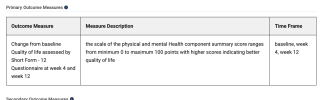
From the Clinical Trial Registry:
Screenshot 2026-05-27 at 1.50.16 PM.png
abstract said:
The primary endpoint was the between-group difference in change in HRQoL, measured by the 12-item Short Form Health Survey (SF-12) physical component summary (PCS) score at 3 weeks post baseline (intervention period).


Looks like the plan was the physical and mental health component scores together. At week 4 and at week 12.
So, not just the physical component summary at 3 weeks after baseline then....

Tripe alert!! @dave30th

Thanks to Dolphin for linking the threads.
 
Participants (mean age 47±12.3 years, 90.4% not hospitalised during acute SARS-CoV-2 infection, 69.2% female) in the REHAB group (n=47) showed a significantly greater improvement in PCS compared with the control group (n=57) (mean difference (Δ) 2.9 points, 95% CI 0.2 to 5.7, p=0.038) at 3 weeks post baseline. This difference remained significant at the 3-month follow-up (Δ 4.2 points, 95% CI 1.5 to 6.9, p=0.003).
I know it's already bad enough.

But, just noting that a mean difference of 2.9 points, or even 4.2 on a 100 point scale is pretty minimal. It might be statistically significant, but it's only hovering at the margins of being clinically useful. And that's before we dig into things like the dropout rates, should anyone be enthusiastic enough to do that. To have that sort of tiny improvement, with subjective outcomes and a control group languishing on the waitlist, is just laughable.

The REHAB group also showed significant improvements in mental HRQoL (MCS: Δ 5.7 points, 95% CI 2.0 to 9.4, p=0.003), as well as in depression symptoms (PHQ-9: Δ −2.7 points, 95% CI −4.2 to −1.2, p<0.001) and anxiety symptoms (GAD-7: Δ −2.4 points, 95% CI −3.7 to −1.1, p<0.001) at 3 weeks post baseline compared with the control group.
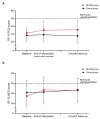
And, that 5.7 point improvement claimed for the MCS 'at three weeks post baseline compared with the control group' simply is incorrect. The 5.7 point change is within the treatment group - see @SNT Gatchaman's post with the charts - from baseline to the end of the treatment. Compared to the control group, it is more like 2 and probably is not statistically significant. Do the authors think that a comma dividing the sentence into two sections allows them to leave the comparator in the first part of the sentence vague?

I don't know how authors of this misleading dribble manage to live with themselves. It's propaganda, not science. They absolutely should be disqualified from receiving more research funds.
 
Enough is enough!!!!!

When @Hutan has to conclude a paper is "misleading dribble" how can patients accept rehabs as a serious bunch of people offering "help".

Plenty of names on it, not the slightest bit of self reflexion amoungst themselves and the dribble gets published without criticism.

How deep does a profession have to sink before they come to their senses and conclude:

Get out of this field, you have nothing to offer.
 
I don't know how authors of this misleading dribble manage to live with themselves. It's propaganda, not science. They absolutely should be disqualified from receiving more research funds.
Professor Koczulla lays out his ME/CFS research vision here (German Ärzteblatt), found via a post in our News in Germany thread.

TLDR: If a patient mentions »self-reported« PEM and the PEM is only »mild«, can rehabilitation improve their health?
More research is needed!

AI translation of relevant statement by Professor Koczulla in Ärzteblatt

Particularly controversial is the use of exercise therapy in Myalgic Encephalomyelitis/Chronic Fatigue Syndrome, as it may negatively affect, for example, post-exertional malaise (PEM). Although many people with ME/CFS report PEM, it is often not systematically assessed in studies; when it is assessed, standardized methods of data collection are usually lacking, which considerably complicates its scientific evaluation. If a person with Long COVID reports mild to moderate PEM, experts currently recommend a cautious, individually adaptive approach (12). Initial data, however, based on a limited number of people with Long COVID and PEM, suggest that activating therapy in cases of predominantly self-reported PEM worsens symptoms in only a small proportion of affected individuals (13). [I dug out the terrible research they are basing their arguments on here]

Consequently, controversial questions arise: Can (future) biomarkers or clinical phenotyping identify a subgroup of people with ME/CFS who may benefit from individualized activation? Which priorities should ME/CFS rehabilitation address? Should even mild PEM be considered an exclusion criterion for exercise and rehabilitation approaches?
 
Back
Top Bottom