Running FLAMES on DecodeME data

Alright I got POPs to run but unsure if some of the parameters I used are correct.

The setup:
  1. Cloned https://github.com/FinucaneLab/pops , then setup a virtual env using python 3.8 (it needs this for some of it's dependencies), installed requirements.txt in this env
  2. I then created a folder in this dir /pops/data
  3. I downloaded "pops_features_full_FUMA_compatible.tar.gz" unzipping into my pops/data dir
  4. I renamed the folder for ease of martins instructions "pops_features_full_FUMA_compatible" -> "pops_features_full"
  5. I then unzipped @forestglip MAGMA full results into my pops/data dir
  6. I then ran POPs using the following parameters as per instructions/parameters here
    1. python pops.py --gene_annot_path {USER DIR}/pops/data/pops_features_full/gene_annots.txt --feature_mat_prefix {USER DIR}/pops/data/pops_features_full/features_munged/pops_features --num_feature_chunks 116 --magma_prefix {USER DIR}\Documents\pops\data\magma --control_features {USER DIR}/pops/data/pops_features_full/control.features --out_prefix test
This created three files: test.coefs, test.marginals, test.preds

I think this worked, happy to upload the files if anyone can check?

Next the hard part, format credible sets.... I think I'll use FINEMAP: http://www.christianbenner.com/ need to spin up a linux distro real quick though
 
Holy cow, step 4 fine mapping is no joke. I wouldn't even say this is programming, more like puzzle solving and plugging in the right inputs.
Files needed for a FINEMAP:
  1. Master file
  2. Z file
  3. LD (Linkage disequilibrium) file. This must be created from the software LDstore
    1. LDstore requires:
      1. Master file
      2. Z file
      3. BGEN file
Starting from the bottom up
BGEN file:
I *think* that you can get this from the UKBioBank here. Can anyone let me know if that's correct? Also how do you even access this file, do I need to sign up? Also this might be able to use the 1000 genomes, but would be way less accurate?

edit: The UK biobank file would be nearly 2TB.... so I think I would have to use the 1000 genomes BGEN
 
Last edited:
Also this might be able to use the 1000 genomes, but would be way less accurate?
BioBank would be ideal, since it more closely matches the participants. But 1000G still worked well enough to get relatively the same results when I used it in FUMA the first time, mostly just less significant.

I don't think @hotblack and I ended up finding a source for UKB LD files when trying to run MAGMA locally.
 
I don't think @hotblack and I ended up finding a source for UKB LD files when trying to run MAGMA locally.
Gemini is telling me this BGEN file would be nearly 2TB from UKbio bank… obviously I cannot verify that. Also it would take a insane computer to do an LD on that file size.

I must be attacking this from the wrong angle. 1000 genes has premade LD file?
 
Last edited:
Gemini is telling me this LD file would be nearly 2TB from UKbio bank… obviously I cannot verify that.
Yeah, I'm not sure of the size. Maybe that's raw individual data while all you'd need is more of a summary format.

It just seemed like you might need to apply as a researcher to get access to UKB data. But it's possible there's some source out there we didn't see.
 
Hi,

I developed the MetaME and DecodeME repositories on GitHub. I am not a scientist, just a patient.

MetaME is a meta-analysis of approximately 21,500 ME cases (DecodeME + UK Biobank + Million Veteran Program). It uses standard methodologies (METAL + FUMA). No fine-mapping was performed.

The analysis identifies significant associations between the genetic profile of this cohort and:
  • a Gene Ontology term related to glutamatergic synapses,
  • gene expression in several brain regions, and
  • gene expression in glutamatergic neurons, both in mice and in humans.
I am still working on the DecodeME fine-mapping. As shown in the repository, I was able to use LD matrices from the UK Biobank. However, the fine-mapping currently available in the repository only employed approximately 5 million SNPs from the original DecodeME summary statistics.

I am intrigued by the possibility that ME/CFS may be linked to a dysfunction of glutamatergic signaling in the brain, at least in a subgroup. In particular, I wonder whether a deficit in this system could explain fatigue and cognitive impairment.

There is a drug used in epilepsy that antagonizes the AMPA receptor: perampanel. It is known to cause fatigue, but it does not appear to be associated with exercise intolerance. If the glutamatergic hypothesis were correct, one might expect this drug to induce an ME/CFS-like phenotype.

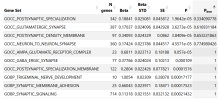
I would like to add more patients to my meta analysis, unfortunately I used all the available summary statistics, to my knowledge. I recently added 6,000 Long Covid patients and I found two risk loci: the one on chromosome 20, already present in DecodeME, and a new one on chromosome 22. But I am still going through this. On the other hand, when adding LC, the signal from the glutamatergic synapses, while still present, does not reach statistical significance, after Bonferroni correction (see table).
1766922593035.png
 
Glutamate receptors came up in some analysis of the Zhang paper and also seem prominent in my clustering analysis of PrecisionLife’s candidate genes from DecodeME data. I guess we’re looking at the same genes and gene set databases but still, may be interesting.

I see that your Cluster_1 points to glutamatergic synapses, which is particularly interesting.

Patients frequently report alcohol intolerance. This could be explained by the inhibitory effect of alcohol on NMDA receptors: under the hypothesis of deficient glutamatergic transmission, alcohol would be expected to exacerbate the disease.

Recently, a paper reported an increased density of AMPA receptors in Long COVID patients with cognitive deficits. One may speculate that, if glutamatergic signalling were reduced, postsynaptic neurons might attempt to compensate by increasing the density of glutamatergic receptors.

One of the few Mendelian ME/CFS cases reported so far involves a woman carrying a structural variant that leads to increased levels of GABAergic neurosteroids (R). I wonder whether a pathological increase in GABAergic signalling would produce symptoms similar to a pathological decrease in glutamatergic signalling.
 
There is a drug used in epilepsy that antagonizes the AMPA receptor: perampanel. It is known to cause fatigue, but it does not appear to be associated with exercise intolerance. If the glutamatergic hypothesis were correct, one might expect this drug to induce an ME/CFS-like phenotype.
Purely as an anecdote for the sake of this theory, I've been taking a low dose of perampanel and it's had a very positive effect on my wired-but-tired cognitive symptoms and on my dissociation. It was bad initially or when taking doses that increased the greatest concentration I had been exposed to (it has a long half life, so it accumulates heavily) but after an adjustment period (perhaps some compensatorily dysregulated systems adjusting), it worked well in my case.

However, I might have an uncommon etiology. I have several notable comorbidities (like mild visual show syndrome) and I developed ME/CFS unusually young, at age 8, and from an unusual trigger, LPR-mediated chronic recurrent sinusitis. Given this and the terrible side effect profile of perampanel I am not suggesting anyone independently try it for ME/CFS or providing any medical advice whatsoever. I'm just providing an anecdote that might be interesting.

Also, I haven't gotten the impression that the perampanel side effects in any form of epilepsy resemble ME/CFS at all.

There are also a few anecdotes online from people with long covid of improvement from low dose perampanel.There's this one of 2mg perampanel helping for years. There's also this one from 0.25mg. There was another on Reddit but it appears to have been deleted. I think this has gotten a lot more popular recently because of the long covid AMPA upregulation paper paolo mentioned.

Perampanel is more specifically a negative allosteric modulator of the AMPA receptor. It's my understanding that competitive antagonists of the AMPA receptor were never seriously investigated in humans due to severe side effects. I believe perampanel is thought to increase glutamate release, which could be relevant. Similarly, I believe AMPA receptor upregulation as observed by that long covid study would be straightforwardly expected to decrease glutamate release.

There are also positive allosteric modulators of the AMPA receptor like fasoracetam and a number of other failed candidates for treating depression/ADHD. Maybe worth looking into the literature regarding those?
 
People interested in the glutamatergic signaling theory may want to look at the papers in this thread, there’s some interesting ideas and some evidence of involvement in mental and physical fatigue as well as mood changes following interferon treatment and in MS, with astrocyte cleanup/recycling thought to be being disrupted.

https://www.s4me.info/threads/ifn-a...sonance-spectroscopy-2014-haroon-et-al.48975/

No mention of AMPA receptors AFAIK (The focus is on NMDA receptors) though and I’m not neurologically knowledgeable enough to interpret if that’s relevant
 
Back
Top Bottom