Preprint Psychometric evaluation of The Index of Myalgic Encephalomyelitis Symptoms TIMES. Part II…, 2026, Tyson, Horton, Fleming

SNT Gatchaman

Senior Member (Voting Rights)
Staff member
Psychometric evaluation of The Index of Myalgic Encephalomyelitis Symptoms TIMES. Part II: Criterion-related and discriminant validity, test-retest reliability and minimal detectable difference.
Sarah F Tyson; Mike C Horton; Russell Fleming

OBJECTIVE
To evaluate the criterion-related and discriminant validity, test-retest reliability and minimal detectable difference of The Index of ME Symptoms (TIMES) in myalgic encephalomyelitis/chronic fatigue syndrome (ME/CFS)

METHODS
People with ME/CFS in the UK completed the TIMES online (n=1055). Rasch-transformed interval data and parametric statistics were used: Pearson correlations (with the ME severity scale); analysis of variance; intra-class correlations (ICC) and standard error of measurement of ICC measured criterion-related and discriminant validity, test-retest reliability and minimal detectable difference respectively.

RESULTS
Highly significant (P<0.001) moderate (r=0.400- 0.528) correlations were seen between the TIMES scales and severity of ME/CFS except the gastro-intestinal and immune systems scales (r= 0.315 and 0.302 P<0.001 respectively). Discriminant validity was demonstrated with significant differences in TIMES scores between all five levels of ME severity, except between levels 4 and 5 in some cases, which were underpowered due to the small group numbers. Test-retest reliability was excellent (ICC>0.7, p<0.001) except the cranial nerves and immune system scales which were good (ICC = 0.681 and 0.669, p<0.001) and minimal detectable difference was excellent (3.95-17.45%).

CONCLUSIONS
The Index of ME Symptoms (TIMES) scales are valid, reliable, sensitive assessments of symptoms in ME/CFS. They are freely available for use.

Web | DOI | PDF | Preprint: MedRxiv | Open Access
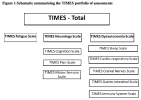
 
The domains excluding fatigue also form valid sub-scales which assess neurological symptoms and dysautonomia.

We commented in the thread for the first paper that it makes no sense to have cranial nerves in a dysautonomia section when neurology is right there. Also sleep and the immune system in dysautonomia ?!? (As well as dysautonomia relating to neurology anyway). Arbitrary and ill-informed.

The TIMES was co-produced with people with ME/CFS and clinicians working in specialist NHS ME/CFS services using the methods detailed in the companion paper. They are summarised here. An ME/CFS advisory group with a wide range of age, duration and severity of ME/CFS was convened from volunteers following publicity in the ME Association’s newsletter. Members of the clinical advisory group were drawn from volunteers from the membership of the British Association of Clinicians in ME (BACME). Both groups contributed to all stages of the project.

TIMES.png
 
"Spoiler: Content warning for crimes against graphic design"
:) you've got to laugh....

I have no idea why they had to spread this stuff over two papers. It seems to be repeating a lot of what was in the first paper, which mostly seems to be 'this is great, we did a fabulous job'.

And I repeat - one question on PEM and, what was it five or six? on aspects of sleep. This scale will make it relatively easy for rehab people to show they have achieved improvements when in fact they have not. 'Excessive farting'* could go from 3 points to zero points just by revising the person's understanding of how much farting is normal. PEM could genuinely go from mild frequency to moderate frequency and it wouldn't increase the score at all.

This scale is junk.

*yes, I am not joking, it is a symptom on the list


Here's the scale for easy access:
Supplementary file 4 is the TIMES final version. Attaching it here so that people can more easily acces it.
 

Attachments

Last edited:
The Index of ME Symptoms (TIMES) scales are valid, reliable, sensitive assessments of symptoms in ME/CFS
No they are not. Like its predecessor the paper appears to overstate its value and use when all thot has been done is massage some numbers. There is no evidence this tells us anything about the real world or gives us biological insight given we have little to measure against. I’m not convinced the results are anything more than a product of mathematical modelling.

Comparing subjective things does not make them objectively valid. There’s a circular loop here, saying a subjective measure validates a subjective measure. Forcing messy human experience into a linear scale is never perfect, admit that to improve a questionnaire rather than pretend maths can make it true.

The repeatability shown could just as well mean this is not capturing variation or changes in the condition, which would be problematic for understanding the condition or effects of any interventions. We know people vary and yet this seems to either not be captured or been squeezed out of the model producing something which lacks sensitivity.

There seems to be questions over measuring severity and I won’t repeat my other concerns from the other paper. But I hope this gets solidly and critically peer reviewed, otherwise the authors will now promote it to say it does things it doesn’t with consequences on the community. What a waste from the MEA and entirely counterproductive to some of their other work and investments.
 
We commented in the thread for the first paper that it makes no sense to have cranial nerves in a dysautonomia section when neurology is right there. Also sleep and the immune system in dysautonomia ?!? (As well as dysautonomia relating to neurology anyway). Arbitrary and ill-informed.


Coproduced ?
That's seems elastic interpretation given the discussions here and on the MEA Facebook page .

I wonder how much participation the patient advisory group had , and how much stats / methodology background they had .
 
"Spoiler: Content warning for crimes against graphic design"
:) you've got to laugh....

I have no idea why they had to spread this stuff over two papers. It seems to be repeating a lot of what was in the first paper, which mostly seems to be 'this is great, we did a fabulous job'.

And I repeat - one question on PEM and, what was it five or six? on aspects of sleep. This scale will make it relatively easy for rehab people to show they have achieved improvements when in fact they have not. 'Excessive farting'* could go from 3 points to zero points just by revising the person's understanding of how much farting is normal. PEM could genuinely go from mild frequency to moderate frequency and it wouldn't increase the score at all.

This scale is junk.

*yes, I am not joking, it is a symptom on the list


Here's the scale for easy access:
Supplementary file 4 is the TIMES final version. Attaching it here so that people can more easily acces it.


" This scale will make it relatively easy for rehab people to show they have achieved improvements when in fact they have not"

Exactly this .
The King is dead , long live the King .

I think this needs a response akin to the BACME letter . This has the potential to do as much damage .
 
I have said this before, but I think it bears repeating given the crap this project has produced, and discussion elsewhere on the forum about choice and openness about patient advisory groups:

When Sarah Tyson via the MEA put out a call for volunteers to join the project PAG I applied. I explained my experience as pwME, carer, and knowledge from extensive forum discussion of pitfalls of existing PROMs etc. I can't remember whether I mentioned my Maths/stats qualifications.

The reply was telling. We're not interested in your knowledge, experience or qualifications. We have all we need. We're just going to pick applicants at random.

Not being involved, I have no idea how they used their PAG.
 
I think this needs a response akin to the BACME letter . This has the potential to do as much damage .
Yes. I fear it's too late. But I think we should try, if only to get our objections on the record and distributed widely.

There's a lot more to come. This is one on symptoms is just the first of a set of PROMs from this project, the ones on PEM and function are much worse, and will doubtless get the same statistical stamp of approval.
 
«These scales are valid.»

Great, please tell us how you’ve managed to solve the construct validity issue that has plagued psychometrics for its entire existence. The people in charge of the DSM-5 manual don’t even know how to solve it. This might be a Nobel prize worthy breakthrough.
 
test-retest reliability
I have no idea how anyone thinks it makes sense to do a test-retest reliability validation in a highly fluctuating condition, because there are no fixed answers. I don't know which is worse, their misunderstanding of the illness or the use of methods that are obviously not valid in this context.

My understanding is that such validation only works when the answers don't change and the evaluation should remain the same. Like with an IQ test. Take it one time, take it another time, a retest should roughly give the same value, with a tiny variation spread, because the underlying intelligence hasn't changed. An IQ test that would give different results would simply not be considered good, because intelligence does not change significantly over a short period of time.

This is not the case at all here, there are no standard answers, there are huge differences not only between individuals but for the same individual at different time points. Also, farts. Really. Farts. Well, here's my answer to this: pbbbbbbbbbbbbbbb.

This is especially absurd after 6 years of (OK, very poor, but still) attempts at trying to create subsets of LC defined by groups of symptoms, only for literally all attempts to find out that they vary wildly, cross-over and overlap across the board. We might as well use Dungeons & Dragons character creation for all that this relates to reality.

Also LMAO at @SNT Gatchaman's spoiler warning.
 
Back
Top Bottom