Plasma exchange

Badpack

Established Member (Voting Rights)
Heyho,
short introduction from my side, im from germany ( english is not my native language so please overlook possible grammar mistakes :) I got CFS after an infection with the legionnaires disease in 2014. I tried a lot of different therapies by now (some examples: Rituximab, Rapamun) and im now short before a plasma exchange treatment bc im still a big believer this disease is an autoimmune problem aka autoantibodies vs adrenergic/muscarinergic receptors and i hope i can at least see a short term relief in symptoms when they are gone for some time.

My question, did anyone else here try it before ? Did it help you and if yes for how long?
Thanks in advance :)
 
Thanks a lot for the answer. Dont know what to expect but will definitely give it a try. I was tested positiv for ß2, M2 and nociceptin receptor autoantibodies. So lets see how life is without them for a while.
 
Heyho,
short introduction from my side, im from germany ( english is not my native language so please overlook possible grammar mistakes :) I got CFS after an infection with the legionnaires disease in 2014. I tried a lot of different therapies by now (some examples: Rituximab, Rapamun) and im now short before a plasma exchange treatment bc im still a big believer this disease is an autoimmune problem aka autoantibodies vs adrenergic/muscarinergic receptors and i hope i can at least see a short term relief in symptoms when they are gone for some time.

My question, did anyone else here try it before ? Did it help you and if yes for how long?
Thanks in advance :)
hey, what dose of rapamune did you try? did it help at all? how severe are you?
 
The following posts were merged from a thread with the title:

If there is a factor in the serum, why is plasma exchange not working?


Any ideas?
 
Last edited by a moderator:
The experiments seem to suggest that the blood factor has an effect on cells for a day or even several days.

Edit:

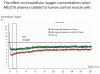
Basal (resting) amino acid–driven mitochondrial respiration (condition I) was moderately increased in muscle cells exposed to ME/CFS serum for 6 days (Figure 5, A and B)

https://www.ncbi.nlm.nih.gov/pmc/articles/PMC5161229/

I'm just realizing it's not actually clear that the effect persisted for six days. That was the duration of the experiment, but did the effect last this long?
 
Last edited:
My understanding seems opposed to what has so far been posted.

If there is something in the blood then it must have got there somehow.

The something in the blood seems to be what is causing a problem in pwME cells - so in order to function 'normally' then that something in the blood needs to be absent, as in not present.

My understanding is that a few 'tests' have been conducted to establish that a healthy cell in plasma from a pwME behave like pwME cells, and that pwME cells in 'normal' plasma behave like 'normal' cells.

Hence the origin of the hypothesis.

If plasma exchange of 'normal' plasma into a pwME isn't working then it seems, to me, that this could be for a couple of reasons;

Whatever made the 'something in the blood' is still making it, so 'contaminating' the fresh plasma or

The universe hates us or

Option C (yet to be determined/remembered)
 
A factor in the blood might have rapid turnover - maybe a half-life of six hours. By the time plasma exchange is over the factor is replenished. Plasma exchange is designed to remove molecules with half-lives of months-like antibodies - which as potential signalling molecules are very unusual this respect.

To hear this from you sir, is very good news for me! So what factor would theoretically be responsible? Virus rna?
 
I'd say also that, if there is an "X" factor in the blood and you remove it, even if the cells instantly return to a normal state, the symptoms may not also clear up instantly. Damage and dysregulation may have occurred and may need some time to "heal" before returning to normal. During that interval, the "X" factor may build back up again.
 
So why isn‘t the whole world not looking for it? I mean there is a huge financial benefit to find this out!
 
The experiments seem to suggest that the blood factor has an effect on cells for a day or even several days.

Edit:


https://www.ncbi.nlm.nih.gov/pmc/articles/PMC5161229/

I'm just realizing it's not actually clear that the effect persisted for six days. That was the duration of the experiment, but did the effect last this long?

In a cell culture system there is no clearance route like liver or kidney which may control a short half life.
 
Back
Top Bottom