Trial Report Plasma cell targeting with the anti-CD38 antibody daratumumab in ME/CFS -a clinical pilot study, 2025, Fluge et al

@Jaybee00
They discussed this some time ago as the basis for their B-cell depletion experiments. I simply assumed that their view on this topic has not changed since then. You can read it here:


Yes, it’s complicated. I’ve just read a bit more about the blood tests for these antibodies, and the methodology doesn’t seem to be properly standardized. The risk of false negatives is definitely real, and who would want to lose hope if, in the end, the result might not even be clinically meaningful.

That said, the hypothesis of impaired oxygen delivery and microcirculation would certainly support a role for GPCR antibodies. But as always, there is still too little evidence to draw firm conclusions. I suppose all that’s left is to wait for the Phase 2 data.

It would still be very interesting if they measured the antibody levels to see whether the participants are generally positive
 
Last edited:
Does anyone know whether autoantibodies against beta-adrenergic receptors were also assessed in the studies investigating daratumumab in ME/CFS? Both Fluge & Mella and Scheibenbogen propose that these GPCR autoantibodies represent a key pathomechanism in the disease. However, most reports I am aware of primarily discuss effects on NK cells.
@Jaybee00
They discussed this some time ago as the basis for their B-cell depletion experiments. I simply assumed that their view on this topic has not changed since then. You can read it here:
This is what they write:
To this end, functional GPCR autoantibodies may be involved (22). Agonistic autoantibodies to β2 adrenergic receptors (β2ARs) and muscarinic 3 receptors have been demonstrated in orthostatic hypotension (23). In POTS, an autoimmune basis has been suggested by the presence of several functional autoantibodies toward GPCRs affecting blood pressure and heart rate regulation, such as antibodies to α1AR, β1AR, and β2AR (24), and also toward angiotensin II type 1 receptor. Autoantibodies to GPCRs, including adrenergic and muscarinic receptors, have been investigated in ME/CFS (25), and anti-β2AR antibodies were proposed to have an important role (26). Although GPCR autoantibodies are also present in healthy individuals, it is possible that they contribute in regulatory networks associated with different physiological states and with disease (27).
It sounds more like an attempted hypothetical explanation for their observations, and less of a «key pathomechanism».

They also had a question mark behind it in a presentation from back when the paper was published:
One of the slides presents following model:

Pattern of autoantibodies after infection?
Persistent, affecting vascular function

Endothelial dysfunction - Large and small arteries
Arteriovenous shunting - Impaired oxygen extraction
Impaired venous tone and return - preload failure

Impaired auto regulation of blood flow on exertion - tissue hypoxia
The Germans seem more convinced, but I’m not sure we’ve seen data to back it up?
 
The situation is simple. The marginal difference between antibody levels to GPCR in people with ME/CFS and controls means that they cannot have any direct pathogenic role in the disease. The idea is refuted. Statistical differences can be important in identifying indirectly relevant changes that might reflect some direct causal factor. But if there is 80-90% overlap between scatter plots it is simply impossible for the difference to indicate a direct causal role.

My understanding is that Fluge and Mella have not committed themselves to claiming GPCR antibodies are causal. They might have done well not to mention them at all but that is a different matter.
 
@Jonathan Edwards do you have any thoughts on how these five patients responded and what it might mean if it's not a placebo response?

Apart from the official phase 2 trial, they are testing dara on additional patients. This is from an updated protocol where everything is unblinded.

TLDR: 4 LC ME/CFS patients and 1 relapsed patient from the pilot study received a single dose of dara. Their symptoms improved for 1-4 months and F/M concluded that more doses are needed. They expect patients from the pilot trial to relapse who will then be retreated.

And did you ever hear back from Fluge when you emailed him about the possibility of anti CD38 being effective by another mechnism than LLPC depletion? It would be interesting to know his thoughts.
 
@Jonathan Edwards do you have any thoughts on how these five patients responded and what it might mean if it's not a placebo response?

What's odd is that they reported symptom improvement after as little as 2 weeks. In the pilot trial it looks as if patients didn't start feeling better until 8-10 weeks after the first injection unless mild improvements weren't captured with the questionnaires.
 
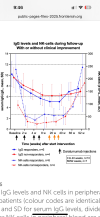
For the seven shot cohort, IGG didn’t decrease with the 3 additional shots (the yellow arrows). Any ideas about this? Maybe Daratumumab can’t deplete any more cells without NK cells?
 

Attachments

  • image.png
    image.png
    857.6 KB · Views: 22
Last edited:
That gives some creedence to the idea that NK cell separation in responders/non responders is related to drug action not disease mechnism.
I mean i think that is very obvious from the scatterplot itself for sure but who knows
 
@Jonathan Edwards

Do you have any idea why IGG levels didn’t decrease after the three additional Daratumumab shots (please see post 406 above).

I think this paper is saying that IGG doesn’t decrease after a certain point.


If that is the case, are additional Daratumumab injections really needed or of any value?

Thank you.
 
Do you have any idea why IGG levels didn’t decrease after the three additional Daratumumab shots (please see post 406 above).

Maybe there is a pool of unkillable cells. It looks as if the last injections may be keeping levels down at a certain value maybe by preventing replacement but not killing more. I think it is relatively unlikely that NK cells are essential for killing but it is possible.
 
Maybe there is a pool of unkillable cells. It looks as if the last injections may be keeping levels down at a certain value maybe by preventing replacement but not killing more. I think it is relatively unlikely that NK cells are essential for killing but it is possible.

well the good news at least is that in remission cases it would seem the ME plasma cells are killable and got killed of. I hope.
 
@Jonathan Edwards,

Does this paragraph:

"Protective antibodies (Diphtheria, Tetanus, SARS-CoV2) were analysed at baseline and after 12 months follow-up. All patients had SARS-CoV-2 antibodies in line with either a previous infection or vaccination. All patients had protective or probably protective levels of antibodies to SARS CoV-2, Diphtheria and Tetanus, both at baseline and after 12 months"

Does this sentence imply that the antibodies to these pathogens were the same level at baseline and 12 months? The wording is generic here.

@forestglip interpreted this as not specific enough to infer the exact levels of these antibodies.

I find this paragraph very interesting and I think its a major clue to something. If it implies that the antibodies were the same level post treatment, it would the plasma cells that produce these antibodies don't express much CD38, isn't it?
 
Last edited:
@Jonathan Edwards,

Does this paragraph:

"Protective antibodies (Diphtheria, Tetanus, SARS-CoV2) were analysed at baseline and after 12 months follow-up. All patients had SARS-CoV-2 antibodies in line with either a previous infection or vaccination. All patients had protective or probably protective levels of antibodies to SARS CoV-2, Diphtheria and Tetanus, both at baseline and after 12 months"

Does this sentence imply that the antibodies to these pathogens were the same level at baseline and 12 months? The wording is generic here.

@forestglip interpreted this as not specific enough to infer the exact levels of these antibodies.

I find this paragraph very interesting and I think its a major clue to something. If it implies that the antibodies were the same level post treatment, it would the plasma cells that produce these antibodies don't express much CD38, isn't it?
I don't quite follow what this is suggestive of - that LLPC depletion isn't the way dara works for ME (if it works)?
 
Back
Top Bottom