Persistent physical symptoms not explained by structural abnormalities or disease processes: a primary care approach [..] recovery, 2026, Abrahamsen+

Because the LP is not a therapeutic approach, it’s a private business with confidential IP considered to have commercial value. Being an LP practitioner is not like being a CBT practitioner in the same way that working for Novo Nordisk is not like being a doctor who prescribes GLP-1s.

I don’t know the contractual relationship between individual LP practitioners and Phil Parker, but practitioners seem to pay (through fees) for access to the LP’s business IP. This kind of contractural relationship is not covered in the list of COIs above, but it is plainly a commercial relationship and arguably should be considered a COI, just like the employee or stockholder relationships which are listed.
 
Why not turn to the arbiters of ethical academic practice? - Cochrane
(yep, that's sarcasm).

Conflict of interest policy for Cochrane Library content (2020)

These policies are for reviews. Review funding and declarations of interest have to be made early in the process, and a summary of the declarations are supposed to be included in the manuscript. Some of Cochrane's rules prevent some people from being authors of submitted reviews. It could be interesting to run through the list, as if this paper was a review.

The paper is really serving the purpose of a review. Its method claims to be
Narrative literature review and consensus development with experienced practitioners.
So a review without rigour. I think in such cases, very careful declarations of interests become extremely important.


  • Submitted content cannot be funded or produced by any commercial organization with a financial interest in the topic of the review.
  • Funders of submitted content should be declared in the ‘Sources of support’ section of the manuscript, including a statement describing the funder’s role in the design, conduct, or publication of the review (if any). 
  • All financial and non-financial interests within 36 months of the submission date must be declared by all authors at the time of submission and acceptance. 
  • Authors without financial conflicts of interest must make up at least two-thirds of the author team. 
  • First and last authors listed in the author byline must be entirely free of financial conflicts of interest and cannot have been involved in studies funded by industry and eligible for inclusion in the review. 
  • Any author who has been involved in the conduct, analysis, and publication of a study that could be included in the review cannot make study eligibility decisions about, extract data from, carry out the risk of bias assessment for, or perform GRADE assessments of that study. 


The following funding and conflicts of interest will prevent people from being authors of submissions: 
  • Current or past employment (part-time or full-time) within 36 months of the submission date by a commercial organization with a financial interest in the topic of the review.
  • Ownership of a commercial organization with a financial interest in the topic of the review
  • Personal ownership of (or pending application for) a patent for an intervention, diagnostic test or prognostic marker that is relevant to the topic of the review. This does not include patents developed, but not owned by individuals.
The following funding and conflicts of interest may prevent people from being authors of submissions (depending on whether they are first or last author, and the overall proportion of authors in the team):
  • Payment from organizations with a financial interest related to the topic of the review for e.g. speaker fees, honoraria, consultancies, and membership of advisory boards.
  • Support for sabbaticals and study tours from organizations with a financial interest related to the topic of the review of the Cochrane Library content.
  • Payment of travel, accommodation, subsistence and conference registration expenses from organizations with a financial interest related to the topic of the review.
  • Ownership of stock/shares in healthcare-related companies with a financial interest.
  • Payment for legal testimony or advice from a commercial organization with a financial interest in the topic of the review.
  • Royalties relevant to the topic of the review.
  • Funding for research received from a commercial organization with a financial interest in the topic of the review.
  • Financial support for fellowships and other professional placements from organizations with a financial interest related to the topic of the review.
Interestingly, the policy says that relevant private professional practice should be declared:
Income from relevant private professional practice should be declared but will not normally prevent contribution to the creation of Cochrane Library content.

Financial interests that must be declared:
Financial interests are relevant if the funding or payment is made by a commercial organization that develops, manufactures, markets or distributes (anywhere in the world), a product or service relevant to the topic of the review.  Such funding or payment may include (but is not limited to): 

  • current/past employment or ownership in a commercial entity with an interest in the topic, including patent or license ownership;  
  • speaker fees, honoraria, consultancies, and membership of advisory boards (whether paid to the individual OR their institution); 
  • payment of travel, accommodation, subsistence and conference registration expenses; 
  • research funding from a commercial organization (including if paid to the individual’s institution);
  • payments to the author directly or via their institution or affiliation. 
Non-financial interests  that must be declared:

Authors must also declare all relevant non-financial interests, though these do not prevent people from being authors of submission. ..Non-financial interests are considered relevant if they have a direct and obvious connection to the topic of the review, and may include: 
  • ideological or political opinions published in the public press, broadcast and social media; 
  • work as a health professional or advisor, whether in public or private practice; 
  • any affiliation to an organization (including not-for-profit) that has a declared ideological or political opinion.

That last one is interesting. An affiliation to an organisation with a declared ideological opinion that has a direct and relevant connection to the topic of the review should be declared. So organisations like COFFI would fit into that.

I guess the key thing in all of this, is determining exactly what the topic of the paper is, and so what is relevant. In this particular case, I think the answer is 'a lot'. Basically any activity that is based on the assumption that persistent symptoms are often psychosomatic, and that a confident sounding therapist can cure people by helping someone to think differently qualifies as 'an interest' that will bias what they attempt to present as fact and the evidence against their views that they ignore.

There absolutely needs to be declarations of interest for this paper.
 
On the difference between Landmark and Chalder.

Landmark is not a clinician and LP is not a therapy, it is a commercial training program that claims to help people understand that they are not sick, and to 'live the life I love'. The whole funding model is based on promoting and selling this one program. So her income is based on a lie that she intends to prop up by doing research on sick people. Her interest in doing the research is therefore solely and financially based on her need to make sure the research gets the result she wants. That is surely a financial conflict of interest.

Chalder is a clinician. She is paid by a university and the NHS to provide CBT to patients with all sorts of conditions including ME/CFS and to research the effectiveness or otherwise of variations of CBT for each illness. If it turns out that the particular form of CBT described in the PACE manuals for ME/CFS is ineffective, or no more effective than doing nothing, she still has a job and can still try out other forms of CBT like ACT or supportive CBT that advises pacing. If the CBT for ME/CFS is useless, she can (and does) move on to researching and using CBT for other conditions including both psychological and physical conditions. She therefore has no conflict of interest in researching CBT for ME/CFS or anything else. Her job and income are secure.
 
There is also clearly a fundamental difference in 'character' between LP & CBT. CBT practitioners don't tell people not to discuss the CBT or to decouple from people in their lives who are sceptical of CBT, whereas at least some LP practitioners have been credibly accused of both in the past; @dave30th even posted an account (link) by one sufferer who was told that she was "not allowed to discuss the process with other sufferers".

That kind of thing surely requires a much higher level of ethical oversight & disclosure in all circumstances. I would even question whether it should be lawful.
 
or to decouple from people in their lives who are sceptical of CBT

Maybe, maybe not. It is common enough for CBT and other psychotherapists to poison relationships with suggestions of abuse where there was none to the extent that families can be completely destroyed. I have winessed examples at close hand.

There are important differences in detail for sure, though, and I think that is another reason why lists and definitions do not help us here.
 
It is common enough for CBT and other psychotherapists to poison relationships with suggestions of abuse where there was none to the extent that families can be completely destroyed.
There have been lots of discussions in US press about the trend of people deciding to cut off "toxic" people in their lives--including parents and siblings--and of the role of therapists in encouraging such behavior.
 
I would even question whether it should be lawful.

This is a debate one could have. But I don't really see it as relevant to the discussion about whether Landmark has COIs she needs to disclose. The LP is currently legal. I understand moral outrage over the LP and all the arguments against it, of course. But moral outrage, however justified, does not create an argument for COI disclosure. The idea that a CBT practitioner like Chalder is not impacted financially by negative CBT findings just because she has a salary is really a fallacy--of course it would impact her ability to get further grants, her ability to write books, give expert testimony. And in the U.S., if she were not tenured, it would impaxt her ability to get tenure. So there are a lot of financial issues entangled in that.

But no one is arguing that she has an obligation to make that disclosure. Some have said she should have to, and that might be a worthy change. But at present, there seems to be a consensus that it is not required by current standards.
I think the bottom line here is that a conflict of interest is not defined by a list of examples, it is defined by a conflict of interest. We all know what that is - potential benefit accruing to the individual influenced by the writing of an article or, in particular, the way it is written.

And Jo's definition here of COI is so broad that it would impact anyone who practices a specific intervention and also researches it having to declare a COI because they offer the intervention--even if they have a salary, given the impact on other ways of making money. Maybe that should be the accepted standard for declaring COIs. But at present, it isn't.

The Cochrane definition is much broader, as is the Declaration of Helsinki provisions, which require declaring professional affiliations as well as "any possible conflicts of interest." But most journals do not have such broad guidelines. As I noted, according to the list provided earlier of what might constitute a financial conflict of interest, none of them seem to me to apply to Landmark. That is, if she is only getting paid for doing the trainings and not through other means.

What would the disclosure actually be? "LL is an LP practitioner."
Is that what people are asking for? What else would it say?
 
I'm not familiar with her or with ICIT. Who is she? What is it?

ICIT is a structured communication tool directed at GPs. It’s used for MUS.

Abrahamsen created ICIT and has sold courses to >40 % of the GPs in Norway.
Is she involved with Recovery Norway? If so, would that be relevant?
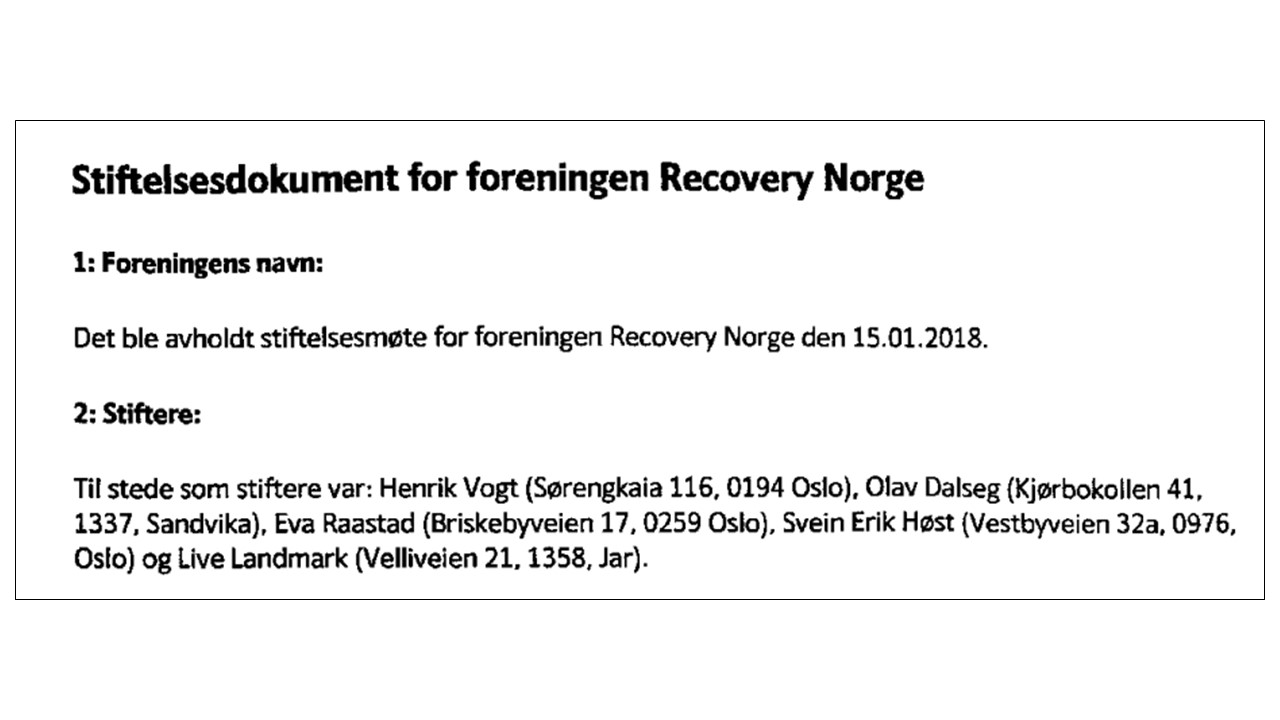
Landmark founded RN, in order to avoid the changes in the laws about marketing of alternative treatments. They claim it’s a patient organisation, but it was founded by LP instructors or their close family.

 
And Jo's definition here of COI is so broad that it would impact anyone who practices a specific intervention and also researches it having to declare a COI because they offer the intervention--even if they have a salary, given the impact on other ways of making money. Maybe that should be the accepted standard for declaring COIs. But at present, it isn't.

It would only impact them or be relevant to them if they did actually accrue benefits or were likely to. And t would also depend on what they might otherwise have written that did not lead to the likelihood of accruing benefits. What you might otherwise write will depend greatly on the status of what you are writing about and the validity of what you did write.

I don't think there is any point in trying to find rules. I have always taken the view that if in reality writing a particular way, when you could have written something else or nothing, is likely to lead to benefits accruing to you then you have a conflict then you are morally obliged to say what those benefits might be. I come at this having spent 10 years on an ethics committee where it was generally understood that it did not matter what lists of rules there might be, only whether a reasonable group of people would judge there to be ethical problems with a research proposal - based on anything you like. Rules are useful for reminding applicants of well known but easily forgotten issues like confidentiality and truly informed consent. But they wee never considered blanket or exhaustive. Every case was considered on its own merits.

Chalder has had a clear conflict of interest because she has built a career and promotions and fees for courses and so on out of writing stuff that she had no business to write because she had no evidence. Cut and dried. Other CBT therapists might have less conflict and if they were writing something that did not actually promote CBT they might well have none.
 
I wonder if we have arrived at something of an impasse because of differing cultural expectations (& with the presence of all manner of commercial entities and often unregulated private practitioners in healthcare in the U.S to a much greater degree). I wonder if most other U.S. members would instinctively share your view & most of the Brits/other Europeans would share mine?
dave30th said:
What would the disclosure actually be? "LL is an LP practitioner."
Is that what people are asking for? What else would it say?
Maybe something like:

"LL is an LP practitioner who derives [part/all] of her income from delivering LP to private clients. She has an ongoing commercial relationship with the [PP/LP] organisation."
 
Here is the declaration from the Oslo manifest:
Trudie Chalder has received royalties for self-help books on chronic fatigue and ad hoc payments for workshops on long-term conditions and travel expenses and accommodation costs of attending conferences. She is on the Expert Advisory Panel for Covid-19 Rapid Guidelines and is in receipt of research grants from Guy’s and St Thomas’ Charity, NIHR and UKRI.
Hege Eriksen is cofounder and part owner of Stressprofessorene, giving paid lectures on stress and coping.
Henrik B Jacobsen receives honorariums for lectures and workshops about stress and health.
Hans Knoop receives royalties for a published manual of cognitive behavior therapy for ME/CFS.
Live Landmark receives honorarium for lectures about stress and coping and payment as an instructor in the Lightning Process.
Helena Liira is the former Editor in Chief of the Scandinavian Journal of Primary Health Care.
Silje E Reme receives honorariums for lectures and workshops about stress and health.
Michael Sharpe is President of the European Association of Psychosomatic medicine and receives royalties for academic publications.
Henrik Vogt initiated and was the former leader of Recovery Norway which is an organization consisting of people who have experienced recovery from conditions such as post-viral illness like PACS and CFS/ME from 2017 until March 2022 and is still a member of this organization. He discloses this as an intellectual and personal COI but declares no financial or economic conflicts of interest.
 
I wonder if most other U.S. members would instinctively share your view & most of the Brits/other Europeans would share mine?
I'd be curious too. I find often in discussions about some of these things that there does seem to be a cross-cultural difference. For me, if I'm going to write a journal, I'd like it to be a slam-dunk, not a borderline case. I can certainly entertain an argument about why it would be good if she made the kind of declaration you suggest. But is she required to by current standards? That's a different matter. Does a BACME member have to disclose membership in BACME? To Cochrane, it seems so. In general, for journals, it seems not.

The issue of whether a trademarked practice is fundamentally different than, say, CBT or whatever, is one I haven't really thought about before, nor have I seen it discussed in the context of COIs. That's the point I'd like to hear about from those who might be considered experts in research ethics.

I hope it doesn't seem like I've been flip here. I have really tried to take in the comments here and make a good faith effort to see if I can make an argument to myself about why she should be required to report a COI for her practice. And personally I just can't get past the fact that it doesn't feel to me like it reaches the bar, absent evidence of her taking money other than from her clients.

I'm not infallible. My instincts are obviously not always right.
 
Here is the declaration from the Oslo manifest

Very interesting, thanks for sharing! So she does receive honoraria, and she did not disclose them here. That's bad!! More significant in my mind than receiving money from clients/patients. The others in the Oslo declaration author list aren't making a similar acknowledgement--maybe they're all on salary. And the same journal, in these two different papers, appears to be operating on a broader definition of COI in one than the other--for example, Sharpe's acknowledgement of being president of the European Woo-Woo Society.

What is striking about the study we're discussing here is the complete absence of any reported COIs. I find that more interesting that no one declared any conflicts than that Landmark specifically did not. Obviously some or many of the purported "experts" in the newer paper must have received honoraria or other declarable income. If there are at least a few of them for whom that is documented, then yes, a letter to the journal would I think be warranted.
 
What is striking about the study we're discussing here is the complete absence of any reported COIs.

I think that may be because it isn't a study. It is simply a propaganda text. Interestingly the journal calls it a 'research article'. The fact that it is nothing of the sort may indicate that this jounral (Scandinavian Journal of Primary Care or whatever) is run by an editor with no idea what research is. The paper might be considered a review but most journals would probably put it under 'opinion' or something.

Basically this is at a level of publishing below any known standards of anything - intelligence, ethics, entertainment even. The editor wouldn't know a conflict of interest if it was a bald eagle grabbing his nose with its talons. The worrying thing is that this sort of thing may have political impact in Norway.

What intrigues me more in a way is how on earth Paul Woof Sealion Garner gets his name on this? Is his position as an expert on evidence in trials a reason to involve him? Is his lived experience a justification? The mind boggles.
 
Landmark is not a clinician and LP is not a therapy
I also don't see how LP is any different from CBT, which is so vague as to be meaningless. And she is now a psychologist, so while not a physician, she is an 'expert'. The issue here is mainly that everyone involved in this ideology has significant biases and conflicts of interest, so much that it's normalized to the point where it's not really considered to apply them as a rule. Plus, let's not kid ourselves, most of the people involved in ethical rulings also think LP is a perfectly acceptable therapy for us, so they would never consider this a problem. The fact that most who promote CBT+GET are perfectly happy promoting LP alongside says it all.

And by everyone I mean literally everyone. It's actually offensive how much bias and conflicts of interest there are in evidence-based medicine, because the same people developing the products are usually the same who 'trial' them, analyze and review them, then attach their reputation onto the outcomes, with financial stakes so big that even governments support them. But that's just the way things are done(TM).

It's also not much different from a professor forcing students who take their class to buy their books. Biases and conflicts of interest are fundamental to almost everything done in academia, to the point where declaring them all is too much of a burden. Far from being the dispassionate search for the truth, academia is an attention economy, very much like social medial influencers. They are more often than not actually correct, but there is nothing to account for when the expert consensus is wrong.

The ideological biases are also blatant, but those biases are mainstream, and that magically takes care of that. To the point where the Norwegian government can essentially falsely argue, in court, that "everyone knows ME is psychological and even simply thinking otherwise is silly". It's false, but the vast majority of physicians would agree, and they can be, and are, expert witnesses asserting so.

It's a derivation of the line in Seinfeld about how "it's not a lie if you believe it". This all might be an ideology, but it is a dominant ideology, and that just magically becomes the expert consensus, and so biases in favor are actually the neutral position. There is just no way to account for issues like this, where a clearly wrong ideology completely dominates. This is essentially what NAV argued in court, that what the government says is "the unquestionable truth and that's final".
 
If the CBT for ME/CFS is useless, (Chalder) can (and does) move on to researching and using CBT for other conditions including both psychological and physical conditions. She therefore has no conflict of interest in researching CBT for ME/CFS or anything else. Her job and income are secure.
Except that she hasn't, including being an author of this paper and all. Chalder is no different than Parker or Landmark. None of these people are. They are all impossibly biased and conflicted about it, but the entire medical system is just as biased and conflicted about it, no one wants to admit how this disastrous ideology has destroyed millions of lives and incurred trillions in losses, so the entire system is extremely motivated at maintaining the lies, the same lies that the LP promotes.
 
I've spent so much time discussing the COI issue that I haven't even had time yet to read the actual paper and see how stupid it is for myself!
For me, if I'm going to write a journal, I'd like it to be a slam-dunk, not a borderline case.
I hope it doesn't seem like I've been flip here.
You don't come across as flip to me at all. I was worrying that, collectively, all our comments might come across as a lot of pressure -- so to be clear, I (for one, at least) just engaged out of interest in the question, I don't meant to suggest you should write to this journal if that doesn't feel right to you.
 
Back
Top Bottom