New Scientist: Exercise advice for long covid may be doing more harm than good

A few quotes, including from @Tom Kindlon and @dave30th:

[on the Berry study]
“If you don’t achieve the level that’s minimally clinically important, you don’t go around claiming success,” says David Tuller at the University of California, Berkley. In response, Berry says it’s not for us to say whether an individual would benefit from this improved mobility. “I think that’s open to interpretation.”
[on PACE]
This situation is reminiscent of chronic fatigue syndrome, also called myalgic encephalomyelitis (ME/CFS), which may be caused by an infection and commonly involves post-exertional malaise. In 2011, The Lancet published the PACE trial, which concluded that graded exercise therapy – incrementally increasing the duration and intensity of activity from an achievable baseline – moderately improved fatigue and the ability to perform daily tasks in people with ME/CFS.
But that trial has been plagued by criticism ever since. In a letter to The Lancet in 2011, Bart Stouten, an independent statistician, writing with health psychologist Ellen Goudsmit and the then-chairman of the ME Association Neil Riley, pointed out that the researchers behind the trial changed their definition of improvement from its starting protocol to the final paper. Five years later, Tom Kindlon at the Irish ME/CFS Association and his colleagues reanalysed the data according to thresholds specified in the starting protocol and concluded that this change to the definition increased the rate of recovery among those doing the exercise intervention four-fold. “We highlighted that there was minimal or no changes in objective measures, and there was no change in long-term improvement,” says Kindlon.
What’s more, Kindlon, Tuller and their colleagues reported in 2018 that serious adverse events, such as hospitalisation, were twice as high in the graded exercise therapy group as the control one, based on the procedures set out in the PACE trial protocol and data obtained via a freedom of information request. “What we learned from trials of exercise studies in ME is that it’s not a benign intervention,” says Dalton.
 
Not sure where it's cut off, but these are the last two paragraphs:
Mike Ormerod, who has long covid and volunteers at Long Covid Support, says he takes research papers that show the dangers of exercising with post-exertional malaise to all of his medical appointments. “Through our support group, we hear instances of people being advised to do exercise,” says O’Hara. “Most doctors generally believe that exercise is good for you, so they’ll encourage people to be active.”

“The risk is that the message is ‘exercise works for long covid’, and that’s potentially so damaging to the people who have an ME-like phenotype,” says Dalton.
 
There's a good argument to make about this being problematic with PEM but it sidesteps the fact that even without the evidence for exercise therapy, and for psychotherapy, in Long Covid is just not there, and not even plausible in the first place. It's literally not there at all, all of which should be offensive to anyone with a scientific mind when it's been known, and asserted from the start as a good thing, how there is a high proportion of natural improvements, far more than the mediocre boasts from trials, which have not once met a single minimum clinical significance threshold. Climate change deniers pointing to minor blips on large graphs are no less dishonest than this, it's exact the same thing.

And that's even before you get to the even more absurd application of this to problems like loss of smell. There is not a single plausible explanation, model or mechanism for exercise to be a meaningful solution to a problem that has absolutely nothing to do with lack of exercise.

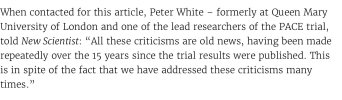
Absurd quote from Peter White, both Andrew Wakefield and Richard Horton very likely said the same thing, but for 12 years instead of 15. Because when one major error goes unpunished, it just leads to more of the same. The tobacco companies must have said the same thing as well.
“If you don’t achieve the level that’s minimally clinically important, you don’t go around claiming success,” says David Tuller at the University of California, Berkley. In response, Berry says it’s not for us to say whether an individual would benefit from this improved mobility. “I think that’s open to interpretation.”
This, they call evidence-based medicine. Most advertising laws make this explicitly illegal when it comes to commercial products and services, it would be considered fraudulent and prosecuted. In medicine? It's all fine and good. Because money is more important than lives.

And you can bet everything you own on the fact that when we finally pass through the last obstacle and all of this scandal is blown open, everyone involved will pretend like it was all just a small misunderstanding and they couldn't possibly know otherwise. Once you shed integrity, you can never wear it again.
 
In response, Berry [Colin Berry, the lead investigator] says it’s not for us to say whether an individual would benefit from this improved mobility. ‘I think that’s open to interpretation.’
This is truly an all-time quote from the lead researcher of a trial that was meant to do exactly that. They literally defined what benefit would mean, and when it fell short, literally, and which they hid, they basically hem and haw about how it's really hard to say. It's truly astounding how little credibility is deserved here. I have never cared this little about any job I ever had, the very thought is alien to me.

And yet again the bar was set so low that almost-dead people could crawl over it and it still fell short. The total lack of ambition here is also completely alien to me. There is absolutely no point to any of this methodology if this is the mediocrity it produces.
 
Back
Top Bottom