It might be relevant. Though I think it might be making too many assumptions to interpret these findings as necessarily a problem with B cell membranes. B cell lipid metabolism is supposed to shift quite dynamically throughout its developmental trajectory. And like I said above, if there truly was a lipid problem that was detrimental to the cell, the most likely response of a B cell is to simply die off. That's why these findings make more sense to me as a sign of different signaling exposure rather than a fundamental lipid problem
Can you elaborate? I don’t understand what this means (or how it would happen or manifest) so my head was very much in the ‘okay, lipids, mitochondria, phospholipid bilayer’ space.
Can you elaborate? I don’t understand what this means (or how it would happen or manifest) so my head was very much in the ‘okay, lipids, mitochondria, phospholipid bilayer’ space.
Overhauling of lipid metabolism is a necessary step in B cell maturation because B cell receptors require lipid rafts. What that means on a transcriptional level is B cells are specially "wired" such that whole suites of lipid related genes are upregulated in concert with other genes that mediate B cell development/response to stimuli/etc.
These suites of genes get induced by coordinated activity of a bunch of transcription factors--they're basically the end points of internal cascades that get triggered when something binds to a receptor on the B cell surface. That could be an antigen binding to the B cell receptor, or a cytokine from another immune cell binding to its specific receptor on the B cell [edit: (usually both are needed to move things along)]. There's also some possible effects from the local environment like hypoxic "pockets" in the germinal centers that might influence transcription factor activity--I'll avoid going into too much detail there.
Important takeaway for the purposes of this paper is that this receptor binding can trigger an epigenetic shift that can persist in the cell even if its not actively receiving a certain signal anymore. The idea is that this paper's lipid signature might be the result of some of those lipid-related gene programs getting switched on because of prior exposure to different signals (or the same signals in different amounts/proportions) in ME/CFS vs. controls.
The idea is that this paper's lipid signature might be the result of some of those lipid-related gene programs getting switched on because of prior exposure to different signals (or the same signals in different amounts/proportions) in ME/CFS vs. controls.
Theoretically possible that they are involved, though it is hard to make sense of how they are driving the illness. Just considering the limited amount of surface receptors that those papers looked at and trying to occams-razor it, it seems more likely that those findings are another downstream consequence of whatever drove the lipid changes here. Though if we get hard proof of an antibody driving the illness then they might be involved in some loop that way
Unfortunately it's a difficult position to piece things together from. What you can do with any transcriptomics data is take a list of differentially expressed genes and cross reference it with databases that list hundreds of transcription factors and their known target genes in different cell types. But even if you get a list of transcription factors that are implicated, it doesn't necessarily mean you've found your culprit--cellular response networks are sprawling, so processes could feasibly involve transcription factors triggering other transcription factors (triggering other transcription factors), or transcription factors causing a change in some other part of the cell that sets of a sensor protein and triggers a different signaling cascade.
The best you can really do is start with a particular signaling pathway in mind and see if there are other findings where someone modified that pathway and measured what you're interested in. It would be nice if I could tie everything back to my interferon hypothesis for example (and I'm more likely to find some shred of connecting evidence just by chance, since the interferon response is one of the most well-studied signaling pathways in biology), but some connections just might not have been explored yet.
Unfortunately it's a difficult position to piece things together from. What you can do with any transcriptomics data is take a list of differentially expressed genes and cross reference it with databases that list hundreds of transcription factors their known target genes in different cell types. But even if you get a list of transcription factors that are implicated, it doesn't necessarily mean you've found your culprit--cellular response networks are sprawling, so processes could feasibly involve transcription factors triggering other transcription factors (triggering other transcription factors), or transcription factors causing a change in some other part of the cell that sets of a sensor protein and triggers a different signaling cascade.
The best you can really do is start with a particular signaling pathway in mind and see if there are other findings where someone modified that pathway and measured what you're interested in. It would be nice if I could tie everything back to my interferon hypothesis for example (and I'm more likely to find some shred of connecting evidence just by chance, since the interferon response is one of the most well-studied signaling pathways in biology), but some connections just might not have been explored yet.
What that means on a transcriptional level is B cells are specially "wired" such that whole suites of lipid related genes are upregulated in concert with other genes that mediate B cell development/response to stimuli/etc.
Is this an entirely unique pathway for B cells, so is your expectation that this would only be seen in antigen+cytokine triggered b-cells? Or are the same pathways/mechanisms present elsewhere in different cell groups, perhaps used a bit differently as often seems to be the way!
The role of rafts in cellular signaling, trafficking, and structure has yet to be determined despite multiple experiments involving several different methods, and their very existence is controversial despite all the above
I do not understand why we mention lipid abnormalities for B Cells specifically. Does this mean that because B Cell-derived LCLs were used , lipid abnormalities in MECFS patients should be only considered for these kind of cells ?
Don't we have evidence of lipid abnormalities and specifically phospholipids and plasmalogens in MECFS using other cell types @jnmaciuch ?
I do not understand why we mention lipid abnormalities for B Cells specifically. Does this mean that because B Cell-derived LCLs were used , lipid abnormalities in MECFS patients should be only considered for these kind of cells ?
Yes, I think it’s just that this is all this paper shows us. It’s researchers being understandably cautious about wider speculation. Or at least drawing a distinction between speculation and evidence.
Is this an entirely unique pathway for B cells, so is your expectation that this would only be seen in antigen+cytokine triggered b-cells? Or are the same pathways/mechanisms present elsewhere in different cell groups, perhaps used a bit differently as often seems to be the way!
The only thing that would be unique for B cells is the specific “wiring”—it is entirely likely that these suites of genes (or specific subsets of them) can be upregulated together in other cell types, but they would be responsive to different triggers. T cells might be the closest to the B cell “wiring” given that they come from the same precursor cells and also have to load lots of TCRs on their cell surface.
First step would be seeing what if anything of these findings can be confirmed in fresh B cells. Though a null result there wouldnt necessarily mean these findings are incorrect, since we have to remember that immortalizing with EBV is in itself a kind of “stimulation”—inducing long term expression in some genes and suppressing others (which has the effect of locking B cells in a developmental stasis outside their normal trajectories). In which case, the focus could move to trying to sort out what exactly is “shifted” in B cells even prior to immortalization through something like an ATAC-seq study
sure, sphingomyelins have come up from baraniuk’s CSF study, for example. But as I’ve learned the hard way even at this early stage of my career: trying to link findings across systems can be useful in specific circumstances, but you need to have prior knowledge about each system/cell type to be able to interpret it coherently. Otherwise, you can end up with a lot of possible connections that ultimately waste your and everyone else’s time (again, speaking from personal experience).
Seeing a broad class of lipids come up twice does not necessarily mean an inherent lipid problem, it could just as well mean that two different cell types respond to the same systemic signal by slightly changing their lipid metabolism in cell-type-specific ways (a change which may ultimately have very little to do with mediating the symptoms or underlying mechanism of ME/CFS). Trying to sort out the upstream cause of a finding in one specific context might be the most useful approach
But as I’ve learned the hard way even at this early stage of my career: trying to link findings across systems can be useful in specific circumstances, but you need to have prior knowledge about each system/cell type to be able to interpret it coherently. Otherwise, you can end up with a lot of possible connections that ultimately waste your and everyone else’s time (again, speaking from personal experience).
Seeing a broad class of lipids come up twice does not necessarily mean an inherent lipid problem, it could just as well mean that two different cell types respond to the same systemic signal by slightly changing their lipid metabolism in cell-type-specific ways (a change which may ultimately have very little to do with mediating the symptoms or underlying mechanism of ME/CFS). Trying to sort out the upstream cause of a finding in one specific context might be the most useful approach
Sure, I understand this but then again we have additional evidence -given the GWAS- that certain defects in ER-phagy may be at play and since the Endoplasmic Reticulum (ER) is the site of lipid metabolism (am I right ?) it is possible that a combination of defects (ER-phagy, vesicle trafficking, and impaired phospholipid repair due to PRDX6 - Tier 1 gene) may well be a cause of the repeated perturbations we see in Phospholipids. Focusing specifically in B Cells may be increasing Precision but we may be loosing critical information from a greater context.
Perhaps my question should be addressed to @DMissa as to whether these results are pointing us specifically to B Cells.
Sure, I understand this but then again we have additional evidence -given the GWAS- that certain defects in ER-phagy may be at play and since the Endoplasmic Reticulum (ER) is the site of lipid metabolism (am I right ?) it is possible that a combination of defects (ER-phagy, vesicle trafficking, and impaired phospholipid repair due to PRDX6 - Tier 1 gene) may well be a cause of the repeated perturbations we see in Phospholipids. Focusing specifically in B Cells may be increasing Precision but we may be loosing critical information from a greater context.
It's an additional piece of support, though worth keeping in mind that every DecodeME hit had a very small OR (difference compared to controls). It's not just a matter of precision but more of coherence, where you can sort through a million potential connections to a hypothesis of how that mechanism actually maintains a chronic disease state, or how it specifically explains symptoms.
I understand I come across as more skeptical towards a completely zoomed-out approach. I think a lot of that comes from knowing that if, for example, we lived in a world where humanity didn't have a fraction of its current understanding about adaptive immunity, research into something like lupus would probably look much the same as it currently does in ME/CFS. If we only knew about things like complement from its connection to synapses in alzheimers, GWAS and various lab findings might lead people to think lupus was an issue of synapses. Or we might have people use HLA associations and EBV epidemiology in lupus to claim that it's caused by EBV reactivation in tissue because EBV enters cells through HLA binding. And we would also have tons of various metabolomic and lipidomic findings in lupus that, unbeknownst to us, were actually downstream of the disease process. So information does have to be considered all together--but a coherent biological story is much more useful for putting pieces together than scattershot context.
One option would be that if you already had good reason to think a certain pathway was involved, you could try inducing it in cells and see if you end up with the same phenotype. Or you could do an unbiased screen looking for epigenetic differences and see if any of them have been previously associated with similar lipid changes. I'm sure Daniel already has several much better ideas in the works on how to go about this.
@jnmaciuch so a "coherent biological story" is the conversation about B Cells and lipids ? So maybe we are looking at a Single Point Of Failure (SPOF) in ME/CFS am I correct (so we do not care about ER Stress, impaired N-glycans, LXR downregulation, etc etc) ? If this is what you are implying and you believe at a SPOF being at play I have no further comments.
I'm only part of the way through the paper, but already there is a lot to like. Thanks to @DMissa and team for listening to us and no doubt to others, and thanks for the careful work.
I agree with Trish that the paper is the better for not spending time in the introduction detailing what ME/CFS is and that it is clearly written. I love that scatterplots are used. It's great that it was realised that only the transcriptomics results from female participants should be used with the metabolite results from the all-female cohort.
A very minor issue that perhaps it is not too late to tidy up is the inconsistent naming of the data sets. In one section (see line 365) it is noted that different definitions will be used in one subsection only i.e. the combined set of polar metabolomics and lipidomics data set is referred to in the subsection as the metabolites dataset. Perhaps that approach could be used throughout, and/or polar and non-polar metabolites? As far as I can see, the lipids are also subset of metabolites, so referring to a metabolic data set and lipidomic data set in most but not all of the paper is odd. The polar metabolite group includes some water-soluble lipids.
Age differences
So far, my biggest concern, or at least a question, is the age difference between the ME/CFS and control participants donating the B cells. There's this at line 190:
190 Samples were selected for these experiments from among our existing cell line collection using random number selection to avoid bias. The mean age of the ME/CFS cohort was 49 and the mean age of the HC cohort was 39, but this difference was not found to be statistically significant. We previously found that age did not exhibit a significant relationship with the expression of genes that are dysregulated in ME/CFS (5). The ages of our participant cohorts were predominantly lower than the final age peak of ME/CFS onset (21). For these reasons, we do not believe age is a confounding factor affecting our conclusions in this work. BMI information was not available.
A mean age of 49 for the ME/CFS donors and a mean age of 39 for the control donors actually is a big deal I think, especially when the participants are all female. Ok, the difference is not statistically significant, but I think if you looked at the difference between the numbers of women in perimenopause and menopause versus those who are not in each group, there would be a significant difference. The authors did not work with male cells due to concerns about sex effects, but I think a post-menopausal woman is likely to be nearly as different I think menopause versus no menopause could cause equally significant variation.
I don't understand the comment about 'the ages of our participant cohorts were predominantly lower than the final age peak of ME/CFS onset' and that that is a reason to think age is not a confounding factor, especially as the reference 21 that is cited there doesn't seem to have anything to do with that ('The utility of lymphoblastoid cell lines').
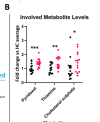
The age difference becomes relevant with things like the difference in cholesterol sulphate. To start with, it is noted that no polar metabolites satisfied the threshold for significance after correction for multiple comparisons. So, the analysis using uncorrected p values is described by the authors as 'a brief indicative exercise'. And, even then, the p value is not impressive and the scatter plot indicates substantial overlap. What we seem to be seeing in the scatterplot is a slight increase in the fold change vs HC average in the ME/CFS group.
We know that hypercholesterol is quite common in older women and it is known that hypercholesterol increases levels of cholesterol sulphate. So, perhaps that apparent slight increase is really just a reflection of the age differences of the cohorts?
That slight difference in cholesterol sulphate that does not survive adjustment for multiple comparisons is the sole driver of the MetaboAnalyst Pathway analysis (line 432) result of 'possible effects on steroid hormone biosynthesis'. Line 439 notes that in each of the 'dysregulated pathways' 'there was one metabolite that the dysregulation was attributable to'. Given all the uncertainties, it seems a very long bow to draw to suggest the slight increase in the mean cholesterol sulphate result is evidence of disease-relevant 'possible effects on steroid hormones biosynthesis'.
I think the differences in cholesterol sulphate could well be the result of age differences affecting the epigenetics of these cells. Regardless, it does not appear to be a driver of disease, as some of the ME/CFS cells had levels lower than the healthy control average.
Missing values
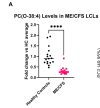
I have a question about the treatment of missing values. At line 356 it is mentioned that missing values were replaced with the feature mean and that features with more than 50% of values missing were excluded. 50% of missing values is quite a high bar for exclusion (not a criticism, just an observation). Figure 3A of the lipid PC(O:38-4) is compelling, even exciting, but I'm wondering how many of the ME/CFS fold change values there are the result of an absolute value imputed due to missingness?
This site uses cookies to help personalise content, tailor your experience and to keep you logged in if you register.
By continuing to use this site, you are consenting to our use of cookies.


 For those who get into science to find answers instead of peddling narratives, anyways