Monocyte Oxidative Stress Underlies Persistent Immune Activation in Long-COVID Postural Orthostatic Tachycardia Syndrome
BACKGROUND
Long COVID postural orthostatic tachycardia syndrome (LCPOTS) is characterized by persistent orthostatic tachycardia and multiple constitutional symptoms, many of which suggest persistent inflammation. We sought to define mechanisms responsible for ongoing immune activation in LCPOTs and to determine if this is related to autonomic dysregulation.
METHODS
We performed a case-control study of 25 patients with LCPOTS and 15 controls who recovered from COVID-19 without persistent autonomic sequelae. Peripheral blood mononuclear cells were analyzed by flow cytometry to quantify circulating CD3⁺CD14⁺ T cell–monocyte doublets, cytokine production, memory phenotype, mitochondrial ROS, and isolevuglandin (IsoLG)-adduct formation. Forster resonance energy transfer was used to assess T-cell receptor–HLA interactions within doublets. Single-cell RNA sequencing (scRNA-seq) was performed on a subset of participants, and autonomic phenotyping included orthostatic heart rate responses, heart rate variability, baroreflex sensitivity, and blood volume measurements.
RESULTS
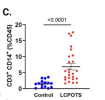
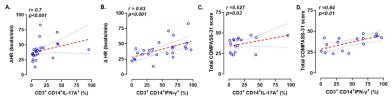
LCPOTS was linked to impaired cardiovagal function and greater autonomic symptom burden. It was also associated with roughly a threefold rise in circulating CD3⁺CD14⁺ doublets and enhanced T cell–monocyte interactions. These complexes demonstrated signs of genuine immune synapse formation and were enriched with effector-memory and TEMRA T-cell types. T cells in doublets produced higher levels of IFN-γ and IL-17A, and the proportion of cytokine-producing doublets correlated with the severity of orthostatic tachycardia and total COMPASS-31 score. Monocytes from LCPOTS showed increased mitochondrial content, superoxide generation, and IsoLG-adduct accumulation, along with decreased expression of antioxidant genes, including those related to NFE2L2.
CONCLUSIONS
Our findings suggest that ongoing immune activation contributes to LCPOTS pathogenesis. We propose that impaired cardiovagal regulation stimulates monocyte ROS production, promotes neoantigen formation, and T cell activation. This persistent immune response, together with disrupted mitochondrial function, likely contributes to the diverse symptoms linked to LCPOTS.
Web | DOI | PDF | Preprint: MedRxiv | Open Access
Marwa A Abd-Eldayem; Meenakshi Vinayagam; Yuliya A Vance; Sachin Y Paranjape; Celestine N Wanjalla; Kuniko C Hunter; Sergey Dikalov; André Diedrich; Surat Kulapatana; Pouya E Mehr; Tatiana X Solis-Montenegro; Joshua D Simmons; David G Harrison; Cyndya A Shibao
BACKGROUND
Long COVID postural orthostatic tachycardia syndrome (LCPOTS) is characterized by persistent orthostatic tachycardia and multiple constitutional symptoms, many of which suggest persistent inflammation. We sought to define mechanisms responsible for ongoing immune activation in LCPOTs and to determine if this is related to autonomic dysregulation.
METHODS
We performed a case-control study of 25 patients with LCPOTS and 15 controls who recovered from COVID-19 without persistent autonomic sequelae. Peripheral blood mononuclear cells were analyzed by flow cytometry to quantify circulating CD3⁺CD14⁺ T cell–monocyte doublets, cytokine production, memory phenotype, mitochondrial ROS, and isolevuglandin (IsoLG)-adduct formation. Forster resonance energy transfer was used to assess T-cell receptor–HLA interactions within doublets. Single-cell RNA sequencing (scRNA-seq) was performed on a subset of participants, and autonomic phenotyping included orthostatic heart rate responses, heart rate variability, baroreflex sensitivity, and blood volume measurements.
RESULTS
LCPOTS was linked to impaired cardiovagal function and greater autonomic symptom burden. It was also associated with roughly a threefold rise in circulating CD3⁺CD14⁺ doublets and enhanced T cell–monocyte interactions. These complexes demonstrated signs of genuine immune synapse formation and were enriched with effector-memory and TEMRA T-cell types. T cells in doublets produced higher levels of IFN-γ and IL-17A, and the proportion of cytokine-producing doublets correlated with the severity of orthostatic tachycardia and total COMPASS-31 score. Monocytes from LCPOTS showed increased mitochondrial content, superoxide generation, and IsoLG-adduct accumulation, along with decreased expression of antioxidant genes, including those related to NFE2L2.
CONCLUSIONS
Our findings suggest that ongoing immune activation contributes to LCPOTS pathogenesis. We propose that impaired cardiovagal regulation stimulates monocyte ROS production, promotes neoantigen formation, and T cell activation. This persistent immune response, together with disrupted mitochondrial function, likely contributes to the diverse symptoms linked to LCPOTS.
Web | DOI | PDF | Preprint: MedRxiv | Open Access