Preprint Microvascular Remodeling and Endothelial Dysfunction Across Post-COVID-19 and ME/CFS: Insights from the All Eyes on PCS Study, 2026, Wallraven et al

forestglip

Moderator
Staff member
Microvascular Remodeling and Endothelial Dysfunction Across Post-COVID-19 and ME/CFS: Insights from the All Eyes on PCS Study

Wallraven, Timon; Günthner, Roman; Lethen, Isabelle; Ribeiro, Andrea; Lech, Maciej; Oertel, Frederike Cosima; Rees, Lukas; Haller, Bernhard; Streese, Lukas; Hanssen, Henner; Wunderle, Michael; Schmaderer, Christoph

[Line breaks added]

Background
Post-viral diseases, including post-COVID-19 syndrome (PCS) and myalgic encephalomyelitis/chronic fatigue syndrome (ME/CFS), cause substantial long-term morbidity. Persistent cardiovascular (CV) risk after acute infection highlights the need for accessible tools to quantify microvascular health.

Methods
All Eyes on PCS is a prospective, observational study investigating the retinal microcirculation using retinal vessel analysis (RVA). We compared RVA parameters in 102 PCS patients with 204 age- and sex-matched healthy controls (HC, matched from n = 303).

Secondary matched analyses included never infected controls (NI, n = 96), recovered individuals (n = 102), PCS patients, and ME/CFS patients (n = 62). Laboratory variables, circulating markers of endothelial dysfunction (ED) and inflammation were compared between cohorts and their associations with RVA parameters were examined.

Results
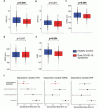
Compared with HC, PCS patients showed reduced venular flicker-induced dilation (3.7 {plus minus} 2.2% vs. 4.5 {plus minus} 2.7%, p = 0.005), narrow retinal arterioles (CRAE, 178.3 {plus minus} 15.5 µm vs. 183.3 {plus minus} 15.9 µm, p = 0.009), and lower arteriolar-to-venular ratio (0.83 {plus minus} 0.06 vs. 0.86 {plus minus} 0.07, p = 0.004).

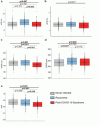
Findings persisted after adjustment for CV factors and remained evident in an extended secondary matched analysis across NI, recovered, and PCS patients. ME/CFS patients showed the most pronounced alterations.

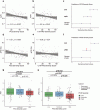
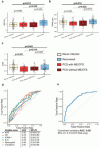
PCS severity correlated with lower AVR (r = -0.21, p = 0.037) and reduced arteriolar FID (r = -0.21, p = 0.039), particularly for neurocognitive symptoms. IL-6, ICAM-1 and VCAM-1 were elevated in PCS and ME/CFS and lower AVR correlated with inflammatory and iron-related markers (all adjusted p < 0.01). A combined model discriminated ME/CFS patients with good accuracy (AUC = 0.80).

Conclusions
PCS is associated with persistent ED, most pronounced in ME/CFS patients and linked to symptom severity and ongoing inflammation. RVA may provide a noninvasive, readout of ED in post-viral syndromes.

Web | DOI | PDF | medRxiv | Preprint
 
This is another study claiming elevated IL-6

I think the problem with IL-6, CRP or ESR is that if you take a population of people who are unwell they are almost certainly going to be contaminated with co-existent subclinical inflammatory disease of all sorts. So to my mind a slight statistical shift in IL-6 is impossible to make much of. We know that most people with ME/FS have a normal ESR and CRP, which are the body's own bioassays for IL-6. So IL-6 is not an essential mediator of whatever is wrong.
 
Based in the figures it seems like there is high variability within the groups and the differences are not very pronounced visually.
IMG_0579.gif
Figure 1
Retinal microvascular parameters in PCS patients and HC. Box plots show dynamic retinal vessel analysis (DVA) parameters: venular flicker-induced dilation (vFID; PCS n = 100, HC n = 195; a) and arteriolar flicker-induced dilation (aFID; PCS n = 100, HC n = 195; b), and static retinal vessel analysis (SVA) parameters: central retinal venular equivalent (CRVE; c), central retinal arteriolar equivalent (CRAE; d), and arteriolar-to-venular ratio (AVR; PCS n = 102, HC n = 199; e) in age- and sex-matched PCS patients (red) and healthy controls (blue). Box plots indicate the median (horizontal line) and mean (black dot). Each data point represents one eye from one individual (one eye analyzed per participant). Group comparisons were performed using the Mann-Whitney U test for non-normally distributed variables and Welch’s two-sample t-test for normally distributed variables. Forest plots (f) display standardized β coefficients with 95% confidence intervals from multivariable linear regression models assessing the independent association of PCS status with vFID, CRAE, and AVR, adjusted for arterial hypertension and hypercholesterolemia. Statistical significance is indicated as *p < 0.05.
IMG_0580.gif
Figure 2
Retinal microvascular parameters across never infected, recovered, and PCS cohorts. Box plots show DVA parameters vFID and aFID (never infected n = 95; recovered n = 92; PCS n = 100; a, b), and SVA parameters CRAE (c), CRVE (d), and AVR (never infected n = 94; recovered n = 99; PCS n = 102; e). Groups are visualized as never infected (grey), recovered (light blue), and PCS (red). Box plots indicate the median (horizontal line) and mean (black dot). Each data point represents one eye from one individual (one eye analyzed per participant). Group comparisons were performed using one-way ANOVA for normally distributed variables or the Kruskal-Wallis test for non-normally distributed variables. Post-hoc pairwise comparisons were conducted using Tukey’s honestly significant difference (HSD) test for ANOVA models and Dunn’s test with multiplicity correction for Kruskal-Wallis models.
IMG_0581.gif
Figure 3
Associations between RVA parameters and PCS symptom burden. (a–b, d–e) Pearson correlations between RVA parameters and symptom scores in PCS patients. Panels a–b show correlations between AVR and the PCS Severity Score (a) and C19-YRS (b). Panels d–e show corresponding correlations for aFID with the PCS Severity Score (d) and C19-YRS (e). Points represent individual patients; the solid line indicates the linear regression fit and the shaded band the 95% confidence interval. Pearson correlation coefficients (r) and p-values are shown in each panel.
(c, f) Forest plots display standardized β-coefficients with 95% confidence intervals from multivariable regression models assessing the association of AVR (c) or aFID (f) with the PCS Severity Score after adjustment for BMI and gender. Statistical significance is indicated as *p < 0.05.
(g–h) Box plots show the distribution of AVR (g) and aFID (h) across three symptom severity groups in PCS patients (black) and recovered individuals (grey). The PCS Severity Score was categorized into low (green), moderate (blue), and high (red) severity using fixed cutoffs (<10, 10–30, >30; colors as indicated). Box plots indicate the median (horizontal line) and individual observations. Group comparisons were performed using one-way ANOVA for normally distributed variables. Post-hoc comparisons were conducted using Tukey’s HSD for ANOVA models. Each data point represents one eye from one individual (one eye analyzed per participant).
IMG_0582.gif
Figure 4
Retinal microvascular parameters and biomarker-based discrimination of ME/CFS. (a–c) Box plots of the DVA parameter vFID (a) and SVA parameters CRAE (b) and AVR (c) across four cohorts: never infected (n = 96, cornsilk), PCS with ME/CFS (n = 62, red), PCS without ME/CFS (n = 39, dark red), and recovered individuals (n = 102, light blue). Box plots indicate the median (horizontal line) and mean (black dot). Group comparisons were performed using one-way ANOVA for normally distributed variables or the Kruskal-Wallis test for non-normally distributed variables, with post-hoc testing using Tukey’s honestly significant difference (HSD) test for ANOVA models or Dunn’s test with multiplicity correction for Kruskal-Wallis models. Adjusted p-values are shown above group comparisons. Each data point represents one eye from one individual (one eye analyzed per participant).
(d) Receiver operating characteristic (ROC) curves for individual biomarkers discriminating PCS patients fulfilling ME/CFS criteria from recovered individuals and PCS patients without ME/CFS. Variables include AVR (dark blue), creatine kinase (CK; red), C-reactive protein (CRP; light blue), interleukin-6 (IL-6; green), low-density lipoprotein cholesterol (LDL; orange), and transferrin (purple) (colors as indicated).
(e) ROC curve showing discrimination between ME/CFS patients and the combined comparator group (recovered individuals and PCS patients without ME/CFS) using a multivariable model integrating AVR, CK, ICAM-1, IL-6, transferrin, and neutrophils. Area under the curve (AUC) with 95% confidence interval (CI) was calculated using DeLong’s method.
IMG_0583.gif
Figure 5
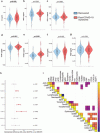
Circulating inflammatory and endothelial dysfunction markers in PCS and their associations with retinal microvascular parameters. (a–g) Violin plots illustrate circulating levels of inflammatory markers (IL-6, MCP-1, CXCL-10, CCL-5) and endothelial dysfunction markers (ICAM-1, VCAM-1, VEGF) in recovered individuals (light blue) and patients with PCS (red). Individual data points represent single participants. Box plots indicate the median (black line) and interquartile range (IQR). Group comparisons were performed using the Wilcoxon rank-sum test for non-normally distributed variables and Welch’s two-sample t-test for normally distributed variables, as appropriate. IL-6, CXCL-10, MCP-1, ICAM-1, VCAM-1, CCL-5, and VEGF were measured in n = 90 recovered individuals and n = 100 PCS patients.
(h) Forest plot illustrating age-adjusted associations between ME/CFS status and seven circulating biomarkers. Effect sizes are presented as standardized differences (SD units) with 95% confidence intervals derived from regression models adjusted for age. Statistically significant associations are highlighted in red (as indicated, p<0.05).
(i) Correlation heatmap showing significant Spearman correlations (p < 0.05) between selected laboratory parameters and retinal vessel analysis (RVA) parameters AVR, CRAE, CRVE, vFID, and aFID in PCS patients. Spearman’s ρ is color-coded from +1 (yellow, positive correlation) to −1 (blue, negative correlation).
 
Back
Top Bottom