I'm working with the assumption that it is a given that for a large proportion of people with ME/CFS, if they went to a sleep doctor and did a sleep study, they would not be seen to have a sleep disorder requiring CPAP.
You think that may be incorrect, and that nearly everyone with ME/CFS would be prescribed a CPAP if they had a sleep study? I understand you think there are certain doctors like Dr. Gold that may be exceptionally good at detecting the sleep abnormalities you're describing, but I'm talking about what is currently accepted as criteria for needing CPAP.
Anecdotally, a pretty high % of people I talk to with ME/CFS that have had sleep studies actually met criteria for OSA on their study. But definitely not everyone. One thing worth mentioning is, some sleep doctors don't even think CPAP is worth trialing for mild OSA (for example, I cite
a study in my thread on SDB and fibromyalgia where CPAP was only offered to fibro patients with moderate and severe OSA, and the ones with mild OSA were advised to lose weight, quit smoking/drinking if applicable, and to avoid using benzos/opioids for fibro - granted, the study is from Saudi Arabia, but I think there are still a lot of sleep doctors in the U.S. who wouldn't necessarily prescribe CPAP for mild OSA, especially if the patient does not complain of excessive daytime sleepiness, is not hypertensive, etc.)
Here is a list of sleep clinics that score RERAs and in theory may diagnose UARS and prescribe CPAP for it (I know it's not exhaustive - e.g. Stony Brook, where Dr. Gold works, is not on there - but I think it's probably safe to say that the majority of sleep clinics in the US do not score RERAs or prescribe CPAP for those who do not meet criteria for OSA, and very few outside the US do).
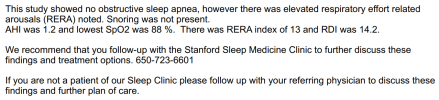
By the way, I had an in-lab sleep study (PSG) at Stanford, and they did not diagnose me with UARS based on my RERA index/RDI; below is what the letter said. I never followed up with them because I had already had a WatchPAT sleep study that had diagnosed me with OSA (WatchPAT is not very reliable at distinguishing between different types of non-hypoxic respiratory event-related arousals - i.e. non-hypoxic hypopneas vs. RERAs - as there are no airflow sensors, and will often inflate AHI) and I already had a CPAP machine (I wanted the PSG because I thought at the time that OSA and UARS were different disorders and I wanted to know what I really had, and I was also considering a palate expansion surgery so needed the PSG for that). So I'm not sure what they would have recommended for me in terms of CPAP treatment if I had followed up with them with these results without the previous diagnosis of OSA.
The value is in showing that common practice is wrong. If the results of a study are consistent with accepted wisdom about who will benefit from CPAP (which I think the associated GWI CPAP study is), then no one has any reason to reconsider or change anything.
I think you could just go with excluding OSA patients then, because I wouldn't say it's "accepted wisdom" within sleep medicine that symptomatic patients with milder SDB not meeting criteria for OSA benefit from CPAP (and it's certainly not common practice to prescribe CPAP for these patients), even if it is technically the standard of care for UARS according to AASM (the diagnosis of UARS was absorbed under OSA, so technically the standard of care for OSA is the standard of care for UARS):
Upper Airway Resistance Syndrome (UARS) was formally absorbed into the classification of Obstructive Sleep Apnea (OSA) by the American Academy of Sleep Medicine (AASM) in 2005. While not recognized as a separate entity in the 1999 AASM Task Force report, it was officially included within the spectrum of OSA in the International Classification of Sleep Disorders, Second Edition (ICSD-2) in 2005.
Current Status: The third edition (ICSD-3, 2014) continues to classify UARS under the diagnosis of adult Obstructive Sleep Apnea (ICD-9-CM code 327.23) because its pathophysiology is not considered significantly different from OSA.
And regarding OSA, I would say it's "accepted wisdom" that CPAP improves fatigue, cognitive function, and sleep quality in OSAS patients (which Dr. Gold's GWI study showed), but I wouldn't say it's accepted wisdom that it improves body pain, which was one of the findings of his GWI study (as well as in his fibromyalgia study - I should make a thread on it - only 1/28 patients in that study were diagnosed with OSA by the way, but I'm sure it would be different today;
I wrote about it in my fibro thread, but basically: thermocouples - not pressure transducers - were used, ≥50% reduction in airflow criteria for hypopnea was used, and the diagnosis of OSA was made based on first-night PSG, which only 18/28 patients underwent - prevalence of IFL in all patients was obtained during return nasal CPAP study)
And it would certainly be a new finding for example, if CPAP improved PEM in ME/CFS patients meeting criteria for OSA. But I guess it would be a more impactful finding if CPAP improved PEM in ME/CFS patients not meeting criteria for OSA.


