Preprint Initial findings from the DecodeME genome-wide association study of myalgic encephalomyelitis/chronic fatigue syndrome, 2025, DecodeMe Collaboration

If it's a brain problem, there's not much we can do, right? Could it be invisible lesions with our current technology?

You could say that of cerebral lupus, or autoimmune encephalitis, which are eminently treatable these days. And if it is a problem capable of remission, which we think it is, then maybe there are no lesions as such and all that is required is an alteration in chemistry.

Hypothyroid effects on the brain (the original meaning of cretinism, when congenital) are entirely reversible with thyroxine. We are not yet quite so good at re-balancing chemicals in Parkinson's or depression but lithium certainly works in some conditions.

And the brain problem may still be dependent on peripheral signals from innate immune cells, which we may be able to block.
 
One thing that your blog didn’t mention was sub-groups. I haven’t managed to keep up with discussions but as far as I understand the data from DecodeME doesn’t yet tell us whether ME/CFS is likely to be more than one disease, or anything about sub-groups. I’m not sure if this is something that may emerge with further analysis or whether we would need WGS for that.

Apologies if this has been discussed and I’ve missed it.

Edit: typo
 
Last edited:
One thing that your blog didn’t mention was sub-groups. I haven’t managed to keep up with discussions but as far as I understand the data from DecodeME doesn’t yet tell us whether ME/CFS is likely to be than one disease, or anything about sub-groups. I’m not sure if this is something that may emerge with further analysis or whether we would need WGS for that.

Apologies if this has been discussed and I’ve missed it.
The summary data that DecodeME has made available doesn't include or allow for subgroup analyses. It doesn't include the raw data and questionnaire data to do this. So it will be up to the DecodeME team to publish more on this.
 
One thing that your blog didn’t mention was sub-groups. I haven’t managed to keep up with discussions but as far as I understand the data from DecodeME doesn’t yet tell us whether ME/CFS is likely to be than one disease, or anything about sub-groups.

I would like to see whether the 8 gene loci SNPs come up more or less often in combination with each other - do we see the linked allele for OLFM4 more often than by chance with that for CA10 or less. How you read the answer would be complicated but if it was cler cut it might be less so.
 
Precision Life have the data and are into the idea of subgroups. Difficult for us to interpret given their analysis methods are a black box and they don’t seem great at communicating with us. But if they show some subgroups with the same data and can explain and perhaps tie it to the same identified genes… could be interesting
 
I was yesterday reading a recent nature paper about mechanisms by which this may occur as tested in mice: https://www.nature.com/articles/s41586-024-07469-y

The abstract etc are full of buzzwords but the actual experiments seem interesting.

Yes, this paper might deserve a thread. It claims to have identified pathways both from peripheral inflammatory insult to brain and back again.

The mystery is how in ME/CFS this would work without any actual ongoing inflammatory stimulus and no circulating cytokine changes. But that may not mean the pathways are not relevant.
 
Blog: DecodeME: the biggest ME/CFS study ever


@ME/CFS Science Blog , spotted a typo, "Rare SNPs might show langer and clearer effects"
Thanks for this piece. Really great! I will definitely come back to this more than once, whenever I've forgotten what had been talked about. What I didn't quite catch in the text is why some of your dots in the graphs are grey and why some are black? I might have missed it in the piece, but if not, I think it could be useful to be included somewhere.

I would think there's a tremendous amount of different analyis that can be done to see how closely related ME/CFS is to a different illness in some sense. My impression is that whilst LDSC gives an indication on the genetic correlation between illnesses the reason to not necessarily take these data too seriously is not necessarily related to how diagnosis was recorded can alter the results (which is sort of how I understood what the text said) but probably rather that to compare the genetic basis of two illnesses in such a way can or may not be appropriate depending on the context. I would imagine that there are illnesses that are entirely different in symptoms and presentation but that share variants in the same region (or as you mentioned in the text that it matters where the genes is expressed) and illnesses that are similar in symptoms and presentation and are similar in terms of the underlying biology but that don't share variants in the same region. In short your results may reflect the following: Pleiotropy (shared genes), Shared risk factors, or correlated measurement artifacts without reflecting anything genuinely connecting the mechanisms of illnesses. Of course you know these things much better than me, I just thought the justification to not take the LDSC too serious was maybe a bit too short for my taste in the text?

I haven't had a closer look but I've understood LDSC estimates global correlation, rather than anything else. Now it seems to me that this possible error in finding an HLA-association that doesn't exist suggests that there is room for imputation error in lots of different places (presumably only the significant findings where triple checked to hold water?). I find it possible that this additionally means that LDSC can from time to time identify common noise not signal as long as there is something systematically causing such issues?
 
Last edited:
Thanks @EndME
What I didn't quite catch in the text is why some of your dots in the graphs are grey and why some are black?
They are all the same color (gray) but I lowered the opacity so that if you see black ones it means there are multiple dots in a similar place overlapping each other.
Pleiotropy (shared genes), Shared risk factors, or correlated measurement artifacts without reflecting anything genuinely connecting the mechanisms of illnesses.
Think that having the same SNP signals, suggest the same genes as risk factors which points to similar biological mechanisms. So this points to a true connection, although there is some ambiguity at each of the steps (similar SNP signals might point to different genes, same genes may have different functions, etc).
I just thought the justification to not take the LDSC too serious was maybe a bit too short for my taste in the text?
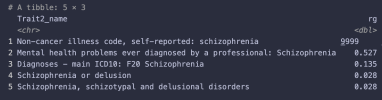
It's mainly because the correlation differed a lot depending on the trait name that you use in the UK biobank database. There were for example multiple for schizophrenia and the correlation differed enormously. The LDSC data also came from us, S4ME members, not the DecodeME researchers or other experts, so another reason to not put too much weight on it yet.

1760024566283.png

Now it seems to me that this possible error in finding an HLA-association that doesn't exist suggests that there is room for imputation error in lots of different places
The HLA region is particularly known to be hard to read because of polymorphism (there many different and similar versions of genes). So it gives quite a different situation compared to the rest of the genome.

Don't think that potential errors elsewhere would affect the overal LDSC because it tests millions of SNP locations. SNPs that suggested a problem with imputation were all filtered out.
 
I thought the pre-print suggested there was no overlap with genes associated with anxiety or depression. I’ve not managed to keep up with discussions. Is that now considered to be inaccurate?
It depends on how you look at it. The 8 significant SNP signals were not seen before in the same pattern in depression or anxiety. There were however genes such as OLFM4 that are implicated in both depression and ME/CFS, even though the SNP pattern around it is different.

In addition, the genetic data is much more than what sticks out above that 5*10^-8 threshold. A high correlation means that ME/CFS and depression show signals in the same genomic regions even if these did not reach significance. An example is NEGR1 which has been implicated in depression GWAS. If we look at this region in ME/CFS, then there is a signal close to this gene with a p-value around 5*10^-7.
 
It depends on how you look at it. The 8 significant SNP signals were not seen before in the same pattern in depression or anxiety. There were however genes such as OLFM4 that are implicated in both depression and ME/CFS, even though the SNP pattern around it is different.

In addition, the genetic data is much more than what sticks out above that 5*10^-8 threshold. A high correlation means that ME/CFS and depression show signals in the same genomic regions even if these did not reach significance. An example is NEGR1 which has been implicated in depression GWAS. If we look at this region in ME/CFS, then there is a signal close to this gene with a p-value around 5*10^-7.
Is it possible people with depression are more prone to ME? Or that a percentage of depression cases are actually people with the prodromal form of ME, whether or not it ever turns into the real thing?
 
Is it possible people with depression are more prone to ME? Or that a percentage of depression cases are actually people with the prodromal form of ME, whether or not it ever turns into the real thing?

If the local SNP patterns are different, as they seem to be, my reading is that it is likely that variations in the same gene or group of genes are relevant both to depression and to ME/CFS but for different reasons. For the CA10 gene and chronic pain it looks more as if the link is for the same or closely related reason.
 
Is it possible people with depression are more prone to ME? Or that a percentage of depression cases are actually people with the prodromal form of ME, whether or not it ever turns into the real thing?
A high score in LDSC simply means that 2 groups on average look more similar thoughout their whole genome than one might expect via a flip of a die. That is the case here for ME/CFS and whole range of other things, but it is also the case for IBD and a whole range of things, Schizophrenia and a whole range of things, SLE and a whole range of things and so forth, without it meaning that Schizophrenia being prodromal SLE.

Based on LDSC, a person whose dad has SLE might be statistically more likely to develop RA, but not in any way that matters.

I also find it a bit hard to make sense of the second statement. ME/CFS people are according to many studies are remarkably undepressed, so if people with depression are supposed to have prodomoral ME/CFS does getting ME/CFS resolve the depression?

One of the highest LDSCs in the above traits is the UK biobank code for chronic fatigue syndrome. My understanding is that we've pretty much agreed that this UK biobank code doesn't really stand for ME/CFS, that the people in DecodeME are somewhat different to these people in a meaningful way and that GWAS results for it are pretty much different but still there is some correlation and it is the strongest one what that was found above, so any connections cannot be stronger than the connections we already think are somewhat loose.
 
Last edited:
Back
Top Bottom