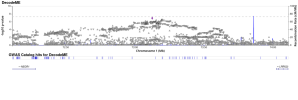
Preprint Initial findings from the DecodeME genome-wide association study of myalgic encephalomyelitis/chronic fatigue syndrome, 2025, DecodeMe Collaboration

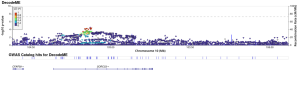
It also makes it possible to look if genes have been found in previous GWAS. For example it helped me find that OLFM4 was a hit in this GWAS on insomnia:
Apparently CA10 was associated with morningness, in the same study.

Suspect that this is something that would be useful: to systematically search if the DecodeME genes show up in other GWAS.
 
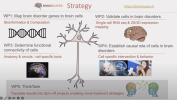
Also noted that the Postuma received a large grant (BRAINSCAPES) of around 20 million euros to work out the biological mechanisms behind genetic results of brain disorders.

Might be useful for DecodeME could make a connection to this group to see if ME/CFS could be included in their work.
The aim of BRAINSCAPES is to map in detail the biological mechanisms underlying multiple brain disorders ('brainscaping').
Recent genetic discovery studies have provided unprecedented insight into the genes involved in brain disorders. The next step is to use this knowledge for gaining mechanistic disease insight. In BRAINSCAPES we will develop novel analytic and experimental tools to study the functional consequences of risk genes on the function of specific cells, their circuits and functional output. We aim to provide insight into the molecular and cellular basis of complex brain disorders that can be used to design novel treatments.

EDIT: added the screenshot and lecture below:
1756151184613.png
 
Apparently CA10 was associated with morningness, in the same study.

Suspect that this is something that would be useful: to systematically search if the DecodeME genes show up in other GWAS.
It doesn’t look like there’s a good method of doing that in the Atlas, maybe just a google scholar search would get a start at coverage so something like this OLFM4 "genome wide" OR gwas or here’s a search for CA10 “genome wide” OR gwas?

And I remember @forestglip was interested in this a while back and working on https://sickgenes.xyz/
 
On the GENE Atlas site you can click on PheWAS:

This allows you to search on geneID or rsID in the GWAS in their database.
Great! Thanks. I think I’d checked every section except that one and was thinking a few of us could take a gene each and go off and do the leg work, but that makes things much easier.
 
Intriguing about the links tosleep problems.
I think sleep disturbances are in all the main case definitions, and it's one of the four core items for IOM criteria. In DecodeME data, it's close to 100% of people reporting sleep problems. This seems much higher than in other chronic illnesses (at least that don't mainly affect older people ) e.g. it's about 50% in MS.
 
Last edited:
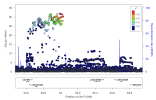
For example it helped me find that OLFM4 was a hit in this GWAS on insomnia:
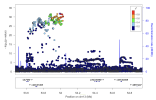
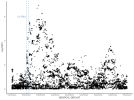
Here's how the signal looked like (notice that the X-axis is much shorter in DecodeME)
EDIT: the graphs are misleading: the Insomnia GWAS uses GRCh37/hg19 positioning versus GRCh38/hg38 in the DecodeME graph.

Insomnia GWAS 2019DecodeME data on ME/CFS 2025
1756201261378.png1756201308244.png

The p-values for the insomnia study are higher because it had a big sample size of 386.000. The odds ratio seems to be around 1.05-1.08 for SNPs in this region (Supplementary table 6 - Insomnia_all_GWAS_leadsnps) which is similar to what DecodeME found: 1.07.
 
Last edited:
EDIT: the graphs are misleading: the Insomnia GWAS uses GRCh37/hg19 positioning versus GRCh38/hg38 in the DecodeME graph.
This might be a better comparison. Tried to convert the DecodeME data back to the GRCh37 positioning (28151 SNPs failed) and then used the same x-axis range.
Insomnia GWAS 2019DecodeME transferred to GRCh37 using
1756211111458.png1756211004306.png
 
This might be a better comparison.

That is interesting. I wonder if you'd get graphs with similarly comparable trends for other conditions that co-occur with ME/CFS, like headache disorders, IBS, 'atopic type' (asthma, eczema, allergies)?

ETA: By the way that was only me wondering whether it could be some kind of artefact, not a suggestion someone puts hours of work into looking at it!
 
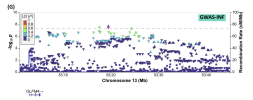
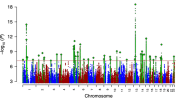
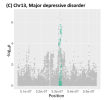
As mentioned in the DecodeME paper OLFM4 is also a clear hit in GWAS on depression. Here's what their Manhatten plot looks like. That big peak on Chromosome 13 is the OLFM4 region. The effect size is quite small though, an odds ratio around 1.04.

1756221138240.png
Genome-wide association analyses identify 44 risk variants and refine the genetic architecture of major depression | Nature Genetics

Subsequent attempts to match these SNPs with gene expression data, however, largely failed. They found that OLFM4 expression looks different than the SNPs found in this region for depression. I think that could mean two things: either OLFM4 is just a bystander and the significant SNPs on that locus are pointing to a different gene or the eQTL is missing the signal (quite possible).

The eQTL with DecodeME data also did not turn out well for OLFM4 (hence why it is not a Tier 1 gene).

DecodeME also compared the signals for this locus on chromosome 13 for ME/CFS and depression and found that they do not match well. I wonder if this excludes that they both have the same effect. If so, then the statement about there being no link to depression genes in the preprint might be an overstatement.
1756221424261.png
 
In other GWAS I read that they compared their results to those of other conditions using LD Hub. Unfortunately that tool no longer seems to be available but perhaps BIGA GWAS might be an alternative?
BIGA provides different tools for quantifying cross-trait genetic architectures, such as genome-wide genetic correlation methods and local genetic correlation analysis.

To enable efficient data analysis, we have aggregated and preprocessed GWAS summary statistics from different sources (e.g., the UK Biobank, PGC, GWAS Catalog, FinnGen, Biobank Japan, BIG-KP, UKB-PPP, CHIMGEN, and UKB Oxford Brain Imaging Team) and provided curated datasets. Our framework can easily be extended to incorporate additional methods and GWAS summary statistics. We plan to update our databases to include new data recourses every six months.

The User can either upload your own data or directly query data from publicly available GWAS data resources (e.g., GWAS Catalog, IEU OpenGWAS project, and Neale lab), BIGA will harmonize user's input summary statistics data, which can also be downloaded after job is finished.
Bivariate Cross-trait Genetic Architecture Analyses of GWAS
 
Last edited:
In other GWAS I read that they compared their results to those of other conditions using LD Hub. Unfortunately that tool no longer seems to be available but perhaps BIGA GWAS might be an alternative?

Bivariate Cross-trait Genetic Architecture Analyses of GWAS
Awesome! I'm not yet positive I understand it right, but I've been trying to find if there's any tool to find the best correlations based on raw genetic data from thousands of other traits, and this might be it? And you don't even have to convert to grch37 or rsids.
 
negr1_2.png
The above was the 10th most significant locus in the main GWAS (though its p-value of 1.19e-7 didn't pass the genome-wide threshold). NEGR1 appears to be the closest gene. Lead variant: 1:73,126,414:C:CA

There appears to be evidence linking NEGR1 to depression. Link to PubMed search for "depression negr1". Here are some snippets from papers:

Identifying causal genes for depression via integration of the proteome and transcriptome from brain and blood, 2022, Molecular Psychiatry
we aimed to highlight potentially causal genes by systematically integrating the brain and blood protein and expression quantitative trait loci (QTL) data with a depression GWAS dataset [...] we identified [...] two genes (TMEM106B and NEGR1) based on blood data with consistent robust evidence at both the protein and transcriptional levels.

Bi-ancestral depression GWAS in the Million Veteran Program and meta-analysis in >1.2 million individuals highlight new therapeutic directions, 2021, Nature Neuroscience
Here we report results of a large meta-analysis of depression using data from the Million Veteran Program, 23andMe, UK Biobank and FinnGen, including individuals of European ancestry (n = 1,154,267; 340,591 cases) and African ancestry (n = 59,600; 25,843 cases). Transcriptome-wide association study analyses revealed significant associations with expression of NEGR1 in the hypothalamus

Depression in multiple sclerosis patients associated with risk variant near NEGR1, 2020, Multiple Sclerosis and Related Disorders
Known NEGR1 variant increases general depression risk in multiple sclerosis cohort.

Regulatory mechanisms of major depressive disorder risk variants, 2020, Molecular Psychiatry
we found that NEGR1 (regulated by the TF binding–disrupting MDD risk SNP rs3101339) was dysregulated in the brains of MDD cases compared with controls, implying that rs3101339 may confer MDD risk by affecting NEGR1 expression.

Integrating genome-wide association study and expression quantitative trait loci data identifies NEGR1 as a causal risk gene of major depression disorder, 2020, Journal of Affective Disorders
Through SMR integrative analysis, we identified the SNP rs10789336 located in Neuronal growth regulator 1 (NEGR1) gene significantly affected the expression level of RPL31P12 in brain tissues and contributed to the risk of MDD (P = 1.96 × 10⁻⁶). Consistently, the SNP rs10789336 was associated with the methylation levels of three nearby DNA methylation sites, including cg09256413 (NEGR1, P=1.72 × 10⁻¹⁰), cg11418303 (prostaglandin E receptor 3 [PTGER3], P = 4.78 × 10⁻⁶), and cg23032215 (ZRANB2 antisense RNA 2 [ZRANB2-AS2], P = 1.23 × 10⁻⁴). Differential expression analysis suggested that the NEGR1 gene was upregulated in prefrontal cortex (P = 5.14 × 10⁻³). Cognitive genetics analysis showed that the SNP rs10789336 was associated with cognitive performance (P = 2.41 × 10⁻¹⁶), educational attainment (P = 1.75 × 10⁻¹⁴), general cognitive function (P = 2.65 × 10⁻¹²), and verbal numerical reasoning (P = 1.36 × 10⁻¹²).

On function of NEGR1:

NEGR1 and FGFR2 cooperatively regulate cortical development and core behaviours related to autism disorders in mice, 2018, Brain
We found that downregulation of the cell adhesion molecule NEGR1 or the receptor tyrosine kinase fibroblast growth factor receptor 2 (FGFR2) similarly affects neuronal migration and spine density during mouse cortical development in vivo and results in impaired core behaviours related to autism spectrum disorders. Mechanistically, NEGR1 physically interacts with FGFR2 and modulates FGFR2-dependent extracellular signal-regulated kinase (ERK) and protein kinase B (AKT) signalling by decreasing FGFR2 degradation from the plasma membrane. Accordingly, FGFR2 overexpression rescues all defects due to Negr1 knockdown in vivo. Negr1 knockout mice present phenotypes similar to Negr1-downregulated animals. These data indicate that NEGR1 and FGFR2 cooperatively regulate cortical development and suggest a role for defective NEGR1-FGFR2 complex and convergent downstream ERK and AKT signalling in autism spectrum disorders.
 
So is that three genes related to autism spectrum disorder, even though the last one had a low p-value?

Makes my ears prick up, although of course it's possible autism-related genes turn up in GWAS studies for all kinds of things because they have other roles.
 
I've now run this tool on a few different datasets using LDSC to find genetic correlations between ME/CFS and other traits. I'll attach all results for download and just mention some specific correlations.

Wikipedia:
In multivariate quantitative genetics, a genetic correlation (denoted rg or ra) is the proportion of variance that two traits share due to genetic causes, the correlation between the genetic influences on a trait and the genetic influences on a different trait estimating the degree of pleiotropy or causal overlap. A genetic correlation of 0 implies that the genetic effects on one trait are independent of the other, while a correlation of 1 implies that all of the genetic influences on the two traits are identical.

First I ran it on the dataset "PGC (Psychiatric Genomics Consortium) and Other Brain Disorders" which includes 24 different phenotypes.

The highest correlation (rg=0.586, p=5.0e-121) is with depression (based on data from this paper). Second most significant was another depression study (though I'm not sure how much overlap there was in participants between the two). The third most significant (rg=0.3116, p=1.2e-28) was with schizophrenia. The fourth was bipolar II disorder (rg=0.5787, p=1.0e-22). Correlations with many other phenotypes in this dataset were significant as well.

(It was at this point I decided to search PubMed for "depression neurons" just to explore, and I saw a paper about NEGR1, which reminded me that I saw this gene in the locus above, which led to the above post.)


I next ran it on a dataset called "Brain and Organ Imaging Traits", subgroup "Regional brain volumes" (101 brain regions). The data is from the BIG-KP resource. Nothing was significant after multiple test correction (FDR).


Next, I ran LDSC on the FinnGen dataset, which includes 303 traits. There should be little overlap in participants with DecodeME since the participants in FinnGen are from Finland.

Again, the most significant correlation is with depression (more specifically "Depression or dysthymia", rg=0.5310, p=1.1e-57). "Depression" is second most significant, and most of the subsequent correlations are related (mood, antidepressants, recurrent depression, anxiety, any mental disorder).

Other correlations:
8th is "Pain (limb, back, neck, head abdominally)" (rg=0.4655, p=1.4e-43).
13th is "Dorsalgia" (back pain) (rg=0.4316, p=1.7e-29)
21st is migraine (rg=0.4425, p=1.6e-23)


I also ran LDSC on the 4347 traits in the UK BioBank. Looking through for interesting correlations (all positive correlations unless explicitly stated):

Most significant is "Frequency of tiredness / lethargy in last 2 weeks" (rg=0.5657, p=2.5e-67).
2nd most significant is "Seen doctor (GP) for nerves, anxiety, tension or depression" (rg=0.5120, p=2.0e-49).
8th is "Chest pain or discomfort"
12th is "Seen a psychiatrist for nerves, anxiety, tension or depression"
17th is a positive correlation with "General happiness with own health" which seems odd. Maybe the meaning of the trait is reversed
18th is a negative correlation with "Getting up in morning", which makes sense
23rd is "Substances taken for depression: Medication prescribed to you (for at least two weeks)"
25th is back pain
28th is "Diseases of the digestive system"
39th is "Medication for pain relief, constipation, heartburn: Omeprazole (e.g. Zanprol)"
47th is "Wheeze or whistling in the chest in last year"
52nd is "Emphysema/chronic bronchitis" (rg=0.4357, p=3.0e-15)


BIGAGWAS also allows running a tool called LAVA, which looks for regions of local correlation on the genome, instead of correlation based on the entire genome. I don't fully understand how it works, but I thought it might be interesting to see if it can tell me what specific parts of the genome are highly correlated with depression, since that was highly ranked in all three of the relevant datasets. I ran the tool against depression, schizophrenia, and Bipolar II from the PGC dataset mentioned above.

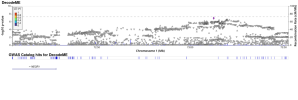
The number one significantly correlated region based on the three traits turned out to be basically the same NEGR1 locus I posted above and was a correlation with depression (p=3.0e-08). (Not that it really matters, but this analysis didn't finish until this morning, so I swear I didn't see this result until after I posted that, so it was quite interesting to see.)

Here is that region with the DecodeME data (converted back to GRCh38 coordinates with UCSC liftOver):
lava1.png
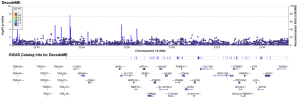
The 2nd and 3rd most significant regions were also correlated with depression:
lava2.png
lava3.png
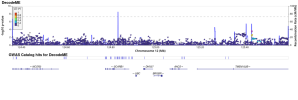
The 4th most significant was a region correlated with schizophrenia (p=2.5e-07):
lava4.png


Asthma was also highly significantly correlated with ME/CFS in FinnGen (rg=0.3699, p=2.8e-30). In UK BioBank, the correlation with asthma (diagnosed by doctor) was rg=0.2480, p=2.0e-11.

Searching for traits related to "sleep", in UK BioBank, "Sleeplessness / insomnia" was correlated with ME/CFS (rg=0.2357, p=3.6e-11). In FinnGen, "Sleep disorders (combined)" was correlated (rg=0.3123, p=6.1e-14).
 

Attachments

Last edited:
The highest correlation (rg=0.586, p=5.0e-121) is with depression (based on data from this paper). Second most significant was another depression study (though I'm not sure how much overlap there was in participants between the two).
Thanks, I suspect this will be one of the areas where the preprint may need to adjust the wording a bit. There does seem to be a link/similarity to depression based on genetic data.

Most significant is "Frequency of tiredness / lethargy in last 2 weeks" (rg=0.5657, p=2.5e-67).
That seems like a confirmation of the data that this came out on top in the UK Biobank.

Asthma was also highly significantly correlated with ME/CFS in FinnGen (rg=0.3699, p=2.8e-30). In UK BioBank, the correlation with asthma (diagnosed by doctor) was rg=0.2480, p=2.0e-11.
That's a bit surprising. The sleep disorders make more sense.

Does the database also include diseases that ME/CFS is often compared with, such as Multiple Sclerosis, Lupus, or mitochondrial disorders?
 
Back
Top Bottom