Nightsong
Senior Member (Voting Rights)
Abstract:
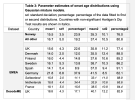
Myalgic Encephalomyelitis, or Chronic Fatigue Syndrome (ME/CFS), is a disease of uncertain origin. Studies of Norwegian health records have suggested that ME/CFS incidence across age groups is bimodal–a characteristic that could provide insight into the aetiology of the disease. Here, we analysed survey data from over 9,000 respondents with ME/CFS from 10 European countries, and observe an early onset peak with a mean of 16.0 years old (standard deviation [sd]: 4.3) and a late onset peak at 36.6 years old (sd: 10.5).
Statistical support for multimodal onset age was evident in 7 of the 10 countries examined. Infection as a trigger for ME/CFS is 10 percentage points higher among early compared to late onset disease (P = 2.1 × 10⁻¹³). Early onset ME/CFS was associated with greater odds of being severely or very severely affected (OR = 2.15, 95% CI [1.84—2.51], p < 2 × 10⁻¹⁶). Those with first degree relatives with ME/CFS had greater odds of early than late onset ME/CFS (OR = 1.43, 95% CI [1.25—1.63], P = 4.4 × 10−07).
We further validated our findings in a UK dataset where we replicated bimodal onset age and observed significantly greater odds of glandular fever/infectious mononucleosis as a trigger in early onset cases (OR = 2.32, 95% CI [1.99—2.71], P = 2.4 × 10⁻²⁴). Our findings suggest that incidence of ME/CFS peaks in adolescence and in early middle-age and that early onset ME/CFS is more common in those with affected relatives, more often triggered by infection, and associated with more severe disease.
Link | PDF (Oxford Open Immunology, March 2026, open access)
Myalgic Encephalomyelitis, or Chronic Fatigue Syndrome (ME/CFS), is a disease of uncertain origin. Studies of Norwegian health records have suggested that ME/CFS incidence across age groups is bimodal–a characteristic that could provide insight into the aetiology of the disease. Here, we analysed survey data from over 9,000 respondents with ME/CFS from 10 European countries, and observe an early onset peak with a mean of 16.0 years old (standard deviation [sd]: 4.3) and a late onset peak at 36.6 years old (sd: 10.5).
Statistical support for multimodal onset age was evident in 7 of the 10 countries examined. Infection as a trigger for ME/CFS is 10 percentage points higher among early compared to late onset disease (P = 2.1 × 10⁻¹³). Early onset ME/CFS was associated with greater odds of being severely or very severely affected (OR = 2.15, 95% CI [1.84—2.51], p < 2 × 10⁻¹⁶). Those with first degree relatives with ME/CFS had greater odds of early than late onset ME/CFS (OR = 1.43, 95% CI [1.25—1.63], P = 4.4 × 10−07).
We further validated our findings in a UK dataset where we replicated bimodal onset age and observed significantly greater odds of glandular fever/infectious mononucleosis as a trigger in early onset cases (OR = 2.32, 95% CI [1.99—2.71], P = 2.4 × 10⁻²⁴). Our findings suggest that incidence of ME/CFS peaks in adolescence and in early middle-age and that early onset ME/CFS is more common in those with affected relatives, more often triggered by infection, and associated with more severe disease.
Link | PDF (Oxford Open Immunology, March 2026, open access)