Germany's "National Decade Against Post-Infectious Diseases"

The ministers appealed for understanding that research takes time
Indeed. This is why millions of people have literally been begging for this for decades. Petitioning, protesting, writing about our plight, telling anyone who would hear us. We knew that it would take time and thus the need to start as early as possible to avoid delaying, and thus denying, a life worth living to millions.

I really hope this initiative will work as intended, but this is still worth pointing out, especially when it's used as an excuse like this. We know. It was you people who refused! We don't want or need people to prostrate in shame before us but when every excuse they have for why so many people will miss out on so much life is that experts completely failed us, it has to be thrown back at them, how it could have all been started decades ago and this is why any solution is still years ahead, too late for way too many.
 
I have no doubt the politicians who pushed this through genuinely want to find cures or at least effective treatments for us and it can’t have been easy to get that much money committed for something still so stigmatised. Well done :thumbup:

However, it’s highly unlikely those politicians fully appreciate the risks of this precious funding being wasted. Which is understandable given the vast amount of misinformation out there, including from people who have every appearance of being trustworthy experts but who in truth are more hindrance than help to the field

What are the patient organisations like in Germany? I expect their lobbying played a role in achieving this? If so, well done :thumbup: But now comes the really difficult part: lobbying even harder to make sure the whole thing gets set up so as to encourage rigorous, methodologically sound science rather than finance some particularly noisy people’s poorly reasoned but confidently presented pet projects

Can our German S4ME members help by writing to their MPs or other relevant politicians (I have no idea how the political system works in Germany) and/or to the relevant patient organisations?
E.g. express gratitude for funding but also explain fears for funds being misdirected and wasted, stress the need for rigorous science, make suggestions for how to get it right, put forward names of suitably competent people who should be on any advisory board (if any suitable candidates are known), point out this thread, etc etc
 

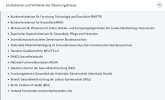
I received a letter today from Minister Bär which I will not publish here. As partners of the decade are named: BMG, NUM, NAKO Gesundheitsstudie, BIH, DZG, Helmholtz centres and Leibniz Institutes, pharma industry, affected-organisations etc. 1/2”
“Who is missing for me personally in the list? The NKSG, our no.1 scientific expertise in Germany by far!

BMG = Bundesministerium für Gesundheit (Federal Ministry of Health) — the German government ministry responsible for public health.

NUM = Netzwerk Universitätsmedizin (Network University Medicine) — a collaborative network of German university hospitals and research institutes formed during the COVID-19 pandemic.

NAKO Gesundheitsstudie = NAKO Gesundheitsstudie (German National Cohort Health Study) — a large population-based health study in Germany to investigate causes and preventative measures for major diseases.

BIH = Berlin Institute of Health — a research institute in Berlin focusing on translational medicine (bridging research and clinical application).

DZG = Deutsches Zentrum für Gesundheitsforschung (German Centre for Health Research)

Helmholtz Zentren = Helmholtz‑Gemeinschaft Deutscher Forschungszentren centres — Germany’s large federal research institutions covering many fields of science.

Leibniz Institute = German research institutions organised under the Leibniz Association, covering a wide array of scientific disciplines.

NKSG = Nationale Klinische Studiengruppe (NKSG) — described as Germany’s top scientific expertise for the diseases in question, here specifically focusing on clinical trials for ME/CFS and Post-COVID-19 syndrome.
 
What are the patient organisations like in Germany? I expect their lobbying played a role in achieving this?
Yes, most likely. The german ME/CFS society works in close cooperation with professor Scheinbenbogen from the Charité Berlin and they produced info material cooperatively in the past. Their website is very informative.
The former health minister Lauterbach asked for double the 500 million euros that were eventually spoken for the initiative.

Today was what seemed a rather successful hamburger health committee session, judging from the few minutes I could watch.
Maybe some of the participants turn out to be very relevant in the future:


BMG = Bundesministerium für Gesundheit (Federal Ministry of Health) — the German government ministry responsible for public health.

NUM = Netzwerk Universitätsmedizin (Network University Medicine) — a collaborative network of German university hospitals and research institutes formed during the COVID-19 pandemic.

NAKO Gesundheitsstudie = NAKO Gesundheitsstudie (German National Cohort Health Study) — a large population-based health study in Germany to investigate causes and preventative measures for major diseases.

BIH = Berlin Institute of Health — a research institute in Berlin focusing on translational medicine (bridging research and clinical application).

DZG = Deutsches Zentrum für Gesundheitsforschung (German Centre for Health Research)

Helmholtz Zentren = Helmholtz‑Gemeinschaft Deutscher Forschungszentren centres — Germany’s large federal research institutions covering many fields of science.

Leibniz Institute = German research institutions organised under the Leibniz Association, covering a wide array of scientific disciplines.

NKSG = Nationale Klinische Studiengruppe (NKSG) — described as Germany’s top scientific expertise for the diseases in question, here specifically focusing on clinical trials for ME/CFS and Post-COVID-19 syndrome.
Don’t know anything about any of these but I do like the fact that some of these institutions cover a wide range of research areas – might just attract some new people with different backgrounds and fresh eyes to the field
 
In case anyone with influence on how the money is going to be allocated is reading along, here’s another unsolicited suggestion to consider

Germany can now do something few if any others have the resources or systems to do: systematically include a strategic replication component into the programme, with emphasis on strategic

Currently replication is done inconsistently, belatedly or not at all. Clearly not every study deserves replication and we need to reserve plenty of money for new lines of investigation but there are a few specific situations where replication should be a high priority, for example

Germany could replicate DecodeME and even try to beat the Brits at their own game. Add a twin DecodeLC, aim for larger cohorts (surely 25k each should be doable in a population this size), do WGS on top of the GWAS. The DecodeME protocol is pretty much ready to go and replication here would set a nice strong foundation for future studies including creating large, well-characterised German cohorts

Germany could also set up a rapid replication programme, where a group is tasked with monitoring for particularly promising study results anywhere in the world. Provided certain strict criteria are met, studies identified this way could then be promoted to other researchers as high priority for replication together with financial and other support

Criteria could be things like an original treatment study being well conducted but maybe not quite big enough to convince health authorities, clinicians or pharma to get the treatment into general clinical use asap. Or it could be a study on a specific pathway where confirming or excluding its involvement conclusively, or as close to that as possible, would significantly move the field forward
 
It's awful to have someone this arrogant and unpleasant to present the wrong side of this story, but in a way this is preferable to someone with good political instincts.
Rumor has it that the TV stations haven’t aired his statements yet.
If that’s true, professor Kleinschnitz might have maneuvered himself into his own dark corner on X, hopefully never to be heard of again in the public debate.

What might be his endgame? Career in politics… founding a movement à la MAHA Germany —> MGHA?
 

AI translation:

Kick-off event of the „Allianz post-infektiöse Erkrankungen: LongCOVID, MECFS“, invited by the Federal Ministry of Health & the Federal Ministry of Education and Research – a historic step: with around 50 million € annually (in total half a billion), a decade of biomedical MECFS research is now possible. This is an enormous advance and long overdue. The event was primarily about presenting the agenda, not about dialogue — which is understandable for a launch format. However, some points left me thinking. The rehab (Reha) perspective was strongly represented, including by a patient with positive rehab experiences — it’s important to share that, but many severely ill people with PEM experience massive, sometimes permanent, deterioration through rehab, and that perspective was missing. For the overview of LongCOVID/MECFS research, Carmen Scheibenbogen (one of the world-leading experts in the field) did not speak. I would have particularly wished for her assessment on this occasion, especially with reference to the most severe courses. Representatives of rehab, the German Pension Insurance (DRV) and the German Social Accident Insurance (DGUV) were strongly present, whereas voices from or for the severely affected had little space: especially those who are barely transportable or able to speak need explicit representation. To me, this shows how crucial it is that future formats enable genuine exchange among science, clinical experience & those affected; with respect for the illness and especially for PEM. I hope that the newly available funds will be used specifically for biomedical research. We cannot afford to invest in concepts which are not scientifically justified or long-since refuted, because they endanger those affected. With my clinical experience I want to contribute so that the decades-long suffering of even the most severely affected is seen, and that research, care & policy align with this MECFS reality. This decade is a historic opportunity! I hope we use it responsibly.

TLDR: rehab people were overrepresented during the kick off meeting. The perspective of severe patients was not considered.
 
Last edited:
TLDR: rehab people were overrepresented during the kick off meeting. The perspective of severe patients was not considered.

At the same time, several points made me stop and think:
The rehabilitation perspective was prominently represented, including by someone affected who had positive #rehab experiences.
Sharing that is important,
but many people who are severely ill with #PEM experience massive — sometimes permanent — deterioration as a result of rehab.
That perspective was missing.
How could they invite a postviral patient that was helped by exercise while ignoring very severe pwME that aren’t able to participate and were harmed by exactly that exercise regime!?
THAT‘S concerning! :scream:
 
From the ME Research UK summary;

The following is being planned to make Germany a world-leader in research in the field.

  • Additional funding for various research projects , including in the areas of pathophysiology and immunology, diagnostics and biomarkers, neurology/mental health, and long-term consequences of ME/CFS
  • Clinical trials are being progressively advanced and strengthened.
  • To increase the number of scientific experts in the long term and thus enable more and more comprehensive research, further structural measures are being implemented, such as the funding of junior research groups
  • Creation of a new patient database . It will serve as a basis for new research projects and for testing new treatment approaches.
  • Genome sequencing : With the NAKO Health Study – Germany’s largest long-term study on common diseases and its more than 200,000 participants, as well as the cohorts of the NAPKON (National Pandemic Cohort Network) Detailed health data is already available from the Network of University Medicine (NUM). Additional sequencing of the genomes of unaffected and ill participants will create the basis for new insights into disease mechanisms.
  • In parallel, AI-based applications are to be enabled. For this purpose, an optimized data environment will be established that guarantees the secure storage and protected sharing of all resulting data.
  • The implementation of networking and training measures for the scientific community, as well as evidence-based public relations work, are also part of the decade.

Anybody know of any German geneticists who might be interested in potential collaborations for the genome sequencing part of this?
 

AI Summary:

The German government is increasing funding to address the long-term effects of COVID-19 and ME/CFS (Myalgic Encephalomyelitis/Chronic Fatigue Syndrome). Although the pandemic is officially over, the lingering effects of the virus, including long-COVID, continue to affect millions of people. Health Minister Nina Warken and Research Minister Dorothee Bär have formed an alliance to improve care and understanding of post-infectious diseases.

Currently, over 1.5 million people in Germany are affected by long-COVID and ME/CFS, but the healthcare system still lacks adequate structures for their care. To address this, the government is investing 500 million euros for research, with additional funding from other sources. The aim is to better understand these conditions and improve treatment.

The lack of research and clinical expertise has led to significant gaps in patient care. Healthcare professionals acknowledge the need for better training, with some regions offering educational events. However, many patients report that their primary care doctors are often less informed about these conditions. The government is working on improving medical guidelines and expanding research, but challenges remain in providing adequate care, particularly for severely affected patients.

New treatment options are also on the horizon, as an expert group has recommended four medications for off-label use in treating long-COVID symptoms. While much work remains, the increased funding and focus on post-COVID care offer hope for better support and treatment in the future.

 
This is excellent news, but I dont think I can watch another RECOVER level opportunity squandering. I have four burning questions:

Can they fund projects outside Germany (e.g. SequenceME)?

How do we get Chris and Sonya (or JE) in touch with the funding people to persuade them to follow the emerging science rather than chasing viral persistance or whatever?

How can we get through to the funders just how useless and harmful the rehab approach is before they allocate any money to PACE 6.0: This Time It'll Work, We Promise?

How do we effectively campaign for this kind of funding elsewhere (e.g. in the UK)?
 
Back
Top Bottom