Genome-wide association study of multisite chronic pain in UK Biobank, 2019, Johnston

wigglethemouse

Senior Member (Voting Rights)
Genome-wide association study of multisite chronic pain in UK Biobank, 2019, Johnston

Abstract


Chronic pain is highly prevalent worldwide and represents a significant socioeconomic and public health burden. Several aspects of chronic pain, for example back pain and a severity-related phenotype ‘chronic pain grade’, have been shown previously to be complex heritable traits with a polygenic component. Additional pain-related phenotypes capturing aspects of an individual’s overall sensitivity to experiencing and reporting chronic pain have also been suggested as a focus for investigation.

We made use of a measure of the number of sites of chronic pain in individuals within the UK general population. This measure, termed Multisite Chronic Pain (MCP), is a complex trait and its genetic architecture has not previously been investigated. To address this, we carried out a large-scale genome-wide association study (GWAS) of MCP in ~380,000 UK Biobank participants.

Our findings were consistent with MCP having a significant polygenic component, with a Single Nucleotide Polymorphism (SNP) heritability of 10.2%. In total 76 independent lead SNPs at 39 risk loci were associated with MCP.

Additional gene-level association analyses identified neurogenesis, synaptic plasticity, nervous system development, cell-cycle progression and apoptosis genes as enriched for genetic association with MCP. Genetic correlations were observed between MCP and a range of psychiatric, autoimmune and anthropometric traits, including major depressive disorder (MDD), asthma and Body Mass Index (BMI).

Furthermore, in Mendelian randomisation (MR) analyses a causal effect of MCP on MDD was observed. Additionally, a polygenic risk score (PRS) for MCP was found to significantly predict chronic widespread pain (pain all over the body), indicating the existence of genetic variants contributing to both of these pain phenotypes.

Overall, our findings support the proposition that chronic pain involves a strong nervous system component with implications for our understanding of the physiology of chronic pain. These discoveries may also inform the future development of novel treatment approaches.


LINK | PDF | PLOS Genetics
 
Last edited:
I posted this study after reading the following comment on a Fibromyalgia thread

I think the group of people with 'severe fibromyalgia' may well include a good proportion with some overlapping process also present in a number of people with MECFS. In the past I have found the category of FM so vague that I was not sure whether the name was much use or whether there was any identifiable 'core' group. I have reasons to think that there probably is, some of which I cannot really go into at present.
 
I am not sure what the point is of studying multi-site chronic pain. I have multi-site chronic pain because various bits of me are bust. That relates to sports, injudicious lifting and worn out bits. For the next person along with multi-site pain it will be other stuff. They excluded people with pain all over - i.e. what we would probably call fibromyalgia.

Unsurprsingly, they end up with a rag-bag of genes and some correlation with depression. This might be a useful study in that it may illustrate the sort of noise signal you get if you study a group that probably have no common causal origin.
 
I am not sure what the point is of studying multi-site chronic pain. I have multi-site chronic pain because various bits of me are bust. That relates to sports, injudicious lifting and worn out bits. For the next person along with multi-site pain it will be other stuff. They excluded people with pain all over - i.e. what we would probably call fibromyalgia.
Yes, this idea of primary chronic pain continues to amaze me. There will be a myriad of reasons why people experience pain, even a body part -specific pain such as 'back pain' - years of manual work, rheumatoid arthritis, shrapnel near the spine, scoliosis, osteoporosis, injuries while giving birth, mechanical stress due to being morbidly obese, mechanical damage due to car accidents so many more... The idea that bundling them all up into one and expecting there to be a clear and common genetic signal is just nonsense.

I guess the idea comes from the same sources as those that talk about 'primary fatigue' - prejudiced people, people who stand to make money from useless therapies, and the insurance industry looking to label a physical problem a mental illness amenable to rehabilitation if the person really wants to be well.
 
Yes, this idea of primary chronic pain continues to amaze me. There will be a myriad of reasons why people experience pain, even a body part -specific pain such as 'back pain' - years of manual work, rheumatoid arthritis, shrapnel near the spine, scoliosis, osteoporosis, injuries while giving birth, mechanical stress due to being morbidly obese, mechanical damage due to car accidents so many more... The idea that bundling them all up into one and expecting there to be a clear and common genetic signal is just nonsense.

I guess the idea comes from the same sources as those that talk about 'primary fatigue' - prejudiced people, people who stand to make money from useless therapies, and the insurance industry looking to label a physical problem a mental illness amenable to rehabilitation if the person really wants to be well.
I think that is important to name the enablers in this as what they are (instead of what they like to lie to themselves that they are: prejudiced people

Who choose for no good reason to believe unpleasant things that mean unpleasant things for other people based on little good evidence and no critical thought by themselves merely because they think they can get away with it ‘socially’ these days by the con of flowery wording pretending they care or ‘it’s help’

That episode two of ‘the program’ on Netflix is well worth a watch on how transparent this playbook is and how it sells at the parent who feels a bit tired or vulnerable the convenient and easy option for often a problem that doesn’t exist (from the kids side) in the way it is then sold and stuck onto the kid by bad mouthing . And the use of the terms help or therapy for what in that case was indeed made up and just an abusive ‘system’ but as an overall (they had kids sit in circles doing a v for victim on their forehead at others in group therapy to say ‘you are playing the victim’ (sound familiar to certain individuals and groups soundbites they’ve publicly put out there about us and to us and inciting that sort of attitude to us) when it never ever was anyway in those instances at least it couldn’t even pretend it was.

These made up constructs become ‘made real’ by engaging these others who are attracted to the end result to engage in the false stories as if they made sense to provide the means to the end/excuse/justificatoon

Except all they are doing is sponsoring the enrichment or power of other agenda of these other group s- which eventually will of course probably include something that affects them too


Of course it sounds a bit mean to say that for all as some are just caught at a weak, ill, mentally ill, having a day they feel sorry for themselves and why should someone else have a better time, so overwhelmed either their own issues they can’t care about society anymore (another thing sadly being actively pushed thru this ‘wellbeing stuff’) so the unacceptable for what holds society up becomes allowed to become made ‘etiquette’ and accepted and ok as collateral damage as long as everyone speaks of it in these hygienic terms.

And yet they aren’t spotting that it’s health care and medicine as a concept that is being removed bit by bit

To be replaced with a form of ideology not based on straightforward facts we all currently just know as common sense. Like that humans wear out or get injuries or get an illness.

And that all of these things can be looked at and treated with something that matches the exact issue where there is something developed that works. And we have research on it. But not if this gets disappeared by someone being able to refuse to acknowledge what they see or being allowed to claim black is white because of another agenda

Imagine if someone broke their leg in the future and things are at the point they are refused an x ray because’leg pain tends to go away on its own or with physio’ based on massaged methods using lowest common denominator is used to claim this, and you’d have to spend a year arguing rhetoric to ‘prove’ the obvious.
 
Last edited:
Still, the general conclusions were interesting.
The genes potentially associated with MCP implicated neurogenesis, neuronal development and neural connectivity, along with cell-cycle and apoptotic processes, and expression was primarily within brain tissues. This is in line with theories of functional and structural changes to the brain contributing to development of chronic pain [21,24,123–125], and may also explain the genetic correlations observed.

I also learned from the paper that there is data in the UK Biobank GWAS database for widespread chronic pain. Tagging @Jonathan Edwards in case it is of interest.

EDIT: I created a thread for a GWAS study on widespread pain
Genome-wide association study identifies novel genetic variants associated with widespread pain in the UK Biobank, 2025, Pan
 
Last edited:
Here is the list of genes highlighted from the Supplementary section.
DCC
SDK1
MAML3
FOXP2
GABRB2
ASTN2
EXD3
MON1A
ECM1
FAM120A
FAF1
KCND3
CTNNA2
GMPPB
BBX
STAG1
ANAPC4
SLC39A8
CEP120
UTRN
SP4
DYNC1I1
Y_RNA
MLLT10
SORCS3
KNDC1
SOX6
NUMB
PRC1
NMT1
SLC24A3
MLN
CA10
MON1B
 
I note that I was ambivalent about interpreting the cohort for this study 6 months ago.
Maybe it is a mixture of red herring and lemon sole and the task is to work out which for which genes. Despite the apparently impenetrable complexity of all the data I am getting the impression that with dedication it will be possible to make sense of all this. I am hugely impressed by the analysis going on here.
 
Despite the apparently impenetrable complexity of all the data I am getting the impression that with dedication it will be possible to make sense of all this. I am hugely impressed by the analysis going on here.
Are the right people seeing it? A bunch of us are prodding at things and asking questions, but can only take things so far and I think largely hope something worthwhile crops up piques the interest of some researchers who can do something with it.

It can be difficult to know what is signal and what is noise, at least I don‘t know when so many avenues look potentially interesting. I can imagine a researcher visiting the forum wouldn’t know where to start to digest some of what we discuss. Is it worth us putting a summary of ideas or thoughts together for an external audience? If so who could curate this and who could we show it to?
 
Are the right people seeing it? A bunch of us are prodding at things and asking questions, but can only take things so far and I think largely hope something worthwhile crops up piques the interest of some researchers who can do something with it.

It can be difficult to know what is signal and what is noise, at least I don‘t know when so many avenues look potentially interesting. I can imagine a researcher visiting the forum wouldn’t know where to start to digest some of what we discuss. Is it worth us putting a summary of ideas or thoughts together for an external audience? If so who could curate this and who could we show it to?
Is it worth tagging or messaging Chris Ponting when you guys think you've found something significant he might want to look into? Ditto other researchers who are members here.

Obviously scientists are very busy and we dont want to spam them with mentions but if it was used sparingly? Just spitballing here.
 
Is it worth tagging or messaging Chris Ponting when you guys think you've found something significant he might want to look into? Ditto other researchers who are members here.
It’s a good idea. I think that’s what I was trying to describe with the difficulty knowing what is signal and noise. Everything is significant when I first spot something and dig into it :) And I don’t really know enough or have the experience to be able to discern.. There’s a common cycle of ‘oh what’s this’ ‘oh maybe it’s nothing’ ‘but wait what about this!’… and so on.

Having others help decide what of all the things we discuss is actually worth shouting about is one thing I wondered about.

And the other thought is how do we get beyond the same few researchers who do frequent these forums? It’s good we’re seeing more people but are there ways we can get the good stuff to them more efficiently?

Maybe we need a Researchers Digest or something?
 
And the other thought is how do we get beyond the same few researchers who do frequent these forums? It’s good we’re seeing more people but are there ways we can get the good stuff to them more efficiently?
I think the route most likely to lead to results is reaching out to researchers already studying whatever the potential "lead" is, but outside of an ME/CFS context. It is much harder for ME/CFS-focused researchers to pivot to follow up on a detailed hypothesis if the methodology needed to investigate it is beyond their experience, and they might have less motivation to do so if they're already focused on a completely different angle.

There isn't really a great way to figure out a priori if something is just noise--there might be a couple instances where someone familiar with genomics can tell you that you always see X and its unlikely to be interesting, but beyond that you only know once you start investigating. In which case it might just be worthwhile to send an email to a researcher in a specific niche asking if they think something is interesting. Sometimes researchers with a basic science focus are actively looking for a way to tie their research to a disease so they have more of a chance to get funding.....
 
Of the genes in that list for this study 4 are in the 59 gene DecodeME set: CA10, DCC, MLLT10, SOX6
And 3 in the 259 gene PrecisionLife anakysis of DecodeME set: CTNNA2, DCC, UTRN
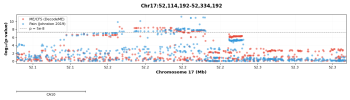
Nice find! Just noting for the thread that this is the study that DecodeME said overlapped at CA10. They didn't look at the other loci because they weren't genome-wide significant.

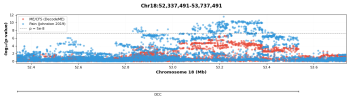
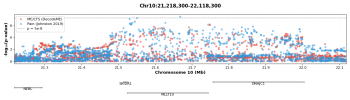
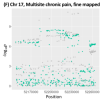
I wanted to compare the other loci, so I downloaded the summary stats for this study from GWAS Catalog, then did liftOver to bring the coordinates to GRCh38 to match DecodeME.

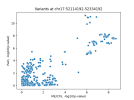
To double check that I'm looking at the right thing, I plotted the overlapping CA10 loci from both studies, like DecodeME did.

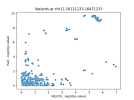
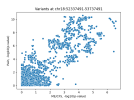
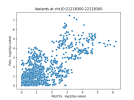
(For each locus, the little thumbnail plot below the main plot is a simple comparison of log10p value for each variant in both studies, just to see if it looks to be the same variants significant in both.)
From DecodeME paper:
1771088642014.png

My plot:
ME_CFS__DecodeME__Pain__Johnston_2019__chr17:52114192-52334192.png
snp_compare_mecfs_pain_chr17:52114192-52334192.png

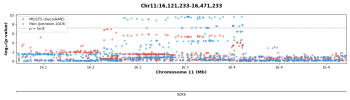
It seems to match up with their plot. And now looking at each of the other three overlapping loci:

SOX6

DCC

MLLT10

It would probably require doing colocalization testing to know for sure, but it looks like it might be possible that some of these other loci might share share causal variants.
 
It would probably require doing colocalization testing to know for sure, but it looks like it might be possible that some of these other loci might share share causal variants
Interesting! Nice charts.

I’ll try and use this gene set in the testing of SOX6 binding sites that @jnmaciuch mentioned here too. It could be another interesting comparison…
 
Back
Top Bottom