What would be quite nice is a way to find a handful of people with ME/CFS who have a BTN2A1 mutation and do some basic molecular biology studies on their samples. [Edit: technically you might not even need that, you could just engineer some proteins with the already-identified mutations into a cell line, though it would be good to get sequence of the whole gene and confirm ME/CFS diagnosis with more stringency than in UK biobank]
What would be quite nice is a way to find a handful of people with ME/CFS who have a BTN2A1 mutation and do some basic molecular biology studies on their samples. [Edit: technically you might not even need that, you could just engineer some proteins with the already-identified mutations into a cell line, though it would be good to get sequence of the whole gene and confirm ME/CFS diagnosis with more stringency than in UK biobank]
I think mutations in protein coding regions would generally be too rare to show up in DecodeME. Just the existing UK biobank data might be a good enough starting place for someone with molecular bio resources though
I don't believe so. SequenceME, once funded, will in part sequence DecodeME samples so we will learn if these rare variants of interest are present or not but I don't believe that we would be able to identify those participants who, in theory, have the variant.
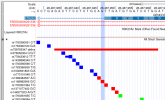
yes, but it seems that only BTN3A1 has the right structure to actually bind the phosphoantigens. There also seems to be a splice region variant flagged somewhat upstream of the whole PRY-SPRY section, I'm trying to figure out what it might do
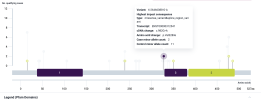
The PRY-SPRY domain is that purple and green box section starting at ~330.
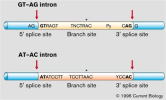
It looks like the mutation 982G>A changes the splice junction acceptor (in the diagram below, it removes the right hand splice site). [Edit: I have to double check the exact effect but either way it means the relevant protein binding domain won’t end up where it should be]
This is an almost guaranteed loss of function. Between that and the Pro486Thr mutation, I think it's clear that the story here is function-impairing mutations.
That's helpful. I guess BTN2A1 variants might inhibit complex formation and presentation of the extracellular dimer or conceivably alter the spectrum of binding of BTN3A1? I am struggling to keep up with the options as I have other things distracting me at the moment.
That's helpful. I guess BTN2A1 variants might inhibit complex formation and presentation of the extracellular dimer or conceivably alter the spectrum of binding of BTN3A1?
Popping in quickly on a break to say that assuming this is spliceosome mediated (highly highly likely), the intron doesnt get cut unless both splice sites are bound first. Meaning that the mostly likely effect of this mutation is retaining a long intron right upstream of the PRY-SPRY domain. Theoretically possible the protein could still be functional but if we’re talking odds, loss of function is still way more likely.
(Also just saw there was another thread made for the AZ analysis, mods feel free to move my posts there)
Hey all, I’m still really interested in how this could link to the potential lipid accumulation that dmissa reported, even though I know it’s not 100% fact since it’s immortalized cells, and dmissa was clear we could not trust those results.
I still ran it by AI a few times… I know it’s probably just slop, but it seems pretty interesting since it would be hard to detect outside the cell level, involves BTN, and gamma tcells. I’d just thought I’d post since I don’t have the depth to call bs on Gemini. Feel free to ignore it if it’s slop. I just really thought those two things could be connected. I can delete if it’s absolute garbage.
The ME/CFS "Bistable Trap" Mechanism: A Step-by-Step Outline
1. The Metabolic Stall and Lipid Hoarding
Following an initial trigger (such as a severe viral infection), the patient's cellular metabolism breaks down. Recent multi-omics studies of ME/CFS cells reveal a massive accumulation of triglycerides and saturated fats, alongside the hyperactivation of specific membrane-remodeling enzymes like PTDSS1.[1]
2. The Mevalonate Bottleneck
This cellular dysregulation leads to a highly specific roadblock in the mevalonate pathway—an essential metabolic assembly line used to synthesize cholesterol, coenzyme Q10, and dolichol. Because the pathway is jammed (likely at an enzyme known as FPPS), normal metabolic production halts.
3. The Toxic "Danger Signal" Buildup
With the mevalonate pathway blocked, a specific upstream building block called isopentenyl pyrophosphate (IPP) begins to back up.[2] IPP pools to massive, unphysiological levels inside the cell, acting as a marker of severe cellular distress.[3]
4. The "Molecular Glue" Sensor
The immune system uses a receptor complex made of two proteins, BTN3A1 and BTN2A1, to monitor internal cellular health. When IPP accumulates to toxic levels, it acts literally as a "molecular glue" inside the cell, tightly locking the interior domains of BTN3A1 and BTN2A1 together.[4, 5]
5. The Extracellular Alarm
This rigid internal locking forces a mechanical shift that propagates to the outside of the cell membrane.[4] The shift exposes previously hidden regions of the BTN proteins, creating a "composite ligand" that acts as a permanent biochemical flag waving on the surface of the distressed cell.[4, 6]
6. The Bistable Trap and Immune Exhaustion
A highly specialized subset of immune cells, called Vγ9Vδ2 T cells, are hardwired by evolution to recognize this specific BTN3A1/BTN2A1 alarm.[7] Under normal circumstances, they would kill the infected cell. However, because this is a sterile metabolic misfire, the danger signal never turns off. Years of relentless, futile engagement with this continuous alarm metabolically cripples the T cells, driving them into a state of severe, terminal immune exhaustion. The patient is left locked in a self-sustaining loop of broken cellular energy and burnt-out immunity.
Was reading Wikipedia on gamma delta tcells and this further resonated with the lipid accumulation “However, increasing evidence suggests that these aminobisphosphonate 'antigens' are not recognised directly by Vγ9/Vδ2 T cells and in fact act indirectly, via their effects on the mevalonate biosynthetic pathway, leading to an accumulation of IPP.
The bisphosphonates are a novel class of drug that have been registered for various clinical applications worldwide. Bisphosphonates, and in particular the aminobisphosphonates (nBPs), are known to have a number of side-effects including a rise in ...
Vγ9Vδ2 T cells are activated by phosphoantigens, such as isopentenyl pyrophosphate (IPP), which is generated in the mevalonate pathway of antigen-presenting cells. IPP is released in the extracellular microenvironment via unknown mechanisms. Here we show that the ATP-binding cassette transporter A1 (ABCA1) mediates extracellular IPP release from dendritic cells (DC) in cooperation with apolipoprotein A-I (apoA-I) and butyrophilin-3A1. IPP concentrations in the supernatants are sufficient to induce Vγ9Vδ2 T cell proliferation after DC mevalonate pathway inhibition with zoledronic acid (ZA). ZA treatment increases ABCA1 and apoA-I expression via IPP-dependent LXRα nuclear translocation and PI3K/Akt/mTOR pathway inhibition. These results close the mechanistic gap in our understanding of extracellular IPP release from DC and provide a framework to fine-tune Vγ9Vδ2 T cell activation via mevalonate and PI3K/Akt/mTOR pathway modulation.
We should be looking more at prenylation and geranylgeranylation as these are directly related to RAB Proteins. From a study of Maureen Hanson's group (https://pubmed.ncbi.nlm.nih.gov/41237904/) :
My personal experience recently on statins was that despite taking 1/2 the normal staring dose of atorvastatin I had aggravation of ME/CFS symptoms notably muscle pain which became obvious when I accidentally ran out and had a few days off them when pain reduced noticeably. So I have stopped taking them. Others had reported no issues when i asked around before I decided to try.
Have been on arvostatin (20mg once per day) for a couple of months and not noticed any specific side effects, though I have been generally lower energy.
So many people on statins I think we’d know now if it helped. I do think the loss of function is far more intriguing than the lipid angle, still I’d like to look at all possibilities until we confirm more!
My personal experience recently on statins was that despite taking 1/2 the normal staring dose of atorvastatin I had aggravation of ME/CFS symptoms notably muscle pain which became obvious when I accidentally ran out and had a few days off them when pain reduced noticeably. So I have stopped taking them. Others had reported no issues when i asked around before I decided to try.
I only know three people (all women) who've taken them, and they all complained of muscle pain.
One found changing to a different type solved the problem, the others stopped them. When my cousin told her GP how achy and heavy her muscles felt, he said she'd only developed pain because she'd read about it on Facebook.
None of them have ME/CFS, but it makes sense that if you're one of the people who gets side effects, they might make existing pain worse.
This site uses cookies to help personalise content, tailor your experience and to keep you logged in if you register.
By continuing to use this site, you are consenting to our use of cookies.