Genetics: Chromosome 6 BTN2A2 and BTN3A3 (BTN2A1)

Thanks. I wonder if we should list the significant variants found in DecodeME in the first post of this thread?
We could do that. These are the variants that passed the genome-wide significance threshold at this locus:
IDrsidEffect allele frequencyBetaLog10(p)
6:26233159:A:Grs109468080.2742260.07900957.93952
6:26239176:A:Grs93589130.2612330.08252518.3862
6:26259579:G:Ars39995430.2906210.07878438.17451
6:26261835:G:Trs93589140.3088170.07358357.40177
6:26264972:G:Ars126615520.3391780.0743947.8743
6:26272601:T:Crs93936910.3661610.07054777.37414
6:26287827:G:Ars109468100.3095310.0731887.3358
6:26291299:G:Ars93798440.366090.07036997.33934
6:26291363:T:Crs93936960.3660340.07021247.30935
6:26295458:G:Ars28938200.3399240.07446657.89601
6:26297164:G:Ars613240920.3398660.07397557.80109
6:26298310:G:Ars19872440.3399350.07340987.69254
6:26298408:GC:Grs58751010.3398660.07398237.80146
6:26298412:A:Trs50123740.3398660.07398237.80146
6:26301691:A:Trs7255750.3400840.07382317.77288
6:26302950:T:Grs18832130.3400260.07405537.81785
6:26305275:T:Crs623947640.339910.07387987.78172
6:26306054:T:Crs93666480.3398840.07379747.76604
6:26314010:G:Crs93798460.3396830.07388787.78432
6:26317156:C:Trs126604320.3396680.07361667.72941
6:26318571:C:Ars176085820.3396010.07355167.71574
6:26322540:C:Grs93589250.3395450.07352067.70812
6:26325805:C:Trs623947680.3396170.07328467.66213
6:26327737:T:Grs69183250.3396550.07344517.69427
6:26328470:A:ATrs58751050.3372320.07428967.83512
6:26338310:T:Grs23936490.3118320.07295427.31526
 
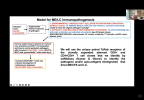
Yes please have a look at the video. I watched it live yesterday and want to relook at some of their points. They are highlighting T cell dysfunction, including increased double-positives (CD4+ CD8+) which are noted to be very poorly understood. The thinking seems to be evidence for ongoing antigenic stimulation which might be via known latency (eg EBV, CMV) and immune compensation. (As opposed to the SARS viral persistence ideas from other researchers.)
 
Yes please have a look at the video. I watched it live yesterday and want to relook at some of their points. They are highlighting T cell dysfunction, including increased double-positives (CD4+ CD8+) which are noted to be very poorly understood. The thinking seems to be evidence for ongoing antigenic stimulation which might be via known latency (eg EBV, CMV) and immune compensation. (As opposed to the SARS viral persistence ideas from other researchers.)

One problem is that lots of others have looked at cell populations, including T cell clonality, and not found much. That does not mean that there is no change in T cells - it seems highly likely that there will be, especially if BTN2A1 and or 2A2 etc are risk factors. But people have been trying to find shifts in T cells relating to specific antigens in autoimmunity (where it may not be there) and spondarthritis (where it almost certainly is) for forty years and I don't think anything has come of it (possibly for psoriasis).

My main grouse would be that they are discussing things teleologically and in terms of presumed general normal mechanisms/rules without focusing on specific pathways that break these rules. They talk about of T cell 'exhaustion' but that seems to be a misnomer. If it is assumed to be due to persistent stimulation and there is no virus there to stimulate then it seems likely we are looking at a shift that looks like exhaustion but isn't. Similarly, the claim that clonal shifts must mean antigen involvement is in a sense an empty truism for T cells. The assumption seems to be that there must be more foreign antigen than there should be, still present, or that autoreactivity has developed. I don't think we need assume either.

What took us forward in RA, allowing us to predict that b cell depletion might be useful, was the realisation that the stereochemistry of adaptive immune signalling is much more subtle than a teleological story presents. Things can go wrong because, as Ivan Roitt always said, all immune ligands have at least some affinity for all other ligands. Cross talk is a constant possibility. The trick is to identify Achilles heels in the mechanisms that keep cross talk to a minimum.

I think studies of this sort are well worth pursuing but I think it is essential to consider the findings entirely in terms of specific pathway dynamic rather than assumptions about normal functional rules.
 
Similarly, the claim that clonal shifts must mean antigen involvement is in a sense an empty truism for T cells. The assumption seems to be that there must be more foreign antigen than there should be, still present, or that autoreactivity has developed. I don't think we need assume either.

Great, that was exactly my question. The statement was made that clonal expansion can only happen due to ongoing antigenic stimulation (I hope I'm remembering correctly). I wondered if a specific infection response might be an initial activating trigger, but then other cell signalling derangement continues, breaking the rules.
 
Last edited:
I wondered if a specific infection response might be an initial activating trigger, but then other cell signalling derangement continues, breaking the rules.

That seems to be the case for post-chlamydia and post-shigella Reiter's syndrome, where we have good evidence for eradication of the trigger antigen at least in terms of living organism. Moreover, the similarity of Reiter's for a range of trigger organisms suggests that identity of the trigger antigen is not that important. What carries on after is its own thing, very much assisted by having HLA-B27.
 
Is there any possibility that BTN2A1 is binding to phospholipid in neurons or glia instead of bacterial phosphoantigens (which seem to be smaller sterols)?

As far as I can see BTN2A1 does not actually present the phosphoantigen to the T cell receptor but binds to the TCR if its cytoplasmic tail is bound by phosphoantigen.
Happened upon this paper while doing some literature review for my PhD work:

Shows that an early gdT cell response is induced in the lungs during influenza infection, driven by mitochondrially derived cardiolipids. It looks like part of the programmed tissue cell response to detecting viral RNA in the cytosol involves cannibalizing their own mitochondria to release lipids from the inner membrane. I don't know specifically if the same phenomenon can happen in brain cells, but if it's part of the hardwired viral response pathways then it would theoretically be possible in most tissue cells. The paper doesn't mention BTN2A1 specifically, just that the gdT cell response can be blocked by anti-gdTCR Abs

The main issue I see is the lack of evidence of any lymphocyte infiltration in the brain in ME/CFS. If they are getting into the brain, it would have to be transient enough to be missed by CSF or autopsy studies. But if this is a transient phenomenon, there has to be some constant issue in the neurons making them prone to cannibalizing their mitochondrial lipids. In which case, that unknown issue might be enough to drive the constant symptoms of ME/CFS, with transient gdT cell infiltration potentially responsible for worsening during PEM. Alternatively, it might not be neurons at all but something like the epithelial cells of the choroid plexus, which would be more likely to behave like the lung epithelial cells from the influenza study (and would be in contact with circulating lymphocytes)
 
Le principal problème que je relève est l'absence de preuve d'une infiltration lymphocytaire dans le cerveau chez les patients atteints d'EM/SFC

Do they have to enter the brain to trigger all those horrible sensations?

I don’t understand any of this, but what if normal levels of signals now triggered the maximum response without nuances ?
 
Last edited:
Alternatively, it might not be neurons at all but something like the epithelial cells of the choroid plexus, which would be more likely to behave like the lung epithelial cells from the influenza study (and would be in contact with circulating lymphocytes)
That an interesting idea. Epithelial cells came up the other day in a discussion on this genetics paper:

Thanks @forestglip

Used AI to screen these genes on function and these two might be interesting:

ITGAE - facilitates adhesion of T-lymphocytes to epithelial cell
TECPR2 - aids in the formation of autophagosomes
Say the problem is as you hypothesised above - how would we test for it? Are there advanced PET scans that could detect this kind of pathology? Or is it just a 'collect enough evidence to justify a theraputic experiment' type deal?
 
If they are getting into the brain, it would have to be transient enough to be missed by CSF or autopsy studies.

Unless this is a local interaction in the subfornical body without shedding T cells into CSF?
I agree that trying to pin gamma delta T cells in brains is not easy though. My hunch would be that endogenous phospholipid can drive a BTN2a1 interaction anywhere - as the lung study suggests. That is enough for the time being. Interesting material.
 
Do they have to enter the brain to trigger all those horrible sensations?

In view of all the pathways via things like nerves from the gut that seem to be available for T cells to talk to brain probably not. My suggestion was triggered by thinking abbout special brain lipids though. Thinking about it more I suspect that genes like BTN2A1 are unlikely to lead us to such tissue specific mechanisms though. In rheumatic disease the MHC gene links helped our understanding of whether diseases were t or B cell mediated but we still know almost nothing about why specific gene alleles confer risk or how they do. DR4 may confer risk in RA because of the way it presents citrullinated peptides but that remains speculative.

I think it is probably more interesting that we already know that BTN2A1 can engage with gamma delta receptors in the context of self generated signals as well as foreign derived signals.
 
Thinking about it more I suspect that genes like BTN2A1 are unlikely to lead us to such tissue specific mechanisms though. In rheumatic disease the MHC gene links helped our understanding of whether diseases were t or B cell mediated but we still know almost nothing about why specific gene alleles confer risk or how they do.
So what kind of experiments could get us from this point to a point where we understand more specifics about a potential gdT cell mechinism?


The paper doesn't mention BTN2A1 specifically, just that the gdT cell response can be blocked by anti-gdTCR Abs
Also, if the issue is BTN2A1 mediated T cell pathology, could this kind of monoclonal antibody be a potential drug? I can only see it being used in lab experiments so I assume there isn't an approved drug form yet.
 
Back
Top Bottom