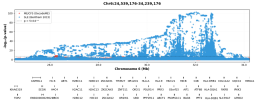
Genetics: Chromosome 6 BTN2A2 and BTN3A3 (BTN2A1)

Now that I've improved, I'm able to do sports, but am still limited by something that I can only describe as exertion intolerance (where exertion includes mental exertion). I've been able to train enough to improve my peak performance and do sports but a defect still persists, where the following days tend to be unpleasant and unproductive.
This was exactly what my prodrome phase was like -- though at the time, of course, I didn't think I was sick and just gradually developed the belief that it was normal to be useless for 3 days after a jog and started arranging my exercise to be long before or after other important commitments.

Agree that the ratcheting down feels like a failure to recover. Wish we knew more about what that means in the brain.
 
Last edited:
This was exactly what my prodrome phase was like -- though at the time, of course, I didn't think I was sick and just gradually developed the belief that it was normal to be useless for 3 days after a jog and starting arranging my exercise to be long before or after other important commitments.

Agree that the ratcheting down feels like a failure to recover. Wish we knew more about what that means in the brain.
This sounds a lot like my prodrome phase, although I never did much formal exercise in that time. But I always felt fried after socialising (nights out took ages to recover from but even just hanging out with mates) or a full day of lectures and seminars etc.

One of the things I remember from that time is how I would consistently get insomnia after e.g. a bartending shift or a night out, to the point of not sleeping until way past dawn, sometimes until mid morning the next day or later. Which now really seems like a tired but wired thing.

So I was definitely not healthy but I don't remember getting anything I can point to definitively as PEM in that time. Maybe during bad hangovers but its so hard to tell. Nothing like my first major incident of PEM I remember, where I had to sit down for a while in Glasgow uni library and couldn't keep my eyes open, feeling ill and lethargic and like a leaden weight was keeping me in the chair.
 
Last edited:
I used to say that my body feels like a flywheel without brakes. If you get the wheel spinning, the momentum is going to keep it going for a long time. If it goes too fast, it’s going to tear itself to pieces. Keeping the wheel spinning will wear the machine out, there’s no time for maintenance.

It reminds me a bit of sleep deprivation.
 
This got me thinking, is there a way to link this to @DMissa newest paper? Would the lipid accumulation seen in that paper trigger the BTN2A1 or BTN3A1, thus triggering the T-cells?
Don't know. Hard to compare observation made with immortalised cells in culture medium with primary cells in peripheral blood. With follow up work maybe we can think about this but I wouldn't run away with it yet
 
That proteomic study with very noticable "non response" pattern to exercise might be the closest someone has ever gotten to the core of the failure to recover defect.

What could possibly cause a, presumably widespread, failure to shift protein expression towards facilitating recovery state? It has to be a metabolic defect or a failure to orchestrate this response due to a weak/bad signal.

The main effect seems to be a delayed so it looks like it's something that occurs during the later stages of recovery. Maybe a hormone or immune problem or something to do with waste removal during sleep.
 
Last edited:
Presumably the defect in ME/CFS is in a part of physiology that has been overlooked so far, or isn't well understood or easily measurable.
This is maybe a silly thought but should we have a thread of areas of biology/physiology that meet this criteria that could be worth having a think about? People could post papers and if anything deserves its own thread it could sort of branch off.

Just a thread for kicking around ideas of 'oh this kind of signalling in this tissue' and 'what about this region of the brain' that might not be developed enough for their own thread.
 
I note that BTN2A1 variants confer risk for systemic lupus. That might be an important clue.

When I was looking yesterday I saw links to spondylitis too, though the genetic burden seemed low (0.3 out of 1.0). But in polygenic disease that could be quite high – hard to know.

ETA: found the page again.

 
Back
Top Bottom