Genetics: Chromosome 20: ARFGEF2, CSE1L, STAU1

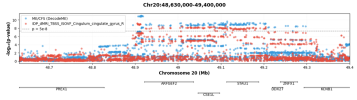
I downloaded the GWAS summary stats for that cingulate gyrus metric to see if there's evidence of colocalization.

Visually, at first it looks promising:
The most significant variants in both traits are in the far left portion of the locus.
Zooming in on that most significant little portion, it looks messier:
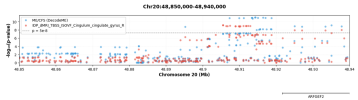
I ran coloc here, like I did for a trait at the CA10 locus. In this case, the posterior probability of a shared causal variant is 37.6%. So it seems more likely that the traits might have causal variants near each other, but where it's not the same variant.
 
Looking at phenotypes associated with ARFGEF2 in the AstraZeneca rare variant study results, two traits reach their suggestive significance threshold, one each from binary and continuous traits:

PhenotypeAncestryCollapsing modelP valueOdds ratioEffect sizeType
41202#M7986#
Other specified soft tissue disorders Lower leg
Europeanptvraredmg3.62e-72.11Binary
1072#426#CD22#P20273#OID20637#v1#
Inflammation
Europeanflexnonsynmtr6.48e-70.25Continuous

The second is expression of the protein CD22. From conclusion of a paper about CD22 (Clark 2018):
CD22 plays a key role in affecting B cell responses to Ags [antigens] and innate immune signals, and CD22-CD22L interactions are essential for maintaining self-tolerance. Despite the evidence implicating CD22 in murine lupus, human genetic studies do not support CD22 as a major disease susceptibility locus in SLE. However, it is likely that defects in CD22 combined with other genetic factors have additive or synergistic effects on disease susceptibility. The ability of CD22 to regulate both BCR and TLRs represents an attractive therapeutic strategy for manipulating B cell responses in autoimmunity.

I also found it interesting that fibromyalgia was the third most significant trait:

PhenotypeAncestryCollapsing modelP valueOdds ratio
41202#M797#
Fibromyalgia
Europeanflexnonsynmtr1.12e-56.95

When looking at the page for fibromyalgia, ARFGEF2 is the third most significant gene for that trait.
 
I found an association of ARFGEF2 (BIG2) with Ehlers Danlos via Periventricular Heterotopia which is mentioned in @Hutan post (1st post of this thread) :

https://www.s4me.info/threads/genetics-chromosome-20-arfgef2-cse1l-stau1.45515/#post-630791

Title : Periventricular Heterotopia: New Insights into Ehlers-Danlos Syndrome
Study : https://pmc.ncbi.nlm.nih.gov/articles/PMC1288408/


A much more rare autosomal recessive form of PH with microcephaly results from mutations in the ARFGEF2 gene which encodes the brefeldin-inhibited guanine exchange factor 2 (BIG2) protein.4 Filamin A interacts with the actin cytoskeleton and thereby regulates various aspects of cell shape, motility and function.5 BIG2 regulates vesicle trafficking from the trans-Golgi apparatus to the cell surface in various tissues of the body. Potentially, the secreted or surface proteins transported through BIG2-dependent vesicles may interact with filamin A near the cell surface and disruption of these as proteins could give rise to PH by impairing neuronal migration.
 
I found an association of ARFGEF2 (BIG2) with Ehlers Danlos via Periventricular Heterotopia which is mentioned in @Hutan post (1st post of this thread) :

I think this is intriguing but potentially confusing. The paper is about some people with a rare genetic disorder, periventricular heterotopia, who had also been told they had 'EDS'. I think the problem here is that 'EDS' can be used to describe anyone with hypermobility. It may be that ARFGEF2 variants encode hypermobility of various degrees. Some rare variants may encode significant hypermobility and skin elasticity. However, it seems likely that these are extremely rare.

In this sense 'EDS' is not one disease entity and so claims of association may be misleading.

I t would be very interesting if some genetic factors influencing hypermobility did, for some obscure indirect reason, also endow risk for ME/CFS but in fact the little reliable epidemiological data we have does not suggest a significant association.
 
As far as I understood from that paper, there are two causes of Periventricular Heterotopia. One is caused by mutations in the FLNA gene. another is caused by mutations in the ARFGEF2 gene. The paper is mostly about the FLNA gene sort, and it is that sort that seems to be associated with EDS type symptoms such as heart issues and joint mobility.

Mutations in two genes have been identified as the genetic cause of PH. The more common X-linked dominant form of PH is due to mutations in the filamin A (FLNA) gene.1,2 At least 80% of all familial cases of PH are due to a FLNA mutation with some 20% of sporadic cases attributable to this gene.3
A much more rare autosomal recessive form of PH with microcephaly results from mutations in the ARFGEF2 gene which encodes the brefeldin-inhibited guanine exchange factor 2 (BIG2) protein.4
Filamin A interacts with the actin cytoskeleton and thereby regulates various aspects of cell shape, motility and function.5 BIG2 regulates vesicle trafficking from the trans-Golgi apparatus to the cell surface in various tissues of the body. Potentially, the secreted or surface proteins transported through BIG2-dependent vesicles may interact with filamin A near the cell surface and disruption of these as proteins could give rise to PH by impairing neuronal migration.

Thus, the finding of PH and EDS due to FLNA mutations would suggest a novel intracellular cause of EDS.

In the autosomal recessive form of PH due to ARFGEF2mutations, magnetic resonance images also demonstrate bilateral near-continuous nodular PH but have distinguishing features of microcephaly, mild ventriculomegaly and white matter changes.4

The sort of PH caused by ARFGEF2 mutations doesn't seem to be associated with EDS symptoms. At least, the paper doesn't seem to be claiming that.
 
Last edited:
Back
Top Bottom