Endothelial dysfunction and ME/CFS

John Mac

Senior Member (Voting Rights)
ME Research UK:
The endothelium – a thin layer of cells lining every blood vessel – plays a pivotal role in regulating blood flow, blood clotting, and inflammatory responses. Research suggests that ME/CFS may involve damage to the endothelium leading to endothelial dysfunction (improper functioning of the endothelium), which contributes to disease manifestations.

Below are articles we have written on endothelial dysfunction in ME/CFS –

https://www.meresearch.org.uk/endothelial-dysfunction-in-me-cfs-our-articles/
 
Last edited by a moderator:
Posts moved from a thread examining the results of GWAS

Would lactate be involved?

"Lactate can disturb the neuronal excitation-inhibition balance
Lactate attenuates neurotransmission at glutamatergic and GABAergic synapses•
Lactate increases oxygen consumption, whereas neural activity can even decrease"

And would dimer PKM2 glycolysis be possible switch flip


And could hypoxia cause both lactate toxicity and glutamate synapse interference


"During hypoxia-ischemia, as cellular energy reserves and Na+ gradients fall, increased release and impaired uptake of glutamate mediate a toxic buildup of extracellular glutamate, leading to overstimulation of glutamate receptors and consequent neuronal cell death."
What could cause hypoxia in pwME/CFS?
Endothelialitis?
 
Last edited by a moderator:
What could cause hypoxia in pwME/CFS?
Endothelialitis?

Endothelial cells as key players in cerebral small vessel disease​


"Dysfunctional endothelial cells can cause cerebral blood vessel dysfunction, alter blood–brain barrier integrity and interfere with cell–cell interactions in the neuro-glial-vascular unit, thereby causing damage to adjacent brain tissue."
 
Yes, and you end up either comatose or with a stroke - from damaged brain tissue. There is no damaged brain tissue in ME/CFS.

The real argument against vascular-based injury is that the vessels do not know which bit of brain to annoy - so you get either the whole brain conking out or one random bit or another conking out (a stroke).

And there isn't such a thing as endothelialitis, as we discussed.

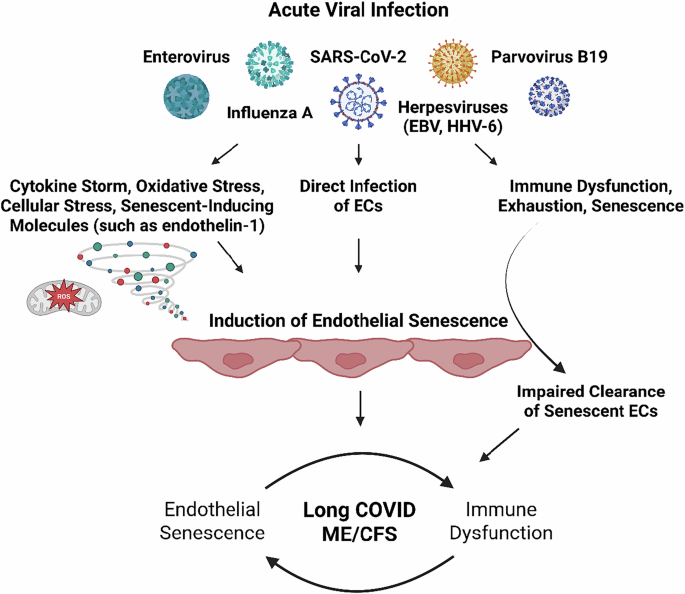
Virus-induced endothelial senescence as a cause and driving factor for ME/CFS and long COVID: mediated by a dysfunctional immune system​


"Myalgic encephalomyelitis/chronic fatigue syndrome (ME/CFS) and long COVID are two post-viral diseases, which share many common symptoms and pathophysiological alterations.

Yet a mechanistic explanation of disease induction and maintenance is lacking. This hinders the discovery and implementation of biomarkers and treatment options, and ultimately the establishment of effective clinical resolution.

Here, we propose that acute viral infection results in (in)direct endothelial dysfunction and senescence, which at the blood-brain barrier, cerebral arteries, gastrointestinal tract, and skeletal muscle can explain symptoms.

The endothelial senescence-associated secretory phenotype (SASP) is proinflammatory, pro-oxidative, procoagulant, primed for vasoconstriction, and characterized by impaired regulation of tissue repair, but also leads to dysregulated inflammatory processes.

Immune abnormalities in ME/CFS and long COVID can account for the persistence of endothelial senescence long past the acute infection by preventing their clearance, thereby providing a mechanism for the chronic nature of ME/CFS and long COVID.

The systemic and tissue-specific effects of endothelial senescence can thus explain the multisystem involvement in and subtypes of ME/CFS and long COVID, including dysregulated blood flow and perfusion deficits.

This can occur in all tissues, but especially the brain as evidenced by findings of reduced cerebral blood flow and impaired perfusion of various brain regions, post-exertional malaise (PEM), gastrointestinal disturbances, and fatigue.

Paramount to this theory is the affected endothelium, and the bidirectional sustainment of immune abnormalities and endothelial senescence. The recognition of endothelial cell dysfunction and senescence as a core element in the aetiology of both ME/CFS and Long COVID should aid in the establishment of effective biomarkers and treatment regimens."

Not everyone agrees with your conclusion.
 

Virus-induced endothelial senescence as a cause and driving factor for ME/CFS and long COVID: mediated by a dysfunctional immune system​


"Myalgic encephalomyelitis/chronic fatigue syndrome (ME/CFS) and long COVID are two post-viral diseases, which share many common symptoms and pathophysiological alterations.

Yet a mechanistic explanation of disease induction and maintenance is lacking. This hinders the discovery and implementation of biomarkers and treatment options, and ultimately the establishment of effective clinical resolution.

Here, we propose that acute viral infection results in (in)direct endothelial dysfunction and senescence, which at the blood-brain barrier, cerebral arteries, gastrointestinal tract, and skeletal muscle can explain symptoms.

The endothelial senescence-associated secretory phenotype (SASP) is proinflammatory, pro-oxidative, procoagulant, primed for vasoconstriction, and characterized by impaired regulation of tissue repair, but also leads to dysregulated inflammatory processes.

Immune abnormalities in ME/CFS and long COVID can account for the persistence of endothelial senescence long past the acute infection by preventing their clearance, thereby providing a mechanism for the chronic nature of ME/CFS and long COVID.

The systemic and tissue-specific effects of endothelial senescence can thus explain the multisystem involvement in and subtypes of ME/CFS and long COVID, including dysregulated blood flow and perfusion deficits.

This can occur in all tissues, but especially the brain as evidenced by findings of reduced cerebral blood flow and impaired perfusion of various brain regions, post-exertional malaise (PEM), gastrointestinal disturbances, and fatigue.

Paramount to this theory is the affected endothelium, and the bidirectional sustainment of immune abnormalities and endothelial senescence. The recognition of endothelial cell dysfunction and senescence as a core element in the aetiology of both ME/CFS and Long COVID should aid in the establishment of effective biomarkers and treatment regimens."

Not everyone agrees with your conclusion.


Mechanical Fingerprint of Senescence in Endothelial Cells​


  • Nafsika Chala
  • Silvia Moimas
  • Costanza Giampietro
  • Xinyu Zhang
  • Tomaso Zambelli
  • Vasileios Exarchos
  • Timo Z. Nazari-Shafti
  • Dimos Poulikakos*
  • Aldo Ferrari*

"Endothelial senescence entails alterations of the healthy cell phenotype, which accumulate over time and contribute to cardiovascular disease. Mechanical aspects regulating cell adhesion, force generation, and the response to flow contribute to the senescence-associated drift; however, they remain largely unexplored. Here, we exploit force microscopy to resolve variations of the cell anchoring to the substrate and the tractions generated upon aging in the nanonewton (nN) range. Senescent endothelial cells display a multifold increase in the levels of basal adhesion and force generation supported by mature and strong focal adhesions. The enhanced mechanical interaction with the substrate yields static endothelial monolayers that polarize in response to flow but fail the process of coordinated cell shape remodeling and reorientation. The emerging picture indicates that senescence reinforces the local cell interaction with the substrate and may therefore prevent endothelial denudation; however, it compromises the ability to functionally adapt to the local hemodynamic conditions."
 
Last edited by a moderator:
Back
Top Bottom